
Short Answer
Understanding Dark Matter
Dark matter is a mysterious and invisible form of matter that does not emit, absorb, or reflect light, making it undetectable through conventional telescopes. Despite its elusive nature, it plays a crucial role in the universe, accounting for about 27% of its total mass-energy content, vastly outweighing the ordinary matter that makes up stars, planets, and living beings, which constitutes only around 5%. Dark matter interacts primarily through gravity, influencing the structure and evolution of cosmic formations.
Gravitational Lensing: A Window into the Invisible
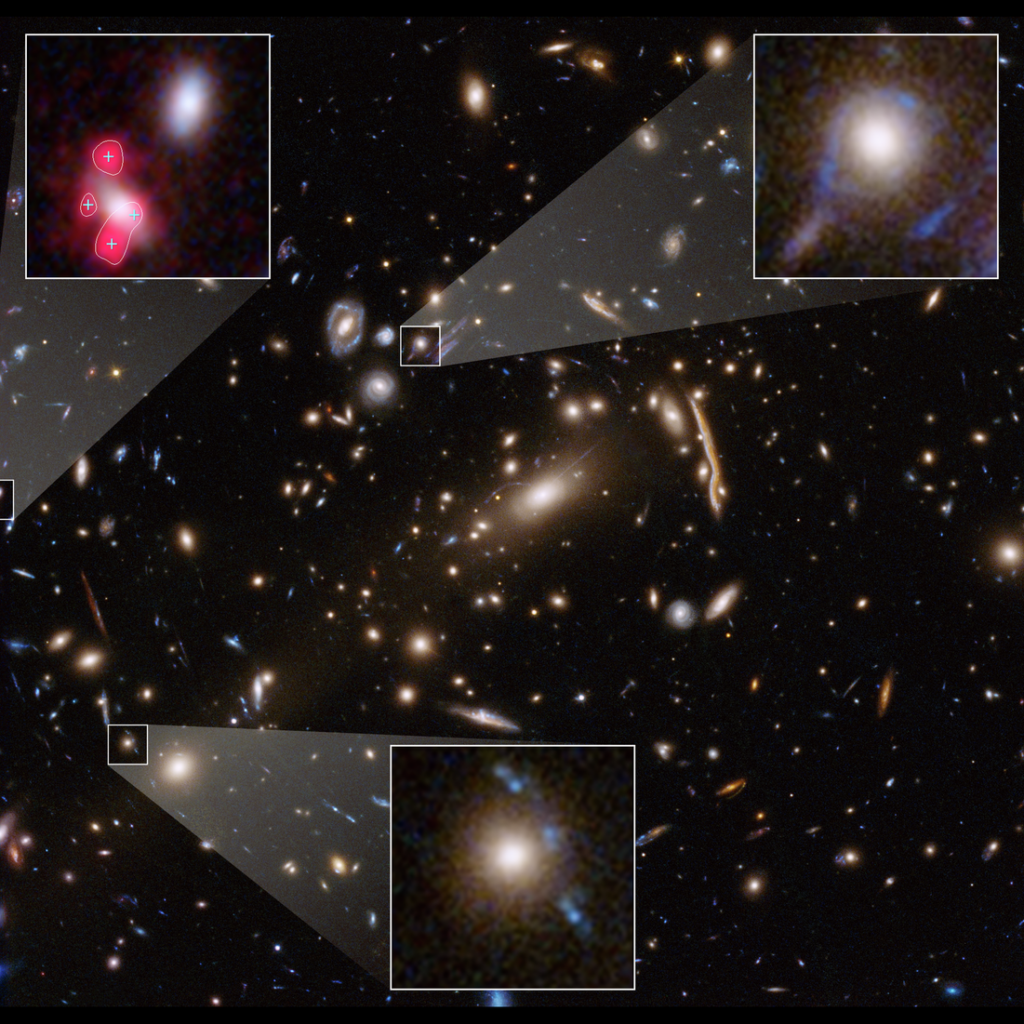
Since dark matter cannot be observed directly, astronomers rely on indirect methods to study its presence. One of the most powerful techniques is gravitational lensing, a phenomenon predicted by Albert Einstein’s General Theory of Relativity. According to this theory, massive objects warp the fabric of spacetime, bending the path of light traveling near them. When light from distant galaxies passes close to massive clusters or concentrations of dark matter, the gravitational field acts like a natural lens, distorting and magnifying the light before it reaches observers.
- Strong Lensing:
This results in dramatic visual effects such as arcs, rings (Einstein rings), or multiple images of the same background object. - Weak Lensing:
A subtler effect causing slight stretching and shearing of background galaxies, detectable only through statistical analysis of many galaxies.
Role of the Hubble Space Telescope in Mapping Dark Matter
The Hubble Space Telescope (HST) has revolutionized the study of dark matter by providing exceptionally sharp and stable images from its vantage point above Earth’s atmosphere. Unlike ground-based telescopes, which suffer from atmospheric distortion, Hubble captures faint and distant galaxies with remarkable clarity, essential for detecting the subtle distortions caused by gravitational lensing.
Hubble’s advanced instruments, such as the Wide Field Camera 3 and the Advanced Camera for Surveys, collect extensive data sets that allow astronomers to analyze lensing effects in detail. This capability has enabled the creation of precise dark matter maps, especially within massive galaxy clusters where gravitational lensing is most pronounced.
Mapping Dark Matter in Galaxy Clusters
One of the most striking applications of gravitational lensing is the detailed mapping of dark matter in galaxy clusters, such as the renowned Bullet Cluster. Studies of these clusters reveal that the visible matter-stars, gas, and dust-accounts for only a small fraction of the total mass. Instead, dark matter forms vast, separate halos that dominate the gravitational landscape.
These observations have profound implications:
- Separation of Matter:
In collisions like those seen in the Bullet Cluster, dark matter halos pass through each other with minimal interaction, unlike the ordinary matter that interacts electromagnetically and slows down. - Insights into Dark Matter Properties:
The behavior of these halos suggests dark matter interacts weakly not only with normal matter but also with itself, hinting at unknown physics beyond the Standard Model.
Advanced Techniques for Dark Matter Reconstruction
Extracting accurate dark matter distributions from lensing data requires sophisticated computational tools and statistical models. Weak gravitational lensing, in particular, demands careful separation of lensing-induced distortions from intrinsic galaxy shapes and instrumental noise. By stacking data from thousands of galaxies, astronomers build statistically significant maps that reveal the underlying mass distribution.
These maps not only chart dark matter but also provide valuable constraints on cosmological parameters, such as the rate at which cosmic structures form and the influence of dark energy on the universe’s expansion.
Complementary Observations and Multi-Wavelength Studies
Hubble’s gravitational lensing data is often combined with observations from other parts of the electromagnetic spectrum to build a comprehensive picture of galaxy clusters and dark matter. For example:
- X-ray Observations:
Detect hot gas in clusters, tracing the ordinary matter component. - Cosmic Microwave Background (CMB):
Provides information on the early universe’s matter distribution and supports dark matter models.
This multi-wavelength approach strengthens the evidence for dark matter’s existence and properties, while also challenging alternative theories such as modified gravity.
Ongoing Challenges and Future Prospects
Despite significant advances, fully understanding dark matter remains a formidable challenge. Gravitational lensing offers a two-dimensional projection of mass along the line of sight, but unraveling the three-dimensional structure and the fundamental nature of dark matter particles requires further innovation.
Future missions and observatories, including the James Webb Space Telescope and the Vera C. Rubin Observatory, aim to enhance sensitivity and resolution, building on Hubble’s legacy. These next-generation instruments will deepen our insight into dark matter’s role in cosmic evolution and may uncover new physics.
Significance of Dark Matter Research
Studying dark matter is essential for understanding the universe’s composition, structure, and fate. It shapes the formation of galaxies and large-scale cosmic web, influencing everything from the motion of stars to the expansion of the cosmos. By mapping dark matter through gravitational lensing, astronomers gain critical clues about the fundamental laws governing the universe, pushing the boundaries of modern physics and cosmology.
Summary
The Hubble Space Telescope’s unique capabilities have transformed dark matter research from theoretical speculation into empirical science. By capturing the subtle bending of light caused by invisible mass, Hubble reveals the hidden scaffolding that underpins cosmic structures. These detailed maps not only illuminate the distribution of dark matter but also provoke profound questions about its nature, inviting ongoing exploration into one of the universe’s greatest mysteries.
FAQ
What is dark matter?
Dark matter is a mysterious form of matter that does not emit or interact with light, making it undetectable by conventional means.
How does Hubble help in studying dark matter?
Hubble captures sharp images that reveal gravitational lensing effects, allowing astronomers to map dark matter in the universe.
What is gravitational lensing?
Gravitational lensing is the bending of light from distant objects due to the gravitational influence of massive foreground objects, such as dark matter.


Leave a Reply