
Short Answer
Definition of Tachyons and Their Cosmological Significance
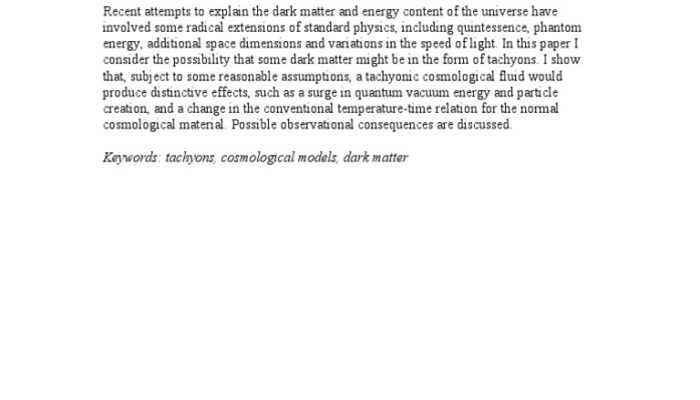
Tachyons are hypothetical particles theorized to travel faster than the speed of light, thereby challenging the fundamental principles of Einstein’s relativity. These particles possess unusual characteristics such as imaginary mass and the potential to reverse causality, making them a subject of intense theoretical interest. In cosmology, tachyons have been proposed as possible contributors to the enigmatic phenomena of dark matter and dark energy, which together dominate the universe’s energy composition yet remain largely mysterious.
Understanding Dark Matter and Dark Energy
Modern astrophysics grapples with two major unresolved components of the cosmos:
- Dark Matter:
An invisible form of matter that does not emit or absorb light but exerts gravitational forces, shaping the formation and structure of galaxies and galaxy clusters. - Dark Energy:
A mysterious force responsible for the accelerated expansion of the universe, counteracting gravitational attraction and influencing the large-scale dynamics of cosmic evolution.
Despite their profound influence, the exact nature and composition of dark matter and dark energy remain elusive, prompting exploration beyond conventional physics.
Tachyons in Theoretical Physics
The concept of tachyons introduces a radical departure from established physics by allowing particles to exceed the speed of light. This leads to several theoretical peculiarities:
- Imaginary Mass:
Unlike ordinary particles, tachyons are characterized by an imaginary mass, which complicates their integration into standard quantum field theories. - Reversed Causality:
Their superluminal speeds imply the possibility of effects preceding causes, challenging the conventional temporal order of events.
Despite these challenges, tachyons remain a fertile ground for extending or revising particle physics and cosmological models.
Tachyonic Fields as a Candidate for Dark Energy
Some cosmological frameworks propose that tachyonic scalar fields could be responsible for the observed acceleration of the universe’s expansion. These fields differ from ordinary matter in that they do not cluster gravitationally but instead exert a negative pressure throughout space, driving cosmic acceleration. This approach offers an alternative to the cosmological constant, providing a dynamic mechanism for dark energy that evolves over time.
Potential Role of Tachyons in Dark Matter Phenomena
The gravitational effects of dark matter without electromagnetic interaction have led theorists to consider tachyons as a possible constituent. Hypothetical tachyonic condensates or diffuse clouds might influence galaxy formation and the large-scale structure of the universe. This perspective offers an exotic alternative to traditional dark matter candidates such as WIMPs (Weakly Interacting Massive Particles) and axions, potentially explaining mass-energy distribution in novel ways.
Theoretical Challenges and Paradoxes
Integrating tachyons into physical theory faces significant obstacles:
- Vacuum Instability:
The imaginary mass of tachyons can destabilize vacuum states in quantum field theory, leading to runaway solutions unless carefully controlled. - Causality Violation:
Tachyons’ ability to transmit information backward in time conflicts with the principle of causality, posing fundamental conceptual difficulties.
Addressing these issues may require new physics or reinterpretations beyond current theoretical frameworks.
Empirical Status and Observational Constraints
To date, no direct experimental evidence confirms the existence of tachyons. Observational techniques struggle to distinguish tachyonic models from more conventional explanations of dark matter and dark energy. Nonetheless, the mathematical elegance of tachyonic theories and their ability to replicate observed cosmic acceleration keep them relevant in theoretical discussions.
Interactions with Standard Model Particles and Cosmic Implications
If tachyons interact weakly with known particles, they could evade detection in particle accelerators and astrophysical observations, effectively remaining hidden as dark matter candidates. Furthermore, stable tachyonic structures might leave subtle imprints on the cosmic microwave background radiation and influence the formation of large-scale cosmic structures, potentially observable with advanced astronomical surveys.
Addressing the Cosmological Coincidence Problem
The cosmological coincidence problem refers to the puzzling observation that the densities of dark energy and matter are of the same order of magnitude in the current epoch. Tachyonic models, with their slowly evolving scalar fields, offer a natural explanation for this coincidence without requiring fine-tuning. This dynamic interplay suggests a universe where dark energy and matter evolve together in a complex, interdependent manner.
Critiques and Scientific Debate
Critics argue that tachyonic theories are overly speculative and complex compared to more conservative models that align closely with established physics. However, the history of cosmology shows that the universe often defies simple explanations, encouraging a balance between imaginative theorizing and empirical rigor. Tachyons challenge orthodox views and stimulate innovative thinking about the universe’s hidden components.
Conclusion: The Future of Tachyonic Hypotheses in Cosmology
The proposition that tachyons could underlie the phenomena of dark matter and dark energy is both provocative and intellectually stimulating. It bridges advanced theoretical physics with observational cosmology, envisioning a universe shaped by faster-than-light particles. While significant theoretical and experimental challenges remain, exploring tachyonic models expands the horizons of cosmological inquiry and enriches the quest to understand the universe’s deepest mysteries. Whether tachyons will ultimately be confirmed or remain theoretical curiosities, their study exemplifies the bold scientific spirit essential for breakthroughs in understanding the cosmos.



Leave a Reply