
Short Answer
Definition of Photon Mass
In physics, photons are the fundamental particles of light, known for their unique dual nature as both waves and particles. A central question in the study of light is whether these photons possess mass. Mass, traditionally understood as a measure of an object’s resistance to acceleration and its gravitational influence, is a defining characteristic of matter. Photons, however, challenge this classical notion, as they are considered to have zero rest mass according to the Standard Model of particle physics.
- Photon:
A quantum of electromagnetic radiation, exhibiting both wave-like and particle-like properties. - Rest Mass:
The intrinsic mass of a particle when it is at rest; for photons, this value is zero. - Relativistic Mass:
An energy-dependent concept of mass that varies with the particle’s velocity and energy.
Wave-Particle Duality and the Nature of Light
Light travels through space at an extraordinary speed of approximately 299,792 kilometers per second, the universal speed limit. Historically described as a wave, the advent of quantum mechanics revealed that light also behaves as discrete packets of energy called photons. These photons are carriers of the electromagnetic force, responsible for phenomena ranging from solar radiation to modern communication technologies like fiber optics.
This duality complicates the understanding of photon mass, as photons do not conform to the classical properties of matter. Their wave-particle nature means they exhibit behaviors that defy simple categorization, such as traveling at light speed and having no rest frame.
Why Photons Are Considered Massless
According to the Standard Model, photons have zero rest mass, meaning they cannot be at rest and always move at the speed of light in a vacuum. This absence of rest mass is crucial for their behavior:
- Constant Speed:
Photons must travel at light speed because any particle with zero rest mass cannot be slowed or stopped. - Gravitational Interaction:
Despite lacking rest mass, photons are influenced by gravity through the curvature of spacetime, as described by General Relativity. - Energy and Momentum:
Photons carry energy proportional to their frequency (E = hf) and momentum, enabling them to exert forces despite having no rest mass.
Relativistic Mass and Photon Energy
While photons have no rest mass, they possess energy and momentum, which can be interpreted as relativistic mass. This concept depends on the particle’s energy and motion rather than an intrinsic property. Einstein’s equation, E = hf, where h is Planck’s constant and f is the frequency, quantifies the energy of a photon.
This energy allows photons to exert radiation pressure, a phenomenon where light imparts force upon surfaces it encounters. This principle is harnessed in technologies such as solar sails, which use sunlight to propel spacecraft without fuel.
Gravitational Effects on Photons
General Relativity explains gravity as the warping of spacetime caused by mass and energy. Photons, though massless in the rest frame, follow the curved paths of spacetime, resulting in observable effects like gravitational lensing. This bending of light around massive objects such as galaxies confirms that photons’ energy interacts with gravity, even in the absence of rest mass.
Mass-Energy Equivalence and the Sun’s Photon Emission
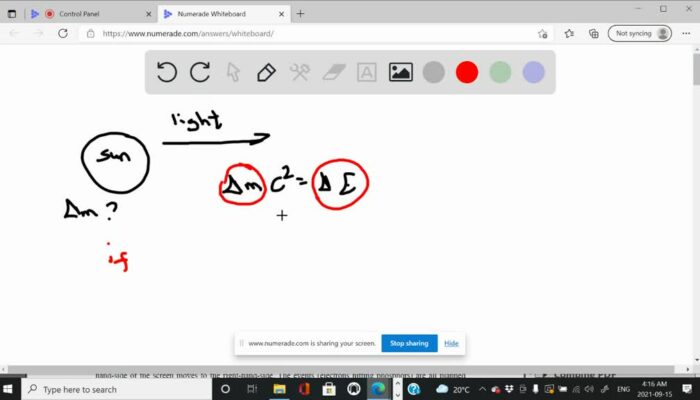
The Sun emits an enormous number of photons, continuously radiating energy into the solar system. According to Einstein’s mass-energy equivalence principle (E=mc²), this energy emission corresponds to a gradual loss of the Sun’s mass over time. Although photons themselves have no rest mass, the energy they carry away effectively reduces the Sun’s mass, influencing its long-term evolution and the gravitational dynamics of the solar system.
Theoretical Considerations of Photon Mass
While experiments have established extremely stringent upper limits on photon mass, the possibility of a tiny, nonzero photon mass remains a subject of theoretical investigation. Even an infinitesimal mass would alter electromagnetic interactions, potentially affecting phenomena such as the propagation of radio waves and the cosmic microwave background radiation. These studies push the boundaries of our understanding of fundamental physics and the nature of light.
Philosophical and Scientific Implications
The question of photon mass challenges traditional distinctions between matter and energy, highlighting the complexity of quantum phenomena. The wave-particle duality of light exemplifies how classical categories can be insufficient to describe the behavior of fundamental particles, necessitating more nuanced frameworks in physics.
Technological Impact of Understanding Photon Mass
Recognizing that photons are massless yet carry energy and momentum has driven numerous technological advancements. Lasers, quantum communication systems, and various scientific instruments rely on the unique properties of photons. These technologies have expanded our capabilities in medicine, telecommunications, and astrophysics, enabling precise measurements and new ways to explore the universe.
Summary: The Unique Status of Photons
Photons occupy a distinctive place in physics as massless particles that nonetheless carry energy and momentum. This paradox enriches our understanding of the quantum world, demonstrating that mass is not the sole factor determining physical influence. The study of photon mass continues to illuminate fundamental principles of motion, force, and interaction, shaping both theoretical inquiry and practical innovation.
Conclusion: The Everlasting Mystery of Light
As research progresses, photons remain central to unraveling the mysteries of the cosmos. Their massless nature and dynamic properties challenge and expand our comprehension of the universe, ensuring that light will continue to be a focal point in the pursuit of scientific knowledge.
FAQ
Do photons have mass?
No, photons are considered massless particles, as they have zero rest mass.
How do photons interact with gravity?
Photons, despite being massless, are influenced by gravity through the curvature of spacetime.
What is the significance of photon energy?
Photon energy is proportional to its frequency and allows photons to exert pressure and influence various physical phenomena.



Leave a Reply