

Short Answer
Definition of Graphene
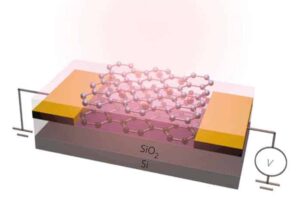
Graphene is a single layer of carbon atoms arranged in a two-dimensional hexagonal lattice. This atom-thin sheet exhibits extraordinary physical and electronic properties, making it a groundbreaking material in modern science and technology. Its unique structure grants it exceptional electrical conductivity, mechanical strength, and thermal properties, positioning it as a key player in the future of advanced materials.
Electronic Properties and Speed Record
One of the most remarkable features of graphene is its extraordinary electron mobility, which surpasses that of traditional conductive materials. This high mobility arises from graphene’s distinctive band structure, allowing electrons to move through the lattice with minimal scattering and resistance. Electrons in graphene behave as if they are massless particles, similar to photons traveling through a vacuum, enabling them to reach unprecedented speeds within the material.
Mechanism Behind Graphene’s Electron Mobility
The exceptional speed of electrons in graphene is rooted in quantum mechanics and relativistic physics. The electrons act like ultra-fast particles navigating a nearly frictionless environment, akin to race cars speeding on a smooth track with minimal drag. This behavior is a direct consequence of graphene’s linear energy-momentum relationship, which contrasts with the parabolic dispersion seen in conventional semiconductors.
Quantitative Comparison with Conventional Materials
Experimental studies have demonstrated that graphene’s electron mobility can reach values as high as 200,000 cm²/V·s, a figure that dwarfs the approximately 1,500 cm²/V·s mobility typical of silicon, the cornerstone of current electronic devices. This vast difference highlights graphene’s potential to revolutionize electronics by enabling faster, more efficient charge transport, potentially transforming computing and communication technologies.
Thermal Management and Stability at High Speeds
Graphene’s ability to sustain high electron velocities without significant heat generation is another of its extraordinary traits. Typically, increased electron speed in conductors leads to higher temperatures and resistance, which degrade performance. However, graphene efficiently dissipates heat, maintaining stability and reducing energy loss. This property is comparable to a river flowing smoothly through a valley without eroding its banks, allowing electronic components such as transistors and oscillators to operate reliably at high frequencies.
Applications Enabled by Graphene’s Speed
The rapid electron transport in graphene opens the door to developing ultra-fast electronic devices capable of processing vast amounts of data at unprecedented rates. This capability could revolutionize fields such as telecommunications, high-performance computing, and data storage, enabling processors that perform trillions of operations per second and significantly enhancing overall system efficiency.
Integration with Other Two-Dimensional Materials
Beyond its intrinsic properties, graphene’s versatility is amplified when combined with other two-dimensional materials to form heterostructures. These layered assemblies retain graphene’s high-speed charge transport while introducing new functionalities, expanding their applicability to areas like optoelectronics, sensors, and quantum computing. Such hybrid materials promise to deliver tailored electronic and photonic properties for next-generation technologies.
Interdisciplinary Impact and Emerging Technologies
Graphene’s exceptional electron mobility has far-reaching implications across multiple disciplines. In biomedical engineering, for instance, graphene-based biosensors can detect minute concentrations of biomarkers, enhancing diagnostic sensitivity and enabling early disease detection. In energy storage, graphene’s rapid charge-discharge capabilities are being harnessed to develop supercapacitors that outperform traditional batteries, offering faster charging times and longer lifespans for portable electronics and electric vehicles.
Challenges in Graphene Utilization
- Scalability:
Producing high-quality graphene at industrial scales remains a significant challenge, limiting widespread adoption. - Cost:
The expense associated with graphene synthesis and processing currently hinders its integration into commercial products. - Integration:
Incorporating graphene into existing electronic infrastructures requires overcoming compatibility and fabrication hurdles.
Despite these obstacles, ongoing research and development efforts continue to address these issues, driven by the immense potential graphene holds for technological advancement.
Significance of Graphene’s Speed Record
Graphene’s record-breaking electron mobility is more than a scientific milestone; it symbolizes the advent of a new era in materials science and technology. By bridging physics, engineering, and materials science, graphene offers profound insights into quantum phenomena and paves the way for innovations that could redefine computing, energy, and healthcare. Its unique combination of speed, efficiency, and adaptability underscores the limitless possibilities at the intersection of advanced materials and technological progress, heralding a future of unprecedented capabilities.
FAQ
What is graphene?
Graphene is a single layer of carbon atoms arranged in a two-dimensional hexagonal lattice, known for its exceptional physical and electronic properties.
Why is graphene's electron mobility significant?
Graphene’s electron mobility can reach up to 200,000 cm²/V·s, which is significantly higher than that of silicon, making it crucial for advanced electronic applications.





Leave a Reply