
Short Answer
Definition of Elementary Particles
Elementary particles are the most basic units of matter, serving as the foundational components of the universe. Unlike composite particles, which are constructed from smaller parts, elementary particles are considered indivisible and not composed of any other entities. They form the cornerstone of particle physics, providing insight into the fundamental structure and behavior of all matter.
Classification of Elementary Particles
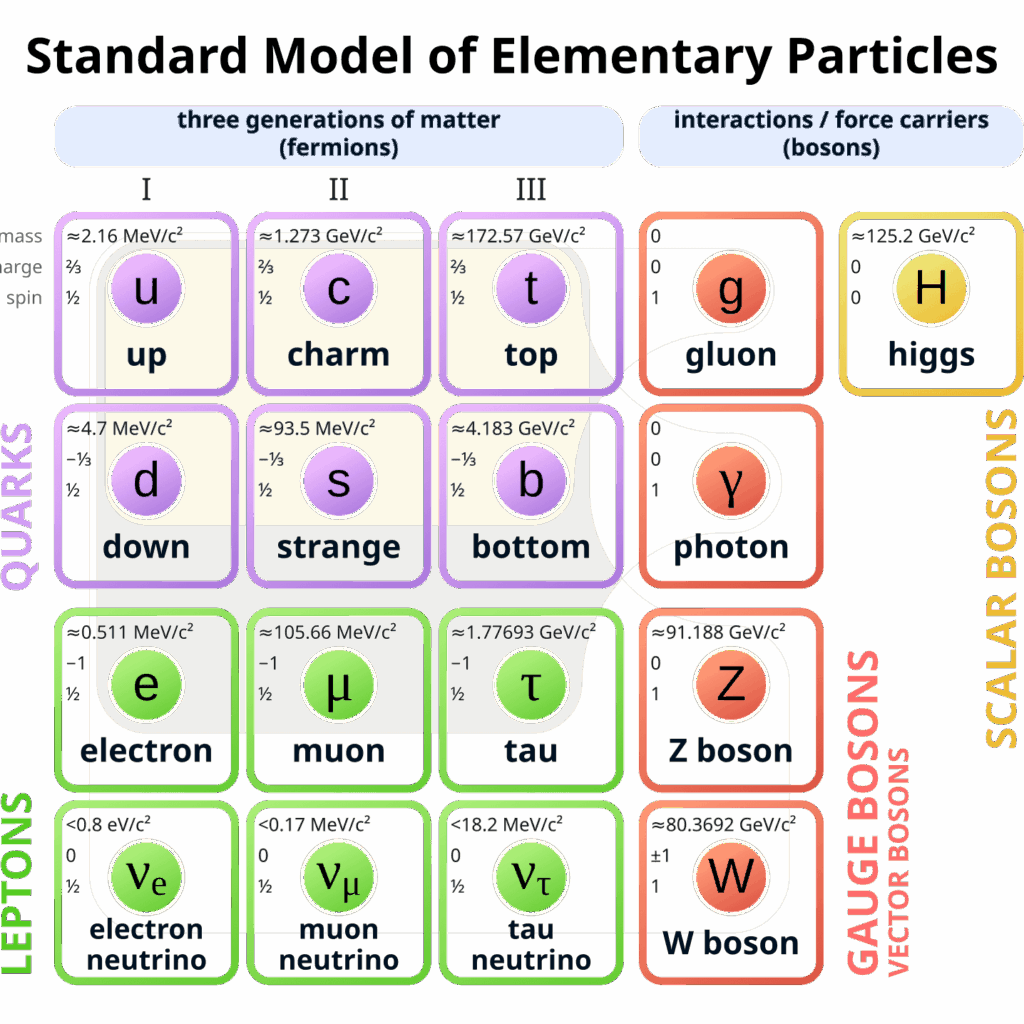
Elementary particles are broadly divided into two main groups based on their intrinsic spin, a quantum mechanical property that influences their statistical behavior: fermions and bosons.
Fermions
Fermions possess half-integer spins (such as 1/2 or 3/2) and obey the Pauli exclusion principle, which forbids identical fermions from occupying the same quantum state simultaneously. This category includes two essential families:
- Quarks:
Six distinct types, or “flavors,” of quarks exist: up, down, charm, strange, top, and bottom. Each flavor is characterized by unique properties including electric charge, color charge, and mass. Quarks interact via the strong nuclear force, mediated by gluons, and combine to form composite particles like protons and neutrons (baryons) as well as mesons. - Leptons:
Leptons are not influenced by the strong force and include particles such as electrons, muons, tau particles, and their corresponding neutrinos. Electrons play a critical role in atomic structure by orbiting the nucleus, which consists of protons and neutrons. Each lepton flavor is paired with a neutrino, which is electrically neutral and extremely light.
Bosons
Bosons are particles with integer spins (0, 1, or 2) and primarily function as force carriers, facilitating interactions between other particles. Key bosons include:
- Photon:
The massless particle responsible for mediating the electromagnetic force between charged particles. - W and Z Bosons:
These particles govern the weak nuclear force, which is involved in processes like beta decay. - Gluons:
Mediators of the strong nuclear force, gluons carry color charge themselves, enabling complex self-interactions that bind quarks together. - Higgs Boson:
Associated with the Higgs field, this scalar boson imparts mass to other particles through the Higgs mechanism, a process involving spontaneous symmetry breaking.
Fundamental Forces and Their Mediators
Elementary particles interact through four fundamental forces, each mediated by specific bosons:
- Electromagnetic Force:
Carried by photons, this force governs interactions between electrically charged particles. - Weak Nuclear Force:
Mediated by W and Z bosons, it is responsible for certain types of radioactive decay and particle transformations. - Strong Nuclear Force:
Gluons mediate this force, which binds quarks inside protons and neutrons, ensuring the stability of atomic nuclei. - Gravitational Force:
Although not yet fully integrated into the Standard Model, gravity is hypothesized to be mediated by the graviton, a theoretical boson with spin 2.
The Higgs Mechanism and Mass Generation
The Higgs boson plays a pivotal role in the Standard Model by interacting with the Higgs field, a pervasive scalar field throughout the universe. Through spontaneous symmetry breaking, this mechanism endows elementary particles with mass, explaining why particles have the mass they do rather than being massless. The experimental confirmation of the Higgs boson at the Large Hadron Collider in 2012 was a landmark achievement, validating this crucial aspect of particle physics theory.
Advancements and Challenges in Particle Physics
Research into elementary particles extends beyond classification, probing the fundamental nature of reality and the forces shaping it. Technological innovations in particle accelerators, detectors, and computational methods have enabled increasingly precise experiments, deepening our understanding of subatomic phenomena.
Unresolved Mysteries
- Dark Matter:
Although it constitutes about 27% of the universe’s mass-energy content, dark matter remains undetected directly. Its gravitational effects suggest the presence of unknown particles beyond the Standard Model. - Supersymmetry:
This theoretical framework proposes a symmetry between fermions and bosons, predicting new particles that could address unresolved issues in particle physics and cosmology. - Unified Theories:
Efforts continue to develop a comprehensive theory that unites all fundamental forces, including gravity, into a single framework.
Significance of Elementary Particles
Understanding elementary particles is crucial for comprehending the universe at its most fundamental level. Their study not only illuminates the origins and structure of matter but also drives technological progress in fields such as medical imaging, materials science, and information technology. Moreover, the exploration of particle physics inspires philosophical reflection on the nature of existence and the interconnectedness of all things.
Summary
The study of elementary particles reveals a complex and dynamic interplay of fundamental constituents and forces. From the classification into fermions and bosons to the mediation of forces and the generation of mass, these particles form the intricate fabric of the cosmos. Ongoing research continues to challenge and expand our understanding, highlighting the profound depth underlying the apparent simplicity of the universe.
FAQ
What are elementary particles?
Elementary particles are the most basic units of matter, indivisible and foundational to the structure of the universe.
How are elementary particles classified?
They are classified into two main groups: fermions, which include quarks and leptons, and bosons, which include force carriers like photons and gluons.
Why are elementary particles important?
They are crucial for understanding the fundamental forces and the overall structure of matter in the universe.






Leave a Reply