

Short Answer
Definition of Space Telescopes and Adaptive Optics
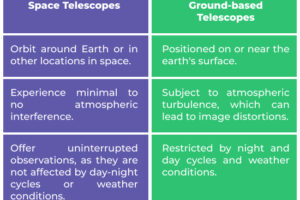
Space telescopes are advanced astronomical instruments positioned beyond Earth’s atmosphere to observe celestial objects with minimal interference. Adaptive optics, on the other hand, is a technology primarily used in ground-based telescopes to correct distortions caused by atmospheric turbulence, thereby enhancing image clarity.
- Space Telescopes:
Instruments placed in orbit or deep space to capture high-resolution images of the universe without atmospheric distortion. - Adaptive Optics:
A system that dynamically adjusts telescope mirrors in real-time to compensate for atmospheric disturbances affecting light waves.
Atmospheric Challenges in Ground-Based Astronomy
Observing the cosmos from Earth presents significant challenges due to the planet’s atmosphere. Turbulent air layers cause incoming light from stars and galaxies to bend unpredictably, a phenomenon known as “seeing,” which blurs images captured by terrestrial telescopes. Adaptive optics was developed to mitigate these effects by using deformable mirrors that adjust hundreds of times per second based on feedback from guide stars or lasers, restoring image sharpness.
Why Adaptive Optics Is Unnecessary for Space Telescopes
Space telescopes operate in the vacuum of space, completely bypassing atmospheric interference. This environment allows them to capture images with exceptional clarity and resolution unattainable from the ground. For instance, the Hubble Space Telescope has delivered decades of high-quality data by avoiding atmospheric distortion altogether, enabling detailed observations in ultraviolet and infrared wavelengths.
Because space telescopes do not contend with atmospheric turbulence, the complex and resource-intensive adaptive optics systems used on Earth-based observatories are redundant in space. The absence of atmospheric distortion means that the primary function of adaptive optics-to correct wavefront errors caused by air turbulence-is not required.
Technical and Operational Considerations
Adaptive optics involves intricate hardware and software, including deformable mirrors, wavefront sensors, and laser guide stars, all of which require continuous calibration and power. Integrating such systems into space telescopes would add significant complexity, weight, and power demands-factors that are critically constrained in space missions. Moreover, the harsh conditions of space necessitate highly reliable and durable instruments; adding adaptive optics could increase the risk of mechanical failure and complicate maintenance or repairs during long-duration missions.
Economic and Resource Implications
The development and deployment of adaptive optics systems are costly endeavors. While these expenses are justified for ground-based observatories due to the necessity of overcoming atmospheric distortion, the financial rationale weakens for space telescopes. Given the already substantial investment required to launch and operate space observatories, allocating funds toward adaptive optics would divert resources from other critical technologies and scientific instruments that directly enhance observational capabilities.
Alternative Approaches to Enhancing Image Quality
Modern space telescopes employ a variety of advanced technologies to maximize image resolution and data quality without relying on adaptive optics. These include ultra-sensitive detectors, precision spectrographs, and large segmented mirrors that can be finely adjusted. Additionally, computational methods such as post-processing algorithms and data fusion techniques are increasingly used to refine images after capture, effectively compensating for any residual imperfections.
Advancements in Space-Based Optical Technologies
New-generation observatories like the James Webb Space Telescope exemplify the shift away from adaptive optics toward innovative design and engineering solutions. These instruments feature large, segmented primary mirrors with precise alignment capabilities, enhanced sensor calibration, and sophisticated data processing pipelines. This approach prioritizes simplicity, reliability, and cutting-edge technology to push the boundaries of astronomical discovery.
Common Misconceptions About Adaptive Optics in Space
Space telescopes need adaptive optics to correct image distortions.
Since space telescopes operate outside Earth’s atmosphere, they do not experience atmospheric turbulence, making adaptive optics unnecessary.
Adaptive optics can improve all types of telescope images.
Adaptive optics specifically addresses atmospheric distortions and is not designed to correct other types of optical aberrations inherent in telescope systems.
Significance of Space Telescopes Without Adaptive Optics
Operating beyond the atmospheric veil, space telescopes provide unparalleled clarity and sensitivity in observing the universe. Their design philosophy emphasizes robustness and efficiency, avoiding the complexities of adaptive optics systems that are essential only for ground-based observations. This strategic choice enables astronomers to explore distant galaxies, nebulae, and exoplanets with unprecedented precision, advancing our understanding of the cosmos.
FAQ
What is adaptive optics?
Adaptive optics is a technology used in ground-based telescopes to correct distortions caused by Earth's atmosphere, improving image clarity by rapidly adjusting mirrors based on real-time data.
Why don’t space telescopes need adaptive optics?
Space telescopes operate outside Earth's atmosphere, which eliminates atmospheric distortions, thus removing the need for adaptive optics.
Are there any challenges to using adaptive optics in space?
Yes, adaptive optics systems add complexity, weight, power requirements, and potential failure points that are impractical for space missions.
How do space telescopes achieve high image quality without adaptive optics?
They utilize their location above the atmosphere, advanced sensor technologies, precise engineering, and computational post-processing techniques.



Leave a Reply