
Short Answer
Definition of Pulsars
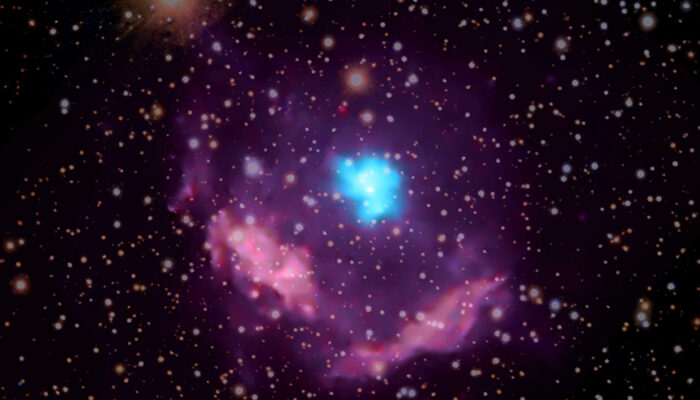
Pulsars are a distinct class of neutron stars characterized by their intense magnetic fields and rapid rotation. These compact remnants arise from the explosive deaths of massive stars, known as supernovae. Composed predominantly of neutrons, pulsars emit beams of electromagnetic radiation from their magnetic poles. As these beams sweep across space, they create periodic pulses detectable from Earth, much like the rotating beam of a lighthouse.
- Neutron Star:
A dense stellar remnant primarily made of neutrons, formed after a supernova collapse. - Magnetic Field:
Extremely strong magnetic fields channel radiation into focused beams. - Rotation:
The rapid spin of the neutron star causes the emission beams to sweep across observers periodically.
Discovery and Characteristics of the Youngest Pulsar
The recently identified pulsar PSR J0901-4046 stands out as the youngest known member of its kind, having formed only a few hundred years ago from a supernova event. This youthfulness is exceptional given the vast age of the universe and offers a rare glimpse into the early stages of pulsar development. Unlike older pulsars, which gradually lose rotational speed due to energy dissipation, PSR J0901-4046 spins at an extraordinary rate, reaching up to 800 rotations per second.
This rapid rotation not only distinguishes it from its older counterparts but also generates a powerful and complex emission pattern. The pulsar’s signals span a broad range of the electromagnetic spectrum, from radio frequencies to high-energy gamma rays, effectively “communicating” its energetic state and internal dynamics to observers.
Mechanisms Behind Pulsar Emissions
The pulsar’s emission arises from the interaction between its rotation and magnetic field. Charged particles accelerated along magnetic field lines emit radiation in tightly focused beams. As the neutron star spins, these beams sweep through space, producing the characteristic pulsed signals detected by telescopes. The multifrequency nature of these emissions provides valuable information about the pulsar’s magnetic environment, particle acceleration processes, and energy output.
Implications for Stellar Evolution and Neutron Star Formation
The study of PSR J0901-4046 challenges traditional models of pulsar evolution, which often involve binary star systems influencing the supernova process. This pulsar’s apparent solitary origin suggests alternative formation pathways, prompting a reevaluation of how neutron stars emerge and evolve. Understanding these mechanisms sheds light on the lifecycle of massive stars and the diversity of outcomes following supernova explosions.
Additionally, the pulsar serves as a natural laboratory for exploring extreme physical conditions, such as ultra-dense matter and intense gravitational fields, which are inaccessible in terrestrial experiments. Insights gained here contribute to broader fields including quantum mechanics and high-energy astrophysics.
Role in Cosmic Element Formation
Supernovae, the progenitors of pulsars, are critical sites for nucleosynthesis-the creation of elements heavier than iron. By analyzing the emissions from PSR J0901-4046, scientists can refine their understanding of how these heavy elements are synthesized and dispersed throughout the galaxy. This process is fundamental to the chemical evolution of the universe and the formation of planets and life.
Applications in Technology and Navigation
The precise and regular pulses emitted by pulsars have practical applications beyond astrophysics. Their consistent timing makes them excellent natural clocks, which can be harnessed for advanced timekeeping and navigation systems. Pulsar-based timing could enhance global positioning technologies and synchronization methods, offering improvements over current satellite-based systems.
Common Misconceptions About Pulsars
Pulsars are stars that emit sound waves.
Pulsars emit electromagnetic radiation, not sound, which travels through space as waves of energy rather than audible vibrations.
All pulsars slow down at the same rate.
The spin-down rate varies depending on factors like magnetic field strength and age; younger pulsars like PSR J0901-4046 can spin much faster than older ones.
Significance of the Youngest Pulsar in Astrophysics
The discovery of PSR J0901-4046 marks a pivotal advancement in astrophysics, offering a unique window into the early life of neutron stars. Its rapid rotation and broad-spectrum emissions provide critical data that enhance our understanding of stellar death, neutron star physics, and cosmic element formation. Moreover, its potential technological applications underscore the broader impact of pulsar research, bridging fundamental science with practical innovation. This pulsar exemplifies the dynamic and interconnected nature of the cosmos, inviting ongoing exploration and discovery.
FAQ
What is a pulsar?
A pulsar is a type of neutron star that emits beams of electromagnetic radiation due to its rapid rotation and strong magnetic field.
Why is PSR J0901-4046 significant?
It is the youngest known pulsar, providing insights into pulsar formation and evolution, and has potential applications in navigation technology.





Leave a Reply