
Short Answer
Understanding Mass at the Atomic Scale
Mass measurement holds a pivotal role in both physics and chemistry, particularly when examining matter at the atomic and subatomic levels. A fundamental question arises: why is it impossible to measure mass directly at its most basic scale? This inquiry reveals a complex landscape that challenges conventional perceptions of mass and invites a deeper investigation into the quantum realm.
Definition of Mass in Atomic Physics
Mass can be understood in two main contexts within atomic physics:
- Intrinsic Mass:
The inherent mass of elementary particles such as protons, neutrons, and electrons. - Effective Mass:
The apparent mass particles exhibit when influenced by external forces or fields.
Atoms are composed of these particles, yet determining their exact mass is far from straightforward due to the complexities involved at microscopic scales.
Challenges in Measuring Atomic Mass
Traditional mass measurement techniques, such as using balances, work well for macroscopic objects by comparing them to known standards. However, these methods become ineffective at the atomic level for several reasons:
- Measurement Disturbance:
The act of measuring can alter the state of the atom, a consequence of the Heisenberg Uncertainty Principle, which states that certain pairs of physical properties (e.g., position and momentum) cannot be simultaneously measured with arbitrary precision. - Interaction Effects:
Techniques involving light or particle interactions to measure atomic mass can change the energy states of atoms, thereby affecting their effective mass.
Atomic Mass Unit and Isotopic Variations
The atomic mass unit (amu) serves as a standardized scale for expressing atomic masses, but it represents an average value influenced by isotopic distribution. For example, carbon’s atomic mass is approximately 12 amu, yet this figure depends on the relative abundance of its isotopes-carbon-12, carbon-13, and carbon-14-each possessing distinct masses. This variability complicates the notion of a fixed atomic mass.
Influence of Nuclear Binding Energy
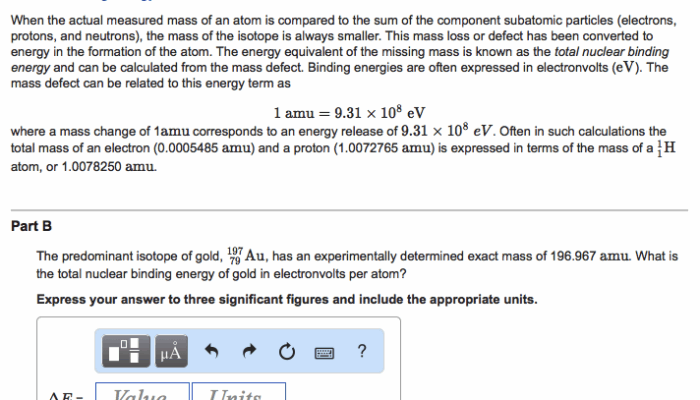
Binding energy plays a crucial role in the mass of atomic nuclei. When protons and neutrons bind together to form isotopes, energy is released or absorbed, altering the total mass. According to Einstein’s mass-energy equivalence principle (E=mc²), mass and energy are interchangeable, meaning the nucleus’s mass is not simply the sum of its constituent particles but is reduced by the binding energy released during formation.
Quantum Fluctuations and Virtual Particles
Quantum field theory introduces the concept of virtual particles-transient entities that spontaneously appear and vanish even in a vacuum. These fluctuations contribute to the effective mass of particles, adding another layer of complexity to defining atomic mass. This probabilistic nature of reality challenges the idea of a precise, immutable mass for atoms.
Distinguishing Mass from Weight
It is essential to differentiate between mass and weight, terms often mistakenly used interchangeably:
- Mass:
The quantity of matter in an object, which remains constant regardless of location. - Weight:
The gravitational force acting on an object’s mass, which varies depending on the strength of the gravitational field.
This distinction is critical when discussing atomic-scale measurements, as weight is irrelevant in such contexts.
Technological Approaches to Atomic Mass Measurement
Advanced instruments like mass spectrometers enable scientists to estimate atomic masses by separating ions based on their mass-to-charge ratios. Despite their sophistication, these methods are indirect and depend on assumptions such as ion behavior and calibration standards, which introduce uncertainties and limit the precision of atomic mass determination.
Why Measuring Atomic Mass Matters
Accurate knowledge of atomic mass is fundamental to numerous scientific fields, including chemistry, nuclear physics, and materials science. It underpins our understanding of atomic structure, isotopic composition, and nuclear reactions, influencing everything from the synthesis of new elements to medical diagnostics and environmental studies.
Common Misconceptions About Atomic Mass
Atomic mass is a fixed, exact value.
Atomic mass is an average influenced by isotopic variations and binding energy effects, making it inherently approximate.
Mass and weight are the same.
Mass is the amount of matter, while weight is the force due to gravity acting on that mass.
Measuring atomic mass does not affect the atom.
Measurement at the atomic scale can disturb the system, altering its properties due to quantum mechanical principles.
Conclusion: The Elusive Nature of Atomic Mass
The endeavor to measure atomic mass precisely is fraught with theoretical, experimental, and technological challenges. From quantum uncertainties and isotopic diversity to the influence of binding energy and virtual particles, the concept of mass at the atomic level defies simple quantification. This ongoing puzzle highlights the intricate relationship between mass, energy, and the fundamental nature of matter, leaving open the question of whether an absolute atomic mass can ever be truly known.
FAQ
Why can't the mass of an atom be measured directly?
Because measuring atomic mass directly disturbs the atom's state due to quantum effects like the Heisenberg Uncertainty Principle, and technological limitations force reliance on indirect methods.
What role does isotopic variation play in measuring atomic mass?
Isotopic variation means atoms of the same element have different masses, so measured atomic masses are averages weighted by isotopic abundance rather than absolute values.
How does binding energy affect atomic mass measurement?
Binding energy causes the mass of a nucleus to differ from the sum of its protons and neutrons due to mass-energy equivalence, complicating precise atomic mass determination.
What is the difference between mass and weight in this context?
Mass is an intrinsic property of matter and remains constant, while weight is the gravitational force on an object and varies with gravitational field strength.
What are common techniques used to estimate atomic mass?
Mass spectrometry is commonly used to separate ions by mass-to-charge ratio, providing indirect measurement of atomic mass.





Leave a Reply