
Short Answer
Definition of Atomic Particles
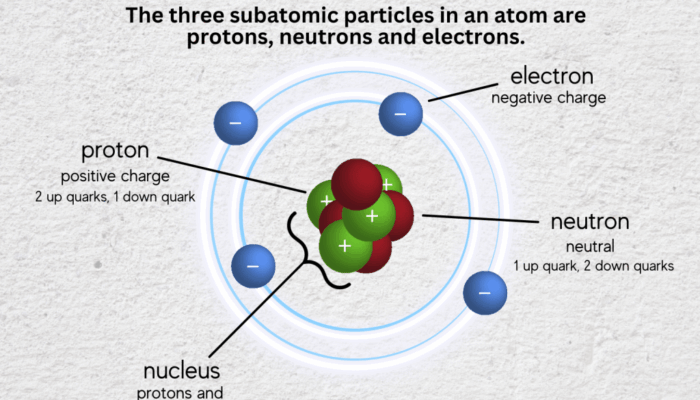
An atom is a fundamental unit of matter, structured much like a miniature solar system, where various particles orbit a central core. The primary constituents of an atom include protons, neutrons, and electrons. Among these, protons and neutrons are classified as heavy particles due to their substantial mass compared to electrons. These particles collectively determine the atom’s mass, stability, and chemical properties.
Components of the Atom
Atoms consist of a dense nucleus surrounded by a cloud of electrons. The nucleus houses the heavy particles-protons and neutrons-also known as nucleons. Electrons, by contrast, are lightweight particles that orbit the nucleus and play a crucial role in chemical bonding and reactions.
Protons: Positive Charge Carriers
Protons are positively charged particles located within the atomic nucleus. Each proton has a mass of approximately 1.67 × 10⁻²⁷ kilograms, making them a major contributor to the atom’s overall mass. The number of protons in an atom defines its elemental identity, which is the foundation of the periodic table. For instance, hydrogen contains one proton, while uranium has 92 protons. Protons attract electrons through electrostatic forces, maintaining the atom’s structural integrity.
Beyond their mass and charge, protons influence nuclear stability. The ratio of protons to neutrons affects whether an atom remains stable or undergoes radioactive decay, highlighting the proton’s role in both elemental identity and nuclear behavior.
Neutrons: Neutral Stabilizers
Neutrons are electrically neutral particles residing alongside protons in the nucleus. Their mass is nearly equal to that of protons, but they carry no charge. This neutrality allows neutrons to act as stabilizing agents within the nucleus by mitigating the repulsive forces between positively charged protons. The strong nuclear force, which binds nucleons together, relies heavily on the presence of neutrons to maintain nuclear cohesion.
Variations in neutron number give rise to isotopes-atoms of the same element with different masses. For example, carbon exists as carbon-12 and carbon-14 isotopes, differing in neutron count. These isotopes have significant implications in fields such as nuclear medicine, archaeology, and energy production due to their radioactive properties and nuclear reactions.
Electrons: The Lightweight Orbiters
Electrons are minuscule particles with a mass roughly 1/1836 that of a proton. They orbit the nucleus in defined energy levels or shells and are essential for chemical bonding and reactions. Although electrons contribute negligibly to atomic mass, their arrangement determines an atom’s chemical behavior and reactivity. Electrons provide a dynamic contrast to the static mass of nucleons, facilitating the complex interactions that define chemistry.
Mass and Stability in Atomic Structure
The heavy particles-protons and neutrons-form the core framework of atomic mass and stability. While their combined mass establishes the atom’s weight, the delicate balance between these nucleons governs nuclear stability. An imbalance can lead to radioactivity, where the atom spontaneously transforms to achieve a more stable state. This interplay is fundamental to understanding nuclear physics and the behavior of elements under various conditions.
Real-World Applications of Heavy Atomic Particles
- Nuclear Medicine:
Isotopes with varying neutron numbers are used in diagnostic imaging and cancer treatment. - Archaeological Dating:
Carbon isotopes help determine the age of ancient artifacts through radiocarbon dating. - Energy Production:
Nuclear reactors harness the energy released from neutron-induced fission reactions.
Common Misconceptions About Atomic Particles
Electrons contribute significantly to atomic mass.
Electrons have negligible mass compared to protons and neutrons and do not affect the atom’s overall mass substantially.
All atoms of an element have the same number of neutrons.
Atoms of the same element can have different numbers of neutrons, resulting in isotopes with varying masses and nuclear properties.
Importance of Heavy Particles in Science and Technology
Understanding the roles of protons and neutrons is crucial for advancements in multiple scientific disciplines. Their influence on atomic mass and nuclear stability underpins chemistry, physics, and various applied technologies. From the creation of new elements to the development of medical treatments and energy solutions, the study of these heavy particles continues to illuminate the fundamental workings of the universe.
FAQ
What are the heavy particles in an atom?
The heavy particles in an atom are protons and neutrons, which reside in the nucleus and constitute most of the atom's mass.
Why are electrons not considered heavy particles?
Electrons have very little mass compared to protons and neutrons, approximately 1/1836 the mass of a proton, so they are not classified as heavy particles.
How do protons and neutrons affect atomic stability?
The ratio of neutrons to protons affects the stability of the nucleus; an imbalance can lead to radioactive decay.
What is the significance of isotopes?
Isotopes are variants of elements with different numbers of neutrons, affecting nuclear properties without changing chemical behavior.





Leave a Reply