
Short Answer
Definition of a Supernova
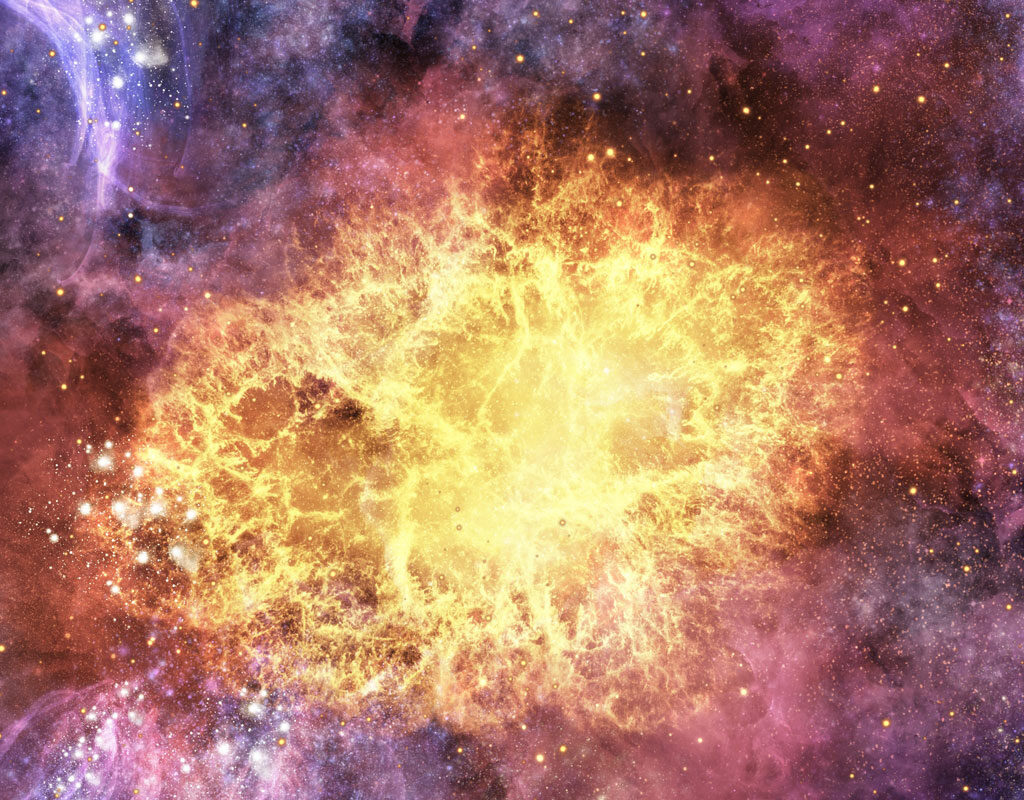
A supernova represents a spectacular and powerful explosion marking the end of a massive star’s life cycle. Far from being a mere act of destruction, it is a transformative cosmic event that briefly shines as one of the brightest objects in the universe. This phenomenon plays a crucial role in the cosmic lifecycle, redistributing elements and energy across galaxies.
Types of Supernovae
Supernovae are generally classified into two primary categories based on their origin and underlying mechanisms:
- Core-Collapse Supernovae:
These occur when a massive star depletes its nuclear fuel, causing its iron-rich core to collapse under gravity. The core’s inability to sustain fusion leads to a rapid implosion, followed by a violent explosion that ejects the star’s outer layers into space. - Thermonuclear Supernovae (Type Ia):
These explosions arise from white dwarf stars in binary systems. When the white dwarf accumulates enough matter from its companion star to reach a critical mass, it undergoes a runaway nuclear fusion reaction, resulting in a uniform and intense explosion.
Mechanism Behind Core-Collapse Supernovae
In massive stars, the balance between gravitational forces and radiation pressure is maintained by ongoing nuclear fusion. Once the star exhausts its fuel, particularly iron which cannot undergo fusion to release energy, this equilibrium collapses. The core implodes, compressing matter to densities comparable to neutron stars or black holes. The outer layers then fall inward and rebound off the dense core, propelling stellar material outward at tremendous speeds, often tens of thousands of kilometers per second. This explosive ejection enriches the interstellar medium with heavy elements essential for future star and planet formation.
Thermonuclear Supernovae: The Role of White Dwarfs
Type Ia supernovae originate from white dwarfs-stellar remnants of sun-like stars-that gain mass from a nearby companion. When the white dwarf’s mass approaches the Chandrasekhar limit (approximately 1.4 times the mass of the Sun), it triggers an uncontrollable fusion reaction. This results in a highly energetic explosion with a consistent peak brightness, making Type Ia supernovae invaluable as “standard candles” for measuring cosmic distances and studying the universe’s expansion.
Energy Production and Nucleosynthesis
The energy unleashed during a supernova is immense, often surpassing the total energy output of the Sun over its entire lifespan within just a few weeks. This energy primarily arises from rapid nucleosynthesis, where new atomic nuclei are forged from existing protons and neutrons. Supernovae act as cosmic forges, synthesizing heavy elements such as gold, silver, and uranium. These elements are then dispersed into space, contributing to the material composition of planets, stars, and living organisms.
Influence of Neutrinos and Magnetic Fields
Recent research highlights the significant role of neutrinos-nearly massless, weakly interacting particles-in supernova explosions. During a core-collapse event, an enormous burst of neutrinos carries away most of the energy, rivaling the electromagnetic radiation emitted. Additionally, the presence of intense magnetic fields and rapid rotation can give rise to magnetars, highly magnetized neutron stars, which may influence the dynamics and intensity of the explosion.
Cosmological Significance of Supernovae
Beyond their immediate astrophysical impact, supernovae provide critical insights into the broader universe. Observations of Type Ia supernovae have been instrumental in discovering dark energy, the mysterious force accelerating cosmic expansion. Thus, supernovae serve as vital tools for understanding the universe’s past, present, and future evolution.
Real-World Examples of Supernovae
Historical and contemporary observations of supernovae have enriched our knowledge of stellar and cosmic processes:
- SN 1987A:
The closest observed supernova in modern times, located in the Large Magellanic Cloud, provided invaluable data on core-collapse mechanisms and neutrino emissions. - Type Ia Supernovae in Distant Galaxies:
These have been used to map the expansion rate of the universe, leading to the groundbreaking discovery of dark energy.
Common Misconceptions About Supernovae
Supernovae only destroy matter.
While they are destructive, supernovae also create and disperse heavy elements essential for life and new star formation.
All supernovae are the same.
There are distinct types of supernovae with different origins and characteristics, such as core-collapse and thermonuclear varieties.
Importance of Supernovae in the Universe
Supernovae are fundamental to the cosmic cycle of matter and energy. They not only mark the death of stars but also catalyze the birth of new stars and planetary systems by enriching the interstellar medium with heavy elements. Their study advances our understanding of fundamental physics, stellar evolution, and the large-scale structure of the cosmos, making them indispensable to both astronomy and cosmology.
FAQ
What causes a supernova?
Supernovae are caused either by the gravitational collapse of a massive star's core or by a thermonuclear explosion of a white dwarf in a binary system.
How do supernovae contribute to element formation?
Supernovae produce heavy elements through nucleosynthesis, distributing these essential materials into space for new stars and planets.
Why are Type Ia supernovae important for astronomers?
Because of their uniform brightness, Type Ia supernovae are used as standard candles to measure cosmic distances and study the universe's expansion.
What is the role of neutrinos in supernova explosions?
Neutrinos carry away most of the explosion energy and influence the dynamics of the supernova event.
What is a magnetar?
A magnetar is a highly magnetized neutron star formed after some supernovae, potentially affecting the explosion and remnant evolution.



Leave a Reply