
Short Answer
Understanding the Composition of the Universe
The universe is an immense and complex entity, filled with various forms of matter and energy. While we often consider the tangible matter around us-stars, planets, and living beings-as the primary constituents of the cosmos, this visible matter represents only a small fraction of the universe’s total makeup. The majority is composed of mysterious components that challenge our understanding: dark matter and dark energy. These elements not only shape the structure of the universe but also govern its expansion and ultimate destiny.
Definition of Key Cosmic Components
- Baryonic Matter:
This is the ordinary matter that forms atoms, molecules, and all visible objects, including stars, planets, and living organisms. - Dark Matter:
An invisible form of matter that does not emit, absorb, or reflect light, making it undetectable by conventional telescopes. Its presence is inferred through gravitational effects on visible matter and cosmic structures. - Dark Energy:
A mysterious form of energy that permeates all space and drives the accelerated expansion of the universe. Unlike matter, it does not cluster but is uniformly distributed.
How the Universe’s Composition is Determined
Modern cosmology employs a variety of observational techniques to estimate the proportions of matter and energy in the universe. Measurements of the cosmic microwave background (CMB) radiation provide a snapshot of the early universe, revealing density fluctuations that inform us about the relative amounts of matter and energy. Observations of distant supernovae serve as “standard candles” to measure cosmic distances and the rate of expansion, offering evidence for dark energy’s accelerating influence. Additionally, large-scale galaxy surveys map the distribution of matter, highlighting the gravitational effects of dark matter on cosmic structures.
Quantitative Breakdown of the Universe’s Constituents
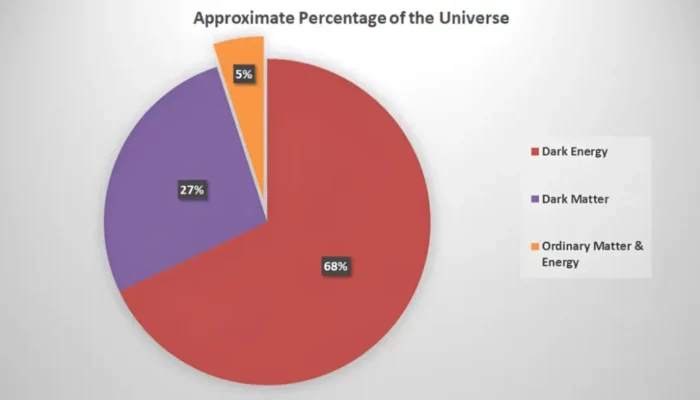
Current cosmological models, supported by precise data, indicate the following approximate composition of the universe:
- Dark Energy: Constitutes about 68-70% of the total energy density, acting as a repulsive force that accelerates cosmic expansion.
- Total Matter: Accounts for roughly 30-32%, including both dark matter and baryonic matter.
- Baryonic (Ordinary) Matter: Makes up a mere 4-5%, representing all visible and tangible matter.
- Dark Matter: Comprises approximately 25-27%, providing the gravitational framework for galaxy formation and clustering.
The Role and Nature of Dark Energy
Dark energy is a pervasive and enigmatic force that influences the universe on the largest scales. It is often associated with the cosmological constant, a concept introduced by Albert Einstein to represent the energy density of empty space. This energy exerts a negative pressure, causing the expansion of the universe to accelerate rather than slow down under gravity. Despite its critical role, the fundamental origin and properties of dark energy remain elusive, posing one of the greatest theoretical challenges in physics, known as the “cosmological constant problem.”
Dark Matter: The Invisible Cosmic Scaffold
While dark matter cannot be observed directly, its gravitational effects are essential for the formation and stability of cosmic structures. It acts as an unseen framework around which galaxies and clusters coalesce. Unlike dark energy, dark matter clumps together under gravity, shaping the large-scale “cosmic web.” Scientists hypothesize various candidates for dark matter particles, including Weakly Interacting Massive Particles (WIMPs), axions, and sterile neutrinos, though none have been definitively detected yet.
The Dynamic Interaction Between Dark Energy and Matter
The universe’s expansion is governed by a cosmic tug-of-war between matter and dark energy. Matter’s gravitational attraction tends to slow down the expansion, while dark energy’s repulsive effect accelerates it. The balance between these forces influences the geometry and ultimate fate of the cosmos. If dark energy remains constant or grows stronger, the universe may expand forever, leading to scenarios such as the “Big Freeze” or “Heat Death,” where galaxies drift apart and star formation ceases. Alternatively, changes in dark energy’s properties could result in different cosmic outcomes, though current evidence favors a stable dark energy model.
Visualizing the Cosmic Composition
Imagine the universe as a vast pie chart:
- More than two-thirds of this pie is filled with dark energy, an invisible force shaping the universe’s expansion.
- Less than one-third consists of matter, both visible and dark.
- Within the matter segment, the portion of ordinary, visible matter is only a small slice.
This distribution defies everyday intuition about the universe’s makeup, highlighting the dominance of unseen components.
Scientific Methods Behind the Measurements
Determining the universe’s composition has been a monumental scientific endeavor, relying on decades of observations and technological advances. The cosmic microwave background radiation offers a detailed map of the early universe’s conditions. Type Ia supernovae provide reliable distance measurements that reveal the acceleration of cosmic expansion. Large-scale galaxy surveys chart the distribution of matter, revealing the gravitational influence of dark matter. Together, these methods form a coherent picture of the universe’s energy and matter content.
Future Prospects in Cosmological Research
Upcoming space missions and observatories promise to deepen our understanding of dark energy and dark matter. Instruments like the James Webb Space Telescope (JWST), the Euclid satellite, and the Vera C. Rubin Observatory will deliver unprecedented precision in measuring cosmic parameters. These projects aim to determine whether dark energy is truly constant or varies over time and to uncover the nature of dark matter through indirect detection and detailed mapping of cosmic structures. Their findings could revolutionize our comprehension of the universe’s fundamental components.
Common Misconceptions About Cosmic Composition
Dark matter and dark energy are the same.
Dark matter is a form of matter that exerts gravitational pull and clusters in space, while dark energy is a uniform energy causing the acceleration of the universe’s expansion.
Ordinary matter makes up most of the universe.
Ordinary matter constitutes only about 4-5% of the universe, with dark matter and dark energy comprising the vast majority.
Dark energy is well understood.
Despite its significant role, dark energy’s nature and origin remain largely unknown and are active areas of research.
Significance of Understanding the Universe’s Composition
Grasping the proportions of dark energy and matter is crucial for comprehending the universe’s past, present, and future. It informs theories about cosmic evolution, the formation of galaxies, and the ultimate fate of all cosmic structures. This knowledge also drives technological and theoretical advancements in physics and astronomy, pushing the boundaries of human understanding and inspiring new generations of scientists to explore the cosmos.
FAQ
What is dark energy?
Dark energy is a mysterious form of energy that drives the accelerated expansion of the universe.
What is the relationship between dark energy and dark matter?
Dark energy causes the universe's expansion to accelerate, while dark matter provides the gravitational framework for galaxy formation.


Leave a Reply