
Short Answer
Definition of Gamma Radiation
Gamma radiation represents a unique form of nuclear radiation distinguished by its emission of highly energetic electromagnetic waves rather than traditional particles. Originating from atomic nuclei, gamma rays are photons with extremely high frequencies and energies, placing them at the extreme end of the electromagnetic spectrum. Unlike alpha or beta radiation, which involve the release of particles such as helium nuclei or electrons, gamma radiation consists solely of massless, chargeless photons.
- Nature of Emission:
Gamma radiation is the release of electromagnetic energy from an excited atomic nucleus transitioning to a lower energy state. - Energy Range:
Gamma photons typically possess energies ranging from hundreds of keV to several MeV, making them the most penetrating form of electromagnetic radiation. - Penetrating Ability:
Due to their high energy, gamma rays can pass through thick layers of matter that would stop less energetic particles.
Origin and Mechanism of Gamma Radiation
Gamma rays are produced when an atomic nucleus, having undergone a radioactive decay such as alpha or beta decay, remains in an excited state. To reach a more stable, lower energy configuration, the nucleus emits excess energy in the form of a gamma photon. This process does not involve the ejection of nucleons but rather the emission of a quantum of electromagnetic radiation, reflecting the principles of quantum mechanics and energy conservation.
The emitted gamma photon travels at the speed of light and interacts with matter through several quantum processes, including the photoelectric effect, Compton scattering, and pair production. These interactions are probabilistic and governed by quantum electrodynamics, highlighting the complex nature of gamma radiation’s interaction with the environment.
Energy Spectrum and Isotopic Signatures
Gamma radiation is not uniform; its energy spectrum varies depending on the radioactive isotope involved. Each radionuclide emits gamma photons with characteristic discrete energies, which serve as unique identifiers in nuclear spectroscopy.
- Cobalt-60:
Emits gamma photons primarily at energies of approximately 1.17 MeV and 1.33 MeV. - Cesium-137:
Produces gamma rays with a peak energy near 0.66 MeV.
These energy “fingerprints” enable scientists to detect and analyze specific isotopes, facilitating applications in nuclear medicine, environmental monitoring, and astrophysics.
Physical Properties of Gamma Photons
Gamma photons are fundamentally different from particle emissions such as alpha or beta particles. They possess no rest mass or electric charge and propagate at the speed of light. Despite their intangible nature, gamma photons carry significant ionizing power, capable of disrupting atomic structures and causing biological effects.
Their interactions with matter are primarily through:
- Photoelectric Effect: Absorption of the photon by an atom, resulting in electron ejection.
- Compton Scattering: Inelastic scattering of the photon by electrons, reducing photon energy.
- Pair Production: Conversion of photon energy into an electron-positron pair near a nucleus.
Applications and Significance of Gamma Radiation
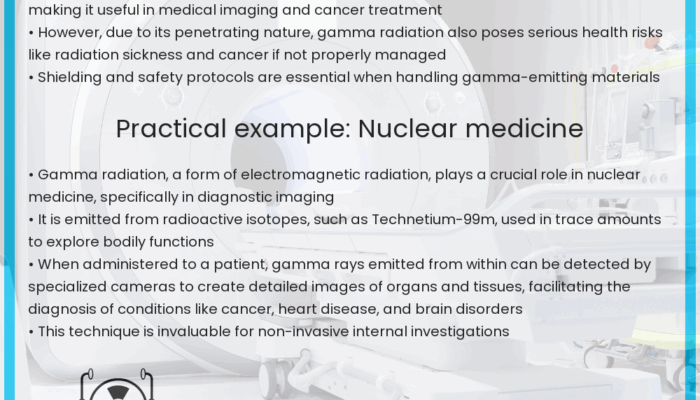
Gamma radiation plays a vital role across various scientific and technological fields due to its penetrating power and energy characteristics.
- Medical Therapy:
Gamma rays are employed in radiotherapy to target and destroy cancerous cells with precision, minimizing damage to surrounding healthy tissue. - Sterilization:
Their ability to kill bacteria and viruses makes gamma rays useful for sterilizing medical instruments and food products. - Astrophysics:
Gamma radiation provides insights into cosmic phenomena such as supernovae, pulsars, and black holes, revealing processes occurring in extreme environments. - Security and Detection:
Gamma photons emitted by radioactive sources are utilized in scanning and detection technologies, though uncontrolled exposure poses health risks.
Quantum Perspective on Gamma Emission
At the microscopic level, gamma emission exemplifies the quantum nature of nuclear transitions. After a nucleus undergoes decay, residual excitation energy is released almost instantaneously as a gamma photon, ensuring the nucleus attains its ground state. This emission embodies the conservation of energy principle and the discrete quantization of nuclear energy levels.
Additionally, gamma photons can arise from matter-antimatter annihilation events, where the collision of particles and antiparticles produces high-energy photons. Although less common than nuclear decay sources, these events further illustrate the fundamental electromagnetic character of gamma radiation.
Common Misconceptions About Gamma Radiation
Gamma radiation involves the emission of particles like alpha or beta radiation.
Gamma radiation consists of photons, which are massless and chargeless electromagnetic quanta, not particles with mass.
Gamma rays are uniform in energy.
Gamma radiation spans a spectrum of energies unique to each radioactive isotope, allowing for precise identification.
Gamma radiation is always harmful.
While gamma rays can be dangerous in uncontrolled exposure, they are also harnessed beneficially in medicine, industry, and scientific research.
Importance of Gamma Radiation in Science and Daily Life
Gamma radiation holds profound significance due to its unique physical properties and diverse applications. Its penetrating ability enables non-invasive medical treatments and sterilization processes, while its spectral characteristics provide a window into nuclear and cosmic phenomena. Understanding gamma radiation enriches our grasp of quantum mechanics, nuclear physics, and electromagnetic theory, bridging abstract scientific concepts with practical technologies that impact health, security, and exploration of the universe.
The dual nature of gamma rays-as both a powerful tool and a potential hazard-underscores the necessity for informed handling and respect. Their invisible yet potent presence continues to inspire scientific inquiry and technological innovation, reflecting the intricate interplay between energy, matter, and the fundamental forces shaping our world.



Leave a Reply