
Short Answer
Definition of Fundamental Particles
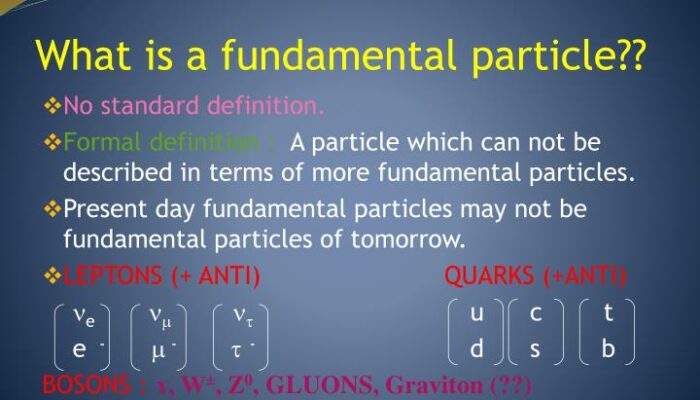
Fundamental particles are often regarded as the most basic constituents of the universe, serving as the essential building blocks from which all matter and forces arise. Unlike everyday objects composed of atoms and molecules, these particles are elementary, meaning they are not made up of smaller components. They are broadly classified into two categories: fermions and bosons, each playing distinct roles in the fabric of reality.
- Fermions:
These particles form the matter that makes up the physical world. Examples include quarks and leptons. Quarks combine to create protons and neutrons, which are the core components of atomic nuclei, while leptons, such as electrons and neutrinos, are crucial to atomic structure and various physical processes. - Bosons:
These particles act as force carriers, mediating the fundamental interactions between matter particles. Photons, W and Z bosons, gluons, and the Higgs boson are examples of bosons, each associated with a specific fundamental force.
The Standard Model and Fundamental Forces
The Standard Model of particle physics is the comprehensive theoretical framework that describes the behavior and interactions of fundamental particles. It identifies four fundamental forces that govern these interactions:
- Electromagnetic Force: Mediated by photons, this force acts between charged particles and is responsible for electricity, magnetism, and light.
- Weak Nuclear Force: Carried by W and Z bosons, it governs processes like radioactive decay and nuclear fusion.
- Strong Nuclear Force: Gluons mediate this force, which binds quarks together within protons and neutrons, and holds atomic nuclei intact.
- Gravitational Force: Although not yet fully integrated into the Standard Model, gravity influences particles with mass and shapes the large-scale structure of the universe.
Energy, Mass, and Quantum Fields
One of the most profound insights in modern physics is the equivalence of energy and mass, encapsulated in Einstein’s famous equation, E=mc². This principle reveals that fundamental particles are not simply “material” objects but rather manifestations of energy fluctuations within quantum fields that permeate space-time.
Particles can be understood as excitations or disturbances in these underlying fields. Their intrinsic properties-such as mass, charge, and spin-arise from how they interact with these fields. This perspective shifts the notion of “what particles are made of” from a tangible substance to dynamic energy patterns governed by quantum mechanics.
The Role of the Higgs Field and Mass Generation
The Higgs boson and its associated field are central to explaining how particles acquire mass. The Higgs field exists throughout the universe, and as fundamental particles move through it, they experience a form of resistance, analogous to moving through a viscous medium. This interaction imparts mass to particles, transforming them from massless energy excitations into entities with measurable mass.
This mechanism challenges traditional ideas of mass as a fixed, inherent property and instead presents it as a relational attribute emerging from particle-field interactions.
Wave-Particle Duality and the Nature of Reality
At the quantum level, fundamental particles exhibit dual characteristics, behaving both as discrete particles and as waves. This wave-particle duality means that particles are better described by probability distributions rather than fixed points in space. Such behavior complicates the classical understanding of “material” and invites philosophical reflection on the essence of existence and substance.
Advanced Theories and Unresolved Mysteries
Beyond the Standard Model, emerging theories like supersymmetry propose the existence of additional particles that could unify the fundamental forces and shed light on enigmatic phenomena such as dark matter. Dark matter, which constitutes about 27% of the universe’s mass-energy content, remains undetected directly but is inferred from gravitational effects on visible matter.
These theories suggest a deeper, more intricate structure underlying the known particles and forces, hinting at a universe far more complex than previously imagined.
Experimental Exploration: Particle Accelerators
To probe the properties and interactions of fundamental particles, scientists employ powerful instruments like the Large Hadron Collider (LHC). By accelerating particles to near-light speeds and colliding them, these experiments recreate conditions similar to those just after the Big Bang, allowing researchers to observe rare phenomena and test theoretical predictions.
Such experimental efforts have confirmed many aspects of the Standard Model and continue to push the boundaries of our understanding, potentially revealing new physics beyond current models.
Philosophical Implications and the Quest for Understanding
The study of fundamental particles transcends pure physics, touching on profound philosophical questions about the nature of reality, existence, and the limits of human knowledge. As we delve deeper into the subatomic world, we confront the paradoxes of quantum mechanics and the challenge of defining what it means for something to “exist” or to be “made of” anything at all.
This ongoing inquiry inspires both scientific curiosity and a sense of wonder at the intricate and elegant design of the cosmos.
Summary: The Essence of Fundamental Particles
Fundamental particles defy simple categorization as traditional matter. They embody a dual nature of energy and mass, governed by the principles of the Standard Model and shaped by interactions with fields like the Higgs field. Understanding these particles involves exploring their properties, forces, and quantum behaviors, which collectively challenge and enrich our conception of the universe’s material foundation.
FAQ
What are fundamental particles?
Fundamental particles are the smallest known constituents of matter and forces, not composed of smaller parts.
How do fundamental particles gain mass?
They gain mass through their interaction with the Higgs field, which imparts resistance and converts energy excitations into particles with mass.
What is the Standard Model?
It is the comprehensive theory describing fundamental particles and their interactions via fundamental forces, except gravity.
What roles do fermions and bosons play?
Fermions make up matter, while bosons mediate forces between matter particles.
Are fundamental particles made out of any material?
No, they are manifestations of energy within quantum fields rather than traditional material substances.






Leave a Reply