
Short Answer
Definition of Atomic Mass and Its Measurement
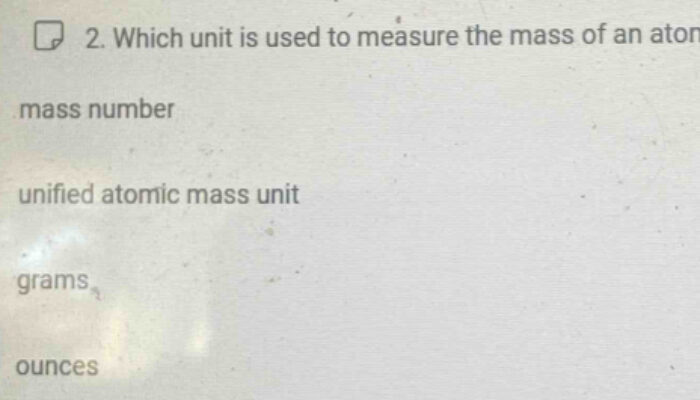
Atomic mass refers to the quantity of matter contained within a single atom, encompassing the combined mass of its protons, neutrons, and electrons. Due to the extraordinarily small scale of atoms, conventional units like grams or kilograms are impractical for expressing atomic mass. Instead, scientists utilize a specialized unit known as the atomic mass unit (amu), which provides a standardized and relative scale for measuring atomic masses across different elements and isotopes.
Historical Background and the Carbon-12 Standard
The atomic mass unit was established as one twelfth of the mass of a carbon-12 atom, a choice rooted deeply in the history of chemistry and physics. This standard emerged in the early 20th century to create a consistent reference point for comparing atomic masses. Carbon-12 was selected because of its universal abundance and central role in organic chemistry, making it an ideal benchmark for atomic mass measurements.
- Carbon-12 as a Reference:
The mass of one carbon-12 atom is divided by twelve to define the atomic mass unit, simplifying calculations and providing a relatable standard for scientists. - Isotopic Averaging:
Atomic masses of elements are expressed as weighted averages of all naturally occurring isotopes, reflecting their relative abundances.
Structure of Atoms and the Need for Atomic Mass Units
Atoms consist of a nucleus containing protons and neutrons, surrounded by electrons. While electrons have negligible mass compared to nucleons, the combined mass of protons and neutrons defines the atom’s mass. Measuring this mass directly in everyday units is challenging due to the atom’s minuscule size, necessitating the use of the atomic mass unit to provide a manageable and meaningful scale.
Role of Atomic Mass Units in Nuclear Physics and Energy
The atomic mass unit is crucial in understanding nuclear processes such as fusion and fission. In these reactions, tiny differences in atomic mass correspond to significant energy changes, as described by Einstein’s equation E=mc². This relationship highlights the importance of precise atomic mass measurements in fields like astrophysics, nuclear energy, and quantum mechanics, where mass-energy equivalence governs fundamental phenomena.
Advancements in Measurement Techniques
Technological progress, particularly the development of mass spectrometry, has dramatically enhanced the precision of atomic mass measurements. This technique allows scientists to distinguish between isotopes with exceptional accuracy, facilitating applications in diverse areas such as geological dating, environmental tracing, and medical diagnostics.
Unified Atomic Mass Unit and International Standardization
To promote global consistency, the International System of Units (SI) adopted the Unified Atomic Mass Unit (symbolized as u), which is equivalent in value and dimension to the traditional amu. This change reflects the scientific community’s commitment to standardized terminology and collaborative research efforts worldwide.
Isotopes and Variations in Atomic Mass
Isotopes are variants of the same element that share the same number of protons but differ in neutron count, resulting in distinct atomic masses. These differences have practical implications in various scientific disciplines:
- Radiometric Dating:
Isotopic mass differences enable the determination of the age of rocks and fossils. - Medical Imaging:
Certain isotopes are used as tracers or treatment agents due to their unique mass and nuclear properties.
Significance of Atomic Mass in Science and Everyday Life
Understanding atomic mass is fundamental to grasping the nature of matter and its interactions. It influences chemical reactions, molecular composition, and the behavior of materials at the atomic level. The atomic mass unit serves as a critical tool for scientists to quantify and compare atomic properties, thereby advancing research in chemistry, physics, biology, and beyond.
Conclusion: The Enduring Importance of the Atomic Mass Unit
The atomic mass unit remains an indispensable metric in the scientific exploration of the microscopic world. By anchoring atomic mass measurements to the carbon-12 standard, scientists have established a coherent framework that continues to evolve with new discoveries and technologies. As research delves deeper into quantum realms and atomic interactions, the atomic mass unit will persist as a foundational element in decoding the complexities of the universe.
FAQ
What is the atomic mass unit (amu)?
The atomic mass unit (amu) is a unit of mass used to express atomic and molecular weights, defined as one twelfth of the mass of a carbon-12 atom.
Why is carbon-12 used as the standard for atomic mass?
Carbon-12 is used as the standard because of its universal abundance and central role in organic chemistry, providing a consistent and practical reference for atomic mass measurements.
How do isotopes affect atomic mass?
Isotopes are atoms of the same element with different numbers of neutrons, resulting in variations in atomic mass, which are accounted for as weighted averages in atomic mass calculations.
What role does the atomic mass unit play in nuclear physics?
The atomic mass unit helps quantify mass differences in nuclear reactions like fusion and fission, which correspond to significant energy changes described by Einstein’s equation E=mc².
How has technology improved the measurement of atomic mass?
Advancements such as mass spectrometry have increased the precision of atomic mass measurements by enabling accurate differentiation between isotopes.





Leave a Reply