
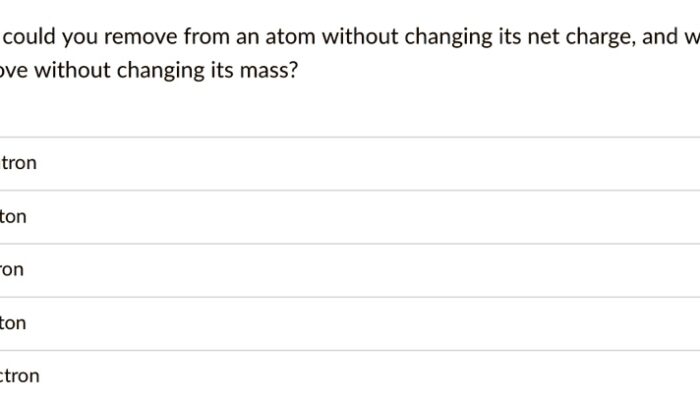
Short Answer
Definition of Subatomic Particles
Atoms are composed of three primary subatomic particles: protons, neutrons, and electrons. Each of these particles plays a distinct role in defining the atom’s characteristics and behavior.
- Protons:
Located in the nucleus, protons carry a positive electrical charge and determine the atomic number, which defines the element. - Neutrons:
Also found in the nucleus, neutrons have no electrical charge and contribute to the atom’s mass, influencing isotopic variations. - Electrons:
Negatively charged particles that orbit the nucleus in defined energy levels, electrons are crucial in chemical reactions and electrical phenomena.
Electron Positioning and Atomic Structure
Electrons exist in a probabilistic cloud surrounding the nucleus, governed by quantum mechanics. Their arrangement in discrete energy levels or shells determines how tightly they are held by the atom. This spatial distribution and the associated electron affinity explain why electrons are more readily removed compared to protons and neutrons, which are confined within the nucleus by strong nuclear forces.
Ionization Energy and Electron Removal
Ionization energy refers to the amount of energy necessary to detach an electron from an atom. Atoms with lower ionization energies lose electrons more easily, facilitating the formation of ions and influencing chemical reactivity.
- Alkali Metals:
These elements have a single electron in their outermost shell, resulting in low ionization energies and a strong tendency to form positively charged ions (cations). - Example – Sodium (Na):
Sodium readily loses its lone valence electron to become Na+, a process that underlies its metallic properties and its role in ionic bonding.
Challenges in Removing Protons and Neutrons
Unlike electrons, protons and neutrons are tightly bound within the nucleus by the strong nuclear force, which is one of the most powerful forces in nature but acts over very short distances. Altering the number of protons changes the element itself, while changing neutrons results in different isotopes. This nuclear stability makes the removal of these particles significantly more difficult than removing electrons.
Electrons in Chemical Bonding
Electrons are fundamental to chemical bonding, either by being shared or transferred between atoms. Their mobility and ease of removal or sharing enable the formation of various types of bonds:
- Covalent Bonds:
Atoms share electrons to form molecules, creating stable chemical compounds. - Ionic Bonds:
Electrons are transferred from one atom to another, resulting in oppositely charged ions that attract each other.
Role of Electrons in Electricity and Magnetism
Electrons are the primary charge carriers in electrical conduction. In conductive materials like metals, electrons move freely under the influence of an electric field, enabling the flow of electric current. Protons and neutrons, confined to the nucleus, do not contribute to electrical conductivity. This electron mobility is fundamental to the operation of countless electrical devices and technologies.
Electron Removal in Plasma and Astrophysics
When atoms lose electrons, they become ionized, forming plasma-a highly energized state of matter often described as the fourth state. Plasma is prevalent in stars, including the Sun, where extreme temperatures strip electrons from nuclei. Understanding electron removal in these contexts is essential for astrophysical research and modeling cosmic phenomena.
Technological Applications of Electron Manipulation
The ability to control electron removal is critical in modern technology. It underpins the functioning of semiconductors, which are the foundation of electronic devices, and plays a role in medical technologies such as radiation therapies. Mastery over electron dynamics allows scientists and engineers to innovate and improve materials and devices that impact everyday life.
Summary: Importance of Electron Removal
While protons and neutrons provide the structural core of atoms, electrons occupy a more accessible region around the nucleus, making them the easiest subatomic particles to remove. This characteristic is central to many scientific phenomena, including chemical bonding, electrical conductivity, and plasma formation. The electron’s unique position and behavior not only define the nature of matter but also enable a wide array of technological advancements that shape our understanding and interaction with the universe.
FAQ
What is the easiest particle to remove from an atom?
Electrons are the easiest particles to remove from an atom due to their location in the electron cloud and relatively low ionization energy.
Why are protons and neutrons harder to remove from an atom?
Protons and neutrons are tightly bound within the nucleus by the strong nuclear force, making them much harder to remove than electrons.
How does ionization energy affect electron removal?
Ionization energy is the energy required to remove an electron from an atom; atoms with lower ionization energies lose electrons more easily.
What role do electrons play in chemical bonding?
Electrons participate in chemical bonding by being shared in covalent bonds or transferred in ionic bonds, facilitating molecule formation.






Leave a Reply