
Short Answer
Definition of the Atom and Atomic Theory
The atom is widely recognized as the fundamental unit of matter, serving as a cornerstone concept in both physics and chemistry. Atomic theory, far from being a mere speculative idea, constitutes a well-substantiated scientific framework that explains the composition and behavior of matter at the smallest scale. This theory provides a detailed understanding of how atoms form the basis of all substances and interact to create the diverse materials observed in nature.
- Atom:
The smallest unit of an element that retains its chemical properties, composed of subatomic particles such as protons, neutrons, and electrons. - Atomic Theory:
A scientific model developed through empirical evidence and experimentation that describes the structure, properties, and interactions of atoms.
Historical Development of Atomic Theory
The concept of the atom has evolved significantly over centuries, shaped by the contributions of numerous scientists who refined our understanding of matter’s fundamental nature.
- John Dalton (Early 19th Century):
Proposed that matter consists of indivisible atoms, each element having unique atoms that combine in fixed ratios to form compounds. This laid the groundwork for stoichiometry and chemical reactions. - J.J. Thomson (1897):
Discovered the electron, revealing that atoms are not indivisible but contain smaller charged particles, leading to the “plum pudding” model of atomic structure. - Ernest Rutherford (1911):
Conducted the gold foil experiment, demonstrating that atoms have a dense, positively charged nucleus surrounded by electrons, overturning previous models. - Niels Bohr (1913):
Introduced the idea of quantized electron orbits, explaining atomic emission spectra and advancing the quantum model of the atom.
Scientific Principles Underlying Atomic Theory
Atomic theory is grounded in rigorous scientific methodology, combining observation, experimentation, and mathematical modeling to describe atomic behavior.
- Empirical Evidence:
Atomic theory is supported by extensive experimental data, including spectroscopy, particle scattering, and quantum measurements. - Quantum Mechanics:
Provides a mathematical framework explaining electron behavior, energy quantization, wave-particle duality, and uncertainty principles within atoms. - Subatomic Particles:
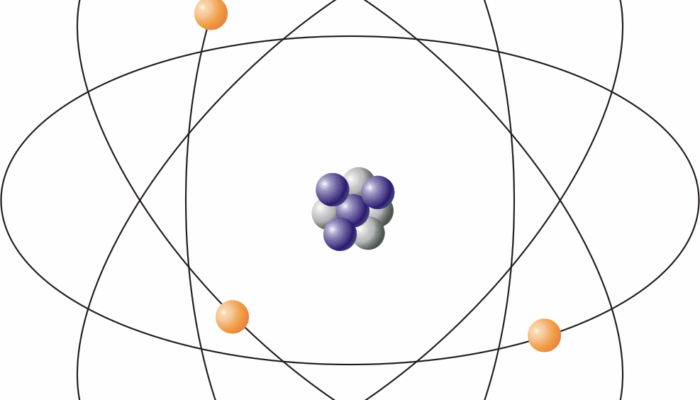
Atoms consist of protons and neutrons in the nucleus, with electrons occupying probabilistic orbitals around it.
Mathematical Framework of Atomic Theory
The behavior and properties of atoms are described using mathematical equations derived from quantum mechanics and classical physics.
- Schrödinger Equation:
A fundamental equation that predicts the probability distribution of an electron’s position within an atom. - Energy Quantization:
Electrons occupy discrete energy levels, described by quantum numbers, which determine atomic spectra and chemical properties. - Atomic Number (Z):
Represents the number of protons in the nucleus, defining the element’s identity. - Mass Number (A):
The total number of protons and neutrons, indicating the isotope of the element.
Applications and Real-World Significance
Atomic theory is integral to numerous scientific and technological fields, influencing both theoretical research and practical innovations.
- Chemistry:
Enables understanding of chemical bonding, reactions, and molecular structures essential for material science and pharmaceuticals. - Physics:
Underpins nuclear physics, particle physics, and the study of fundamental forces, contributing to energy production and advanced technologies. - Technology:
Atomic-level manipulation is crucial in semiconductor design, nanotechnology, and the development of electronic devices. - Environmental Science:
Helps analyze atmospheric chemistry, pollutant behavior, and climate change mechanisms through atomic interactions.
Common Misunderstandings About Atomic Theory
- Misconception: The atom is “just a theory,” implying it is unproven or speculative.
Correction: In scientific terms, a theory is a well-supported explanation based on evidence, not a guess. Atomic theory is one of the most rigorously tested and validated models in science. - Misconception: Atoms are indivisible and static.
Correction: Atoms are composed of smaller particles and exhibit dynamic behavior governed by quantum mechanics.
Importance of Atomic Theory in Modern Science and Society
Atomic theory is foundational to our comprehension of the universe, enabling advancements that shape modern life and scientific progress. It provides the framework for exploring the microcosm of particles and the macrocosm of cosmic phenomena, bridging gaps between disciplines and fostering innovation.
Its role extends beyond academia, influencing medicine, energy, environmental policy, and technology development. By understanding atomic interactions, scientists and engineers can design new materials, develop targeted drugs, harness nuclear energy, and address environmental challenges, demonstrating the theory’s profound and practical impact.
Philosophical and Scientific Reflections on Atomic Theory
Exploring atomic theory also invites deeper contemplation about the nature of reality, determinism, and the limits of human knowledge. Quantum mechanics, emerging from atomic studies, challenges classical intuitions and introduces concepts such as uncertainty and duality, prompting ongoing inquiry into the fundamental workings of the universe.
This intellectual journey underscores the value of theoretical frameworks in science-not as static truths but as evolving models that expand our understanding and inspire continuous exploration.
FAQ
Why is the atom considered a theory?
The term ‘theory’ in science refers to a well-supported explanation based on evidence. Atomic theory is a rigorously tested scientific model explaining the nature and behavior of atoms.
What are the main components of an atom?
An atom is composed of protons and neutrons in the nucleus, with electrons occupying orbitals around the nucleus.
How has atomic theory evolved over time?
Atomic theory has evolved through key contributions from scientists like John Dalton, J.J. Thomson, Ernest Rutherford, and Niels Bohr, refining our understanding of atomic structure and behavior.
What role does quantum mechanics play in atomic theory?
Quantum mechanics provides the mathematical framework explaining electron behavior, energy quantization, and wave-particle duality within atoms.
What are common misconceptions about atomic theory?
Common misconceptions include thinking that atoms are indivisible or that theories are mere guesses. In reality, atoms consist of smaller particles and atomic theory is a well-substantiated scientific framework.





Leave a Reply