
Short Answer
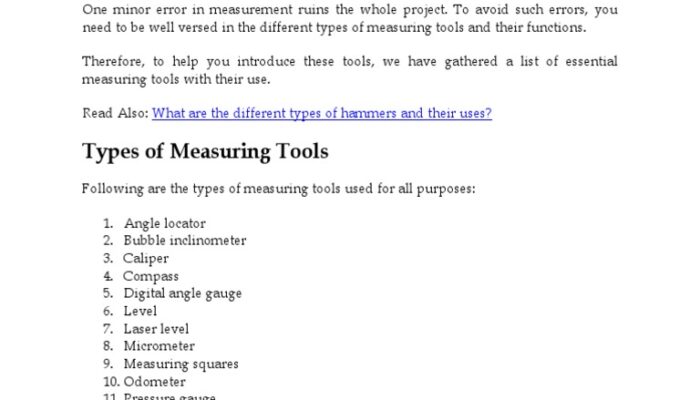
Definition of Measuring Tools
Measuring tools are essential devices used across scientific, engineering, and everyday contexts to quantify various physical properties. These instruments enable the precise determination of attributes such as length, mass, volume, and temperature, transforming abstract concepts into concrete, measurable data. By providing accuracy and consistency, measuring tools form the foundation for empirical research and technological development.
Historical and Linguistic Background
The word “measure” originates from the Latin term mensura, meaning the act of assessing dimensions. This etymology highlights the fundamental role of measurement in numerous disciplines, where quantification ensures reliability and exactness. Measuring tools can be viewed as extensions of human perception, enhanced by mathematical frameworks and scientific principles that allow us to detect and evaluate characteristics beyond natural sensory capabilities.
Classification of Measuring Tools
Measuring instruments can be grouped based on their specific applications and the types of quantities they assess:
- Linear Measurement:
Tools such as rulers, tape measures, and calipers are widely used to determine length or distance. These devices are common in educational, industrial, and domestic environments due to their straightforward operation and high accuracy. - Volumetric Measurement:
Instruments like graduated cylinders, pipettes, and burettes are indispensable in chemistry and biology for measuring liquid volumes precisely, ensuring experimental reproducibility. - Temperature Measurement:
Thermometers, including traditional mercury types and modern digital variants, measure thermal conditions. Infrared thermometers have further advanced this field by allowing non-contact temperature readings, enhancing safety and convenience. - Mass Measurement:
Scales and balances quantify mass by comparing unknown weights to known standards or by measuring gravitational forces acting on objects. Digital scales are prevalent in laboratories and commercial settings where precision is critical.
Technological Evolution of Measuring Instruments
Technological progress has significantly refined traditional measuring tools, introducing devices with enhanced precision and functionality. For example, laser distance meters have largely supplanted tape measures in professional fields such as architecture, construction, and surveying. These instruments employ laser technology to deliver highly accurate distance measurements, revolutionizing spatial assessment practices.
Measuring Abstract Phenomena
Beyond physical quantities, measuring tools also extend into intangible domains. Psychometrics, for instance, utilizes specialized instruments to quantify cognitive abilities and emotional states. These tools are vital in educational testing and psychological diagnostics, demonstrating how measurement transcends material properties to explore complex human behaviors.
Principles of Measurement: Accuracy and Precision
Understanding measurement involves distinguishing between two key concepts:
- Accuracy:
The closeness of a measurement to the true or accepted value. - Precision:
The consistency or repeatability of measurements under unchanged conditions.
This distinction is crucial for scientists and engineers, as it influences the interpretation of data and the management of uncertainty and error, which are inherent challenges in all measurement processes.
Ethical and Practical Considerations
The use of measuring tools carries ethical responsibilities, especially in sensitive areas like medical diagnostics and environmental monitoring. Proper calibration, maintenance, and data integrity are essential to prevent errors that could have significant societal consequences. Accountability in measurement practices ensures trustworthiness and reliability in the information produced.
Cultural and Historical Significance
Measuring tools also reflect the intellectual and cultural contexts of their times. Ancient civilizations, such as the Egyptians, developed unique units like the cubit for monumental construction, while Renaissance scholars crafted intricate astronomical instruments. These artifacts not only served practical purposes but also embodied the scientific knowledge and cultural values of their eras.
Future Trends: Integration of Digital and Smart Technologies
The convergence of traditional measurement methods with digital innovation is shaping the future of measuring tools. Incorporating artificial intelligence and connectivity features, smart measuring devices promise to enhance accuracy, automate data collection, and facilitate real-time analysis. This integration is poised to transform scientific research and practical applications by enabling more comprehensive and interactive measurement systems.
Conclusion: The Enduring Importance of Measuring Tools
Measuring tools are far more than simple instruments; they are critical frameworks that underpin our pursuit of knowledge and understanding. By enabling the quantification of relationships between measurable phenomena, these tools support advancements across diverse fields. Their ongoing evolution mirrors technological progress and challenges us to rethink our engagement with measurement and reality. As we continue to explore the universe, measuring tools will remain indispensable in uncovering new dimensions of insight.
FAQ
What are measuring tools?
Measuring tools are devices used to quantify physical properties such as length, mass, volume, and temperature.
How have measuring tools evolved?
Technological advancements have led to the development of more precise instruments, such as laser distance meters and digital thermometers.

Leave a Reply