
Short Answer
Definition of the Kondo Problem
The Kondo problem is a complex and intriguing phenomenon in condensed matter physics that arises from the interaction between localized magnetic moments-often due to impurity atoms-and conduction electrons within a metallic host. This interaction, though seemingly straightforward, leads to a variety of subtle and rich physical effects, making the Kondo problem a central topic of study in understanding electron correlations and quantum many-body systems.
Fundamental Phenomenon: The Kondo Effect
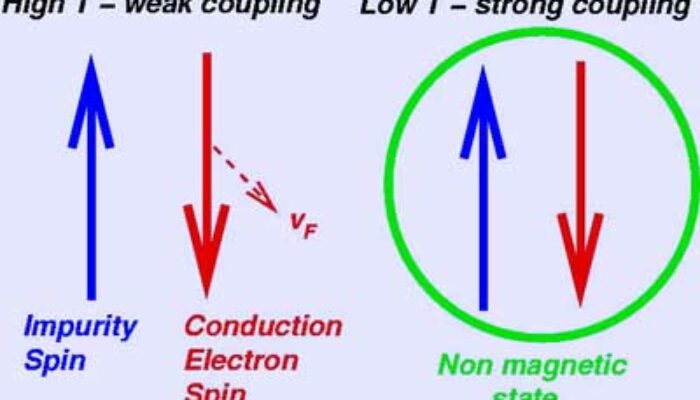
At the heart of the Kondo problem lies the Kondo effect, a counterintuitive behavior where the electrical resistivity of certain metals containing magnetic impurities increases as the temperature decreases. This observation contradicts classical expectations, which predict that resistivity should fall with cooling due to diminished electron scattering. The Kondo effect reveals how the hybridization between conduction electrons and localized spins alters the metal’s transport properties, highlighting the role of quantum fluctuations and many-body interactions.
Renormalization Group Insights and Low-Temperature Behavior
A key feature of the Kondo problem is its description through renormalization group (RG) analysis, which provides profound understanding of how the coupling between impurity spins and conduction electrons evolves with energy scale. Initially weak interactions become stronger as the system is probed at lower energies, culminating in a logarithmic increase in resistivity at low temperatures. This behavior exemplifies the emergence of collective phenomena in quantum many-body systems, where interactions among numerous particles give rise to complex macroscopic effects.
Theoretical Framework: The Kondo Model
Proposed by Jun Kondo in 1964, the Kondo model offers a simplified yet powerful Hamiltonian to describe the interaction between a single localized spin and a sea of conduction electrons. The model’s Hamiltonian includes terms representing the kinetic energy of conduction electrons and an exchange interaction coupling the electrons to the impurity spin. Due to the absence of an exact analytic solution, advanced computational techniques such as the numerical renormalization group (NRG) have become essential tools for exploring the model’s intricate behavior.
Variants of the Kondo Effect
The manifestations of the Kondo effect vary depending on the nature of the magnetic impurity involved:
- Spin-½ Kondo Model:
This is the simplest and most studied case, involving a single localized spin-½ impurity interacting with conduction electrons. - Multi-Channel Kondo Effect:
When multiple conduction electron channels couple to a higher-spin impurity, the system exhibits more complex behavior, including non-Fermi liquid ground states and fractionalized excitations.
Each variant introduces unique challenges and enriches the theoretical landscape of the Kondo problem.
Physical Properties Influenced by the Kondo Effect
Beyond resistivity, the Kondo effect significantly impacts other physical quantities:
- Specific Heat:
Near absolute zero, the specific heat associated with Kondo interactions shows an unusual linear temperature dependence, indicative of conformally invariant ground states. - Magnetic Susceptibility:
The susceptibility exhibits anomalous temperature dependence due to the screening of impurity spins by conduction electrons. - Spin Dynamics:
The interplay between localized spins and conduction electrons leads to complex spin fluctuation phenomena.
These properties provide deeper insight into low-energy excitations and quantum criticality in correlated electron systems.
Kondo Effect in Quantum Dots
Quantum dots-nanoscale semiconductor structures confining electrons in all three spatial dimensions-offer a controlled environment to study the Kondo effect on a miniature scale. In these systems, localized quantum states interact with conduction electrons, reproducing Kondo-like phenomena observed in bulk metals. Investigations of quantum dots in the Kondo regime have advanced understanding of quantum coherence, entanglement, and have implications for the development of quantum computing technologies.
Connections to Topological Insulators and Emergent Phenomena
The Kondo problem also intersects with the study of topological insulators, materials characterized by robust surface states protected by topological order. The interplay between Kondo physics and topological states enriches the exploration of many-body localization, quantum entanglement, and emergent quantum criticality, highlighting the Kondo effect’s relevance in cutting-edge condensed matter research.
Significance and Applications of the Kondo Problem
The Kondo problem is not only a theoretical cornerstone but also a phenomenon with broad practical implications. By challenging classical views on electron scattering and conductivity, it has reshaped our understanding of correlated electron systems. Its influence spans materials science, nanoscale device engineering, and quantum information science, making it a vital subject for both fundamental research and technological innovation.
Common Misconceptions About the Kondo Effect
Resistivity always decreases as temperature lowers.
In metals with magnetic impurities, resistivity can increase at low temperatures due to the Kondo effect.
The Kondo effect only occurs in bulk metals.
The effect also appears in nanoscale systems like quantum dots, demonstrating its universality.
Summary
The Kondo problem exemplifies the intricate quantum mechanical interactions that govern electron behavior in metals with magnetic impurities. Through the Kondo effect, physicists gain valuable insights into electron spin interactions, anomalous resistivity trends, and many-body correlations. Studying this problem illuminates fundamental aspects of quantum physics and continues to inspire advances in condensed matter theory and applications, underscoring the enduring importance of localized magnetic moments in conductive environments.
FAQ
What causes the Kondo effect?
It is caused by the interaction between localized magnetic impurity spins and conduction electrons in a metal.
Why does resistivity increase at low temperatures in the Kondo problem?
Because the coupling between impurity spins and conduction electrons strengthens at low temperatures, leading to enhanced electron scattering.
What are some variants of the Kondo effect?
Variants include the spin-½ Kondo model and the multi-channel Kondo effect involving higher-spin impurities and multiple conduction channels.
How does the Kondo effect relate to quantum dots?
Quantum dots can exhibit Kondo-like behavior, allowing controlled studies of electron interactions on a nanoscale.



Leave a Reply