
Short Answer
Definition
Mathematics and computer science are two distinct yet interconnected disciplines that play crucial roles in technology, science, and engineering. While they share some foundational elements, each field possesses unique characteristics, methodologies, and objectives. Understanding their differences helps clarify their individual contributions and applications.
Historical Background and Core Essence
Mathematics: Originating from ancient efforts to quantify and interpret the natural world, mathematics is fundamentally concerned with abstract structures, relationships, and logical reasoning. It aims to uncover universal truths through axioms, theorems, and rigorous proofs, emphasizing theoretical exploration over practical application.
Computer Science: Emerging in the mid-20th century alongside the development of electronic computers, computer science focuses on the study of algorithms, data structures, and computational processes. Although it draws on mathematical theory, its primary goal is to design and implement practical solutions to real-world problems.
Domains and Theoretical Foundations
Mathematical Branches: Mathematics encompasses diverse fields such as algebra, calculus, topology, and number theory. These areas investigate abstract concepts-like the properties of space in topology or the nature of integers in number theory-often without immediate concern for practical use.
Computer Science Subfields: Computer science includes specialties like algorithms, programming languages, artificial intelligence, and hardware design. While these areas incorporate mathematical principles, they emphasize practical efficiency, optimization, and real-world applicability, such as improving algorithmic performance.
Approaches to Problem Solving
Mathematicians primarily utilize deductive reasoning, constructing proofs and counterexamples to establish broad, generalized theories. Their work is grounded in logical rigor and abstraction.
In contrast, computer scientists blend deductive and inductive reasoning, valuing both theoretical validation and empirical testing. Their problem-solving often involves designing, implementing, and refining algorithms or systems to ensure they function effectively in practical environments.
Practical Applications and Industry Impact
Mathematics: The discipline underpins numerous scientific and economic fields, including physics, engineering, finance, and economics. Mathematicians develop models to describe phenomena such as population dynamics or particle behavior, providing foundational insights that support applied research.
Computer Science: This field has transformed industries through innovations in software development, cybersecurity, data analytics, and machine learning. Roles like software engineers, data scientists, and systems analysts demonstrate how computer science drives technological progress and everyday digital experiences.
Educational Pathways and Skill Development
Mathematics education emphasizes analytical thinking, proof techniques, and theoretical frameworks, cultivating strong logical reasoning and abstract thought.
Computer science curricula combine theory with hands-on experience, focusing on programming, software engineering, and system design. Students develop skills in coding, algorithm creation, and technical problem-solving, preparing them for applied technological roles.
Interdisciplinary Connections and Collaborative Advances
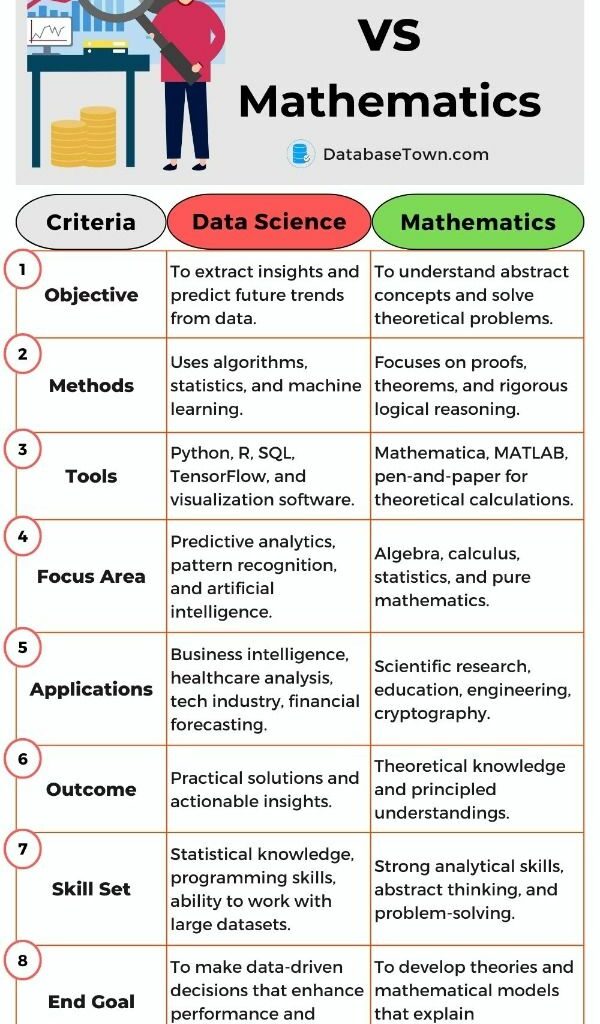
Despite their differences, mathematics and computer science share a deep interrelationship. Mathematical disciplines such as discrete mathematics, linear algebra, and probability theory are foundational to computational methods and algorithm development.
Fields like data science and machine learning exemplify this synergy, integrating mathematical rigor with computational techniques to address complex, data-intensive challenges. Mastery of both areas is often essential for innovation in these interdisciplinary domains.
Common Misconceptions
Mathematics and computer science are the same.
While related, mathematics focuses on abstract theory and proofs, whereas computer science centers on practical algorithm design and system implementation.
Computer science does not require mathematical knowledge.
Many computer science areas rely heavily on mathematical concepts, especially in algorithms, cryptography, and machine learning.
Significance in Modern Society
Both mathematics and computer science are indispensable in advancing technology, scientific understanding, and economic development. Mathematics provides the theoretical foundation for logical reasoning and modeling, while computer science translates these principles into practical tools and innovations that shape the digital world. Together, they empower progress across numerous disciplines and industries.
FAQ
What is the main difference between mathematics and computer science?
Mathematics focuses on abstract theory, while computer science emphasizes practical algorithm design and system implementation.
Can one study computer science without a background in mathematics?
While it is possible, a strong understanding of mathematics is crucial for many areas in computer science, particularly algorithms and data structures.





Leave a Reply