
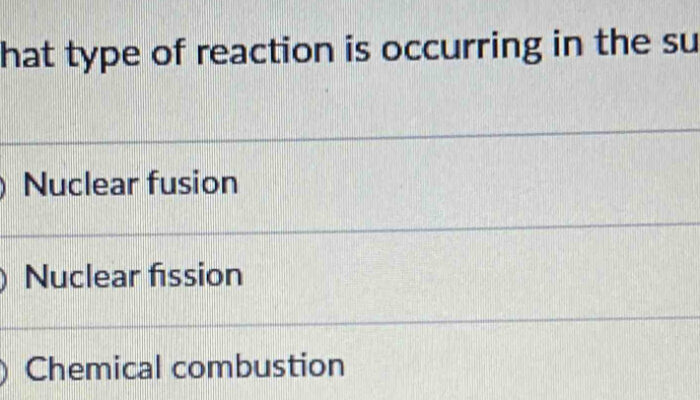
Short Answer
Definition of Nuclear Fusion and Fission
Nuclear fusion is a process where the nuclei of atoms combine to form a heavier nucleus, releasing a significant amount of energy. This contrasts with nuclear fission, where a heavy atomic nucleus splits into two or more smaller nuclei, also releasing energy. While nuclear fission is widely known for its use in nuclear reactors and weapons, it is nuclear fusion that powers the Sun and other stars, driving the energy that sustains life on Earth.
- Nuclear Fusion:
The merging of light atomic nuclei, such as hydrogen, to form heavier elements, accompanied by energy release. - Nuclear Fission:
The splitting of heavy atomic nuclei, like uranium or plutonium, into smaller fragments, releasing energy.
How Nuclear Fusion Powers the Sun
The Sun primarily consists of hydrogen, the universe’s most abundant and simplest element. At its core, extreme temperatures and pressures enable hydrogen nuclei to undergo fusion, forming helium and liberating vast amounts of energy. This energy production is governed by Einstein’s mass-energy equivalence principle, expressed as E=mc², where a tiny amount of mass is converted into energy, fueling the Sun’s radiant light and heat.
The dominant fusion process in the Sun is the proton-proton chain reaction. This multi-stage sequence begins when two protons collide under the Sun’s intense core conditions-temperatures exceeding 15 million degrees Celsius and immense pressure. One proton transforms into a neutron by emitting a positron and a neutrino, creating deuterium, an isotope of hydrogen with one neutron. This step releases energy in the form of gamma rays.
Subsequently, another proton fuses with the deuterium nucleus to produce helium-3, an isotope containing two protons and one neutron, releasing additional energy. The final stage involves the collision of two helium-3 nuclei, resulting in helium-4 (two protons and two neutrons) and the release of a substantial amount of energy, perpetuating the fusion cycle that sustains the Sun’s luminosity.
Mathematical Explanation of Energy Generation
The energy released during fusion is quantitatively described by Einstein’s equation:
E = mc²
- E: Energy produced (joules)
- m: Mass lost during the fusion process (kilograms)
- c: Speed of light in vacuum (~3 x 10⁸ meters/second)
In the Sun’s core, the mass difference between the reactants (hydrogen nuclei) and the products (helium nuclei) is converted into energy, which radiates outward as light and heat.
Stellar Nucleosynthesis and Element Formation
Beyond hydrogen fusion, stars like the Sun contribute to the cosmic creation of heavier elements through stellar nucleosynthesis. Fusion reactions in stellar cores synthesize elements heavier than hydrogen and helium, which are later dispersed into space by stellar winds or supernova explosions. This process enriches the interstellar medium, providing the raw materials for planet formation and the chemical diversity essential for life.
Solar Magnetic Activity and Its Effects
The Sun’s magnetic field, generated by the movement of charged particles in its interior, plays a crucial role in solar phenomena such as solar flares and coronal mass ejections. These events influence Earth’s magnetic environment and atmosphere, affecting satellite operations, communication systems, and even climate patterns. The interplay between solar fusion processes and magnetic activity highlights the complex relationship between the Sun and our planet.
Applications and Future Potential of Nuclear Fusion
Nuclear fusion holds promise as a clean, sustainable energy source for humanity. Unlike fossil fuels, fusion produces minimal radioactive waste and relies on abundant fuels like hydrogen isotopes found in water. Scientific efforts to replicate fusion on Earth involve advanced technologies such as magnetic confinement in tokamaks and inertial confinement using powerful lasers. Success in these endeavors could revolutionize energy production, reducing environmental impact and meeting global energy demands.
Common Misconceptions About Solar Energy Processes
The Sun’s energy comes from nuclear fission.
The Sun’s energy is generated through nuclear fusion, where hydrogen nuclei combine to form helium, not by splitting atoms.
Fusion reactions produce large amounts of radioactive waste.
Fusion produces significantly less radioactive waste compared to fission, making it a cleaner energy source.
Why Understanding Solar Fusion Is Important
Comprehending the nuclear fusion processes within the Sun is vital for multiple scientific fields, including astrophysics, nuclear physics, and environmental science. It enhances our knowledge of stellar lifecycles, the origin of elements, and the dynamics of our solar system. Moreover, mastering fusion technology could provide humanity with a nearly inexhaustible and eco-friendly energy source, addressing critical challenges related to climate change and energy security.
Conclusion: The Sun as a Fusion Powerhouse
While nuclear fission is often mistakenly linked to the Sun’s energy production, it is nuclear fusion that truly fuels our star. This process not only sustains life on Earth by providing light and warmth but also symbolizes human curiosity and the quest for sustainable energy solutions. The ongoing study of solar fusion continues to illuminate our understanding of the universe and holds transformative potential for the future of energy on our planet.
FAQ
What is the difference between nuclear fission and fusion?
Nuclear fission splits heavy atomic nuclei into smaller parts, releasing energy, whereas nuclear fusion combines light nuclei, such as hydrogen, to form heavier nuclei, releasing energy.
How does the proton-proton chain reaction work?
It starts when two protons fuse, forming deuterium, followed by additional reactions producing helium-3 and helium-4, releasing energy at each step.
Why is nuclear fusion important for life on Earth?
Fusion in the Sun produces the energy that provides heat and light, supporting Earth's climate and life forms.
Can nuclear fusion be replicated on Earth?
Scientists are working on replicating fusion through technologies like tokamaks and laser confinement, aiming for a clean energy source.


Leave a Reply