
Short Answer
Definition of the Big Bang
The Big Bang theory describes the origin of the universe as a transition from an extremely hot, dense state to the vast cosmos we observe today. It suggests that approximately 13.8 billion years ago, all matter and energy were concentrated in a singular, infinitesimally small point known as a singularity. Rather than an explosion occurring within space, the Big Bang represents the rapid expansion of space itself, initiating the formation of all cosmic structures.
Fundamental Principles and Mechanism
At the heart of the Big Bang model lies the concept of cosmic inflation-a brief but extraordinarily rapid expansion of space that occurred within fractions of a second after the universe’s inception. This expansion caused every point in the universe to move away from every other point, stretching the fabric of space-time and setting the stage for the gradual development of particles, atoms, stars, galaxies, and eventually life.
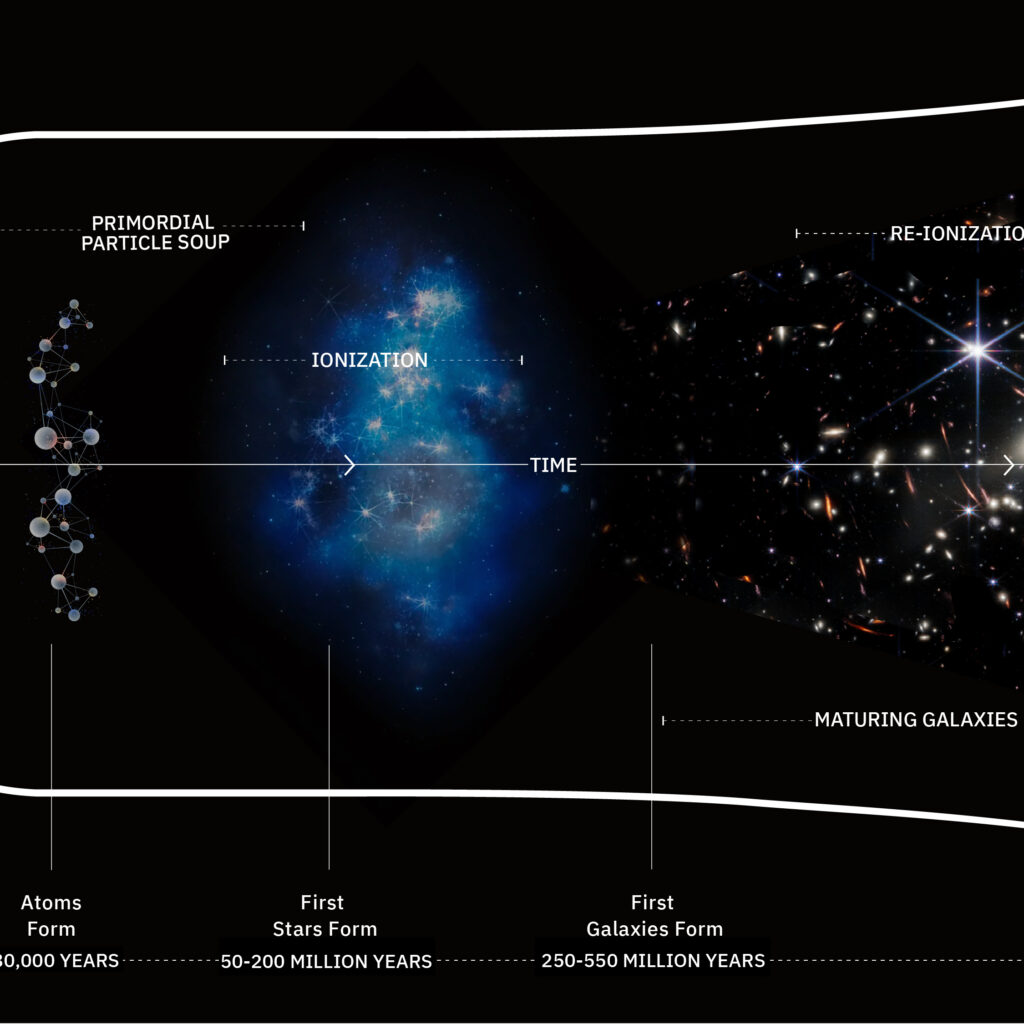
Visual representations often depict the universe’s timeline as a cylindrical or tubular shape, symbolizing the continuous unfolding of time and space. This metaphor helps clarify that the universe is not expanding into an empty void; instead, the dimensions of space themselves are stretching, causing galaxies to recede from one another. This depiction also aligns with our intuitive understanding of time as a linear progression, though the true nature of time and space is far more complex.
Scientific Evidence Supporting the Big Bang
- Cosmic Microwave Background Radiation:
This faint glow of radiation permeates the universe and is considered the residual heat from the early universe, matching predictions made by the Big Bang theory. - Galactic Redshift:
Observations show that distant galaxies are moving away from us, with their light shifted toward the red end of the spectrum, indicating an expanding universe. - Elemental Abundances:
The proportions of light elements such as hydrogen, helium, and lithium observed in the universe correspond closely with theoretical models of nucleosynthesis during the first few minutes after the Big Bang.
Cosmic Fine-Tuning and Structure Formation
The Big Bang also highlights the delicate balance of fundamental forces-gravity, electromagnetism, and the strong and weak nuclear forces-that shaped the universe’s evolution. Slight variations in initial conditions allowed matter to coalesce into galaxies and stars rather than dispersing uniformly or collapsing chaotically. This fine-tuning created an environment conducive to complexity, ultimately enabling the emergence of planetary systems and life.
Philosophical and Existential Implications
The Big Bang captivates not only because of its scientific significance but also due to its profound philosophical resonance. It confronts humanity with questions about the origin of existence, causality, and the nature of time itself. By tracing our cosmic ancestry back to this singular event, we gain a deeper appreciation of our place in the universe and the interconnectedness of all matter, including the atoms that compose our bodies.
Unresolved Questions and Theoretical Frontiers
Despite its robust empirical foundation, the Big Bang theory leaves several mysteries unanswered. What triggered the initial expansion? Is there a meaningful concept of “before” the Big Bang, given that time itself began with this event? Contemporary physics explores these questions through advanced theories involving quantum mechanics, multiverse hypotheses, and the behavior of spacetime at the Planck scale. These investigations push the boundaries of our understanding and challenge the limits of conventional cosmology.
Why Understanding the Big Bang Is Crucial
Grasping the Big Bang’s significance provides essential context for both science and human self-awareness. It situates our existence within a vast, dynamic cosmos shaped by natural laws and cosmic history. This knowledge fosters intellectual humility and inspires ongoing exploration, reminding us that the universe is an ever-evolving story filled with mysteries yet to be uncovered. The Big Bang is not merely a scientific explanation but a gateway to deeper inquiry into the nature of reality and our role within it.
Summary: The Big Bang as a Cosmic Narrative
Far beyond a scientific hypothesis, the Big Bang represents a transformative narrative that redefines our understanding of time, space, and existence. It invites wonder by addressing fundamental questions about origins and destiny while anchoring humanity in a shared cosmic heritage. The theory’s appeal lies in its ability to connect the infinitesimal with the infinite, opening a door to endless curiosity and discovery. Ultimately, the Big Bang story is one of possibility-the emergence of everything from nothing and the enduring human quest to comprehend the universe’s grand design.
FAQ
What is the Big Bang?
The Big Bang is the leading scientific explanation for the origin of the universe, proposing that it began from an extremely hot and dense state and expanded to form the cosmos we know today.
What evidence supports the Big Bang theory?
Key evidence includes the Cosmic Microwave Background Radiation, the observable redshift of distant galaxies, and the abundance of light elements such as hydrogen and helium.
What are the philosophical implications of the Big Bang?
The Big Bang raises profound questions about existence, causality, and the nature of time, prompting deeper reflection on humanity’s place in the universe.

Leave a Reply