

Short Answer
Definition of Quantum Computing
Quantum computing is an innovative computational approach that harnesses the principles of quantum mechanics to process information. Unlike classical computers that use bits as the smallest unit of data, quantum computers utilize quantum bits, or qubits, which can exist in multiple states simultaneously. This capability stems from unique quantum phenomena such as superposition and entanglement, enabling quantum systems to handle complex calculations more efficiently than traditional binary-based machines.
Fundamental Quantum Mechanical Concepts in Computing
The operation of quantum computers is deeply rooted in the core concepts of quantum mechanics:
- Superposition:
This principle allows a qubit to represent both 0 and 1 at the same time, unlike classical bits that are limited to a single state. This multiplicity enables quantum computers to explore many possibilities concurrently. - Entanglement:
When qubits become entangled, the state of one qubit instantly influences the state of another, regardless of the physical distance between them. This interconnectedness is crucial for the enhanced processing power of quantum systems.
These phenomena collectively empower quantum computers to perform calculations at speeds and scales unattainable by classical devices.
Classification of Quantum Computers
Quantum computing devices can be broadly divided into three main categories, each designed for specific computational tasks and leveraging different quantum properties:
- Gate-Based Quantum Computers:
These systems manipulate qubits through quantum gates, analogous to logic gates in classical computing. They implement algorithms such as Shor’s algorithm for integer factorization and Grover’s algorithm for database searching, making them suitable for a wide range of complex problems. - Quantum Annealers:
Specialized for optimization challenges, quantum annealers use quantum tunneling to explore multiple solutions simultaneously, helping to find the global minimum in complex problem spaces. This approach is particularly useful in industries like logistics and finance. - Topological Quantum Computers:
Still largely theoretical, these computers aim to utilize anyons-quasi-particles existing in two-dimensional spaces-to create qubits that are inherently resistant to errors caused by environmental noise, promising greater stability and fault tolerance.
Applications Across Various Fields
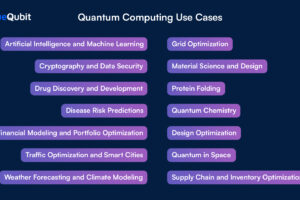
Quantum computing holds transformative potential across multiple domains, including:
- Cryptography:
Quantum algorithms threaten to break many classical encryption methods, necessitating the development of quantum-resistant cryptographic protocols to secure data in the future. - Pharmaceutical Research:
By accurately simulating molecular interactions, quantum computers can accelerate drug discovery processes, reducing both time and costs associated with developing new treatments. - Artificial Intelligence:
Quantum-enhanced machine learning algorithms can process vast datasets more efficiently, potentially leading to breakthroughs in AI capabilities and applications. - Logistics and Supply Chain Management:
Quantum annealing techniques can optimize routing, inventory, and production schedules, significantly improving operational efficiency.
Technical and Practical Challenges
Despite its promise, quantum computing faces several significant obstacles:
- Qubit Coherence:
Qubits are extremely sensitive to external disturbances, which can cause loss of quantum information and computational errors. - Error Correction:
Developing robust quantum error correction methods is essential to build reliable, fault-tolerant quantum computers. - Skill Shortage:
The complexity of quantum theory and technology demands specialized knowledge, creating a gap in qualified professionals capable of advancing the field.
Future Prospects and Industry Impact
The future of quantum computing is poised for significant growth, with ongoing research striving to achieve quantum advantage-the point where quantum devices outperform classical counterparts in practical tasks. As commercial quantum systems emerge, sectors such as finance, healthcare, and supply chain management are beginning to leverage quantum capabilities:
- Financial institutions may use quantum computing to predict market trends with unprecedented precision.
- Personalized medicine could benefit from rapid genetic analysis, enabling tailored treatment plans.
- Supply chains might achieve new levels of efficiency through optimized logistics powered by quantum algorithms.
Common Misconceptions About Quantum Computing
Quantum computers will replace classical computers entirely.
Quantum computers are designed to complement classical systems by solving specific types of problems more efficiently, not to replace them altogether.
Quantum computing is already widely available and practical.
While progress is rapid, fully functional, large-scale quantum computers are still in development and not yet broadly accessible for everyday use.
Significance of Quantum Computing
Quantum computing represents a revolutionary advancement in computational science, with the potential to solve problems currently beyond the reach of classical computers. Its impact spans scientific research, technological innovation, and practical applications, promising to reshape industries and enhance our understanding of complex systems. As the technology matures, it will play a critical role in driving future breakthroughs and addressing global challenges.
FAQ
What is quantum computing?
Quantum computing utilizes quantum bits (qubits) that can exist in multiple states simultaneously, allowing for faster and more complex computations than classical computers.
What are qubits?
Qubits are the basic units of quantum information, capable of representing both 0 and 1 at the same time due to superposition.
What is superposition?
Superposition is a quantum principle where a qubit exists in multiple states simultaneously until measured.
How can quantum computing impact cryptography?
Quantum computers can break many classical encryption methods, prompting the development of quantum-resistant cryptographic techniques.
What is the biggest challenge in quantum computing?
Maintaining qubit coherence and developing effective error correction are major challenges to achieve fault-tolerant quantum computing.


Leave a Reply