
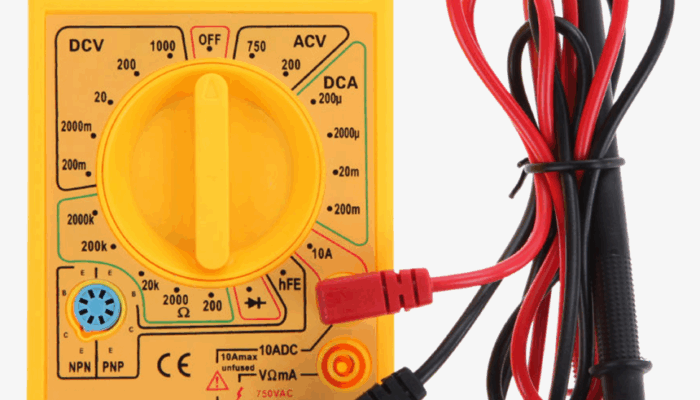
Short Answer
Definition of Resistance and Ohmmeter
Resistance is a fundamental electrical property that quantifies how much a material opposes the flow of electric current. It is measured in ohms (Ω) and plays a crucial role in determining the behavior of electrical circuits. An ohmmeter is a specialized instrument designed to measure this resistance, providing essential data for analyzing and troubleshooting electrical components and systems.
- Resistance:
The opposition to current flow within a conductor or component, influencing how much current passes through at a given voltage. - Ohmmeter:
A device that measures resistance by applying a known current and detecting the resulting voltage drop across the component.
Fundamental Principles: Ohm’s Law and Resistance Measurement
The concept of resistance is deeply rooted in Ohm’s Law, which establishes a direct relationship between voltage (V), current (I), and resistance (R) in an electrical circuit, expressed as V = I × R. This formula allows the calculation of resistance when voltage and current are known. Measuring resistance accurately is vital for engineers and technicians to verify circuit integrity and ensure components function as intended.
How an Ohmmeter Functions
An ohmmeter operates by sending a small, controlled current through the resistor or component under test. It then measures the voltage drop across the component, using Ohm’s Law to calculate the resistance value. The device typically contains an internal power source, such as a battery, to provide the test current. It is important to ensure the circuit is de-energized before measurement to avoid inaccurate readings or damage to the instrument.
Types of Ohmmeters
Ohmmeters come in two main varieties, each with distinct features and applications:
- Analog Ohmmeter:
Utilizes a galvanometer to display resistance on a needle-driven dial. While offering a visual representation, it requires skill to interpret readings accurately. - Digital Ohmmeter:
Provides numerical resistance values on a digital screen, enhancing precision and ease of use. Digital models are more common in modern electrical testing due to their accuracy and user-friendly interface.
Advanced Ohmmeter Technologies
Beyond standard models, specialized ohmmeters have been developed to address specific measurement challenges:
- Micro-Ohmmeters:
Designed to measure extremely low resistance values, crucial for high-power electrical connections and ensuring minimal energy loss. - Four-Wire Ohmmeters:
Employ separate pairs of leads for current supply and voltage measurement, effectively eliminating lead resistance from the reading and improving accuracy, especially in low-resistance scenarios.
Practical Applications of Resistance Measurement
Resistance measurement is indispensable across various fields, particularly in electronics and electrical maintenance:
- Circuit Design:
Engineers use resistance values to balance electrical loads, regulate current flow, and fine-tune signal frequencies within circuits. - Thermal Management:
Resistance affects heat generation; understanding it helps prevent overheating and extends component lifespan. - Troubleshooting and Maintenance:
Technicians detect faults by identifying unexpected changes in resistance, enabling timely repairs and enhancing system reliability.
Environmental Factors Affecting Resistance Measurements
Resistance readings can be influenced by external conditions, particularly temperature. Most metals exhibit a positive temperature coefficient, meaning their resistance increases as temperature rises. Conversely, some materials may have a negative temperature coefficient. Accurate resistance measurement requires consideration of these environmental variables to ensure meaningful results.
Integration with Modern Technologies
With the rise of the Internet of Things (IoT) and smart devices, ohmmeters have evolved to incorporate connectivity and data analytics. Smart ohmmeters can continuously monitor resistance values, providing real-time alerts for maintenance needs before failures occur. This proactive approach enhances device longevity and operational efficiency in complex electronic systems.
Common Misconceptions About Ohmmeters and Resistance
Ohmmeters can be used on live circuits.
Ohmmeters must only be connected to de-energized circuits to avoid inaccurate readings and potential damage.
Analog ohmmeters are obsolete.
While digital ohmmeters are more prevalent, analog models still offer valuable visual feedback in certain applications.
Significance of Accurate Resistance Measurement
Precise resistance measurement is critical for ensuring the safety, efficiency, and performance of electrical and electronic systems. It supports the design of reliable circuits, aids in preventive maintenance, and helps avoid costly failures. As technology advances, the role of the ohmmeter becomes increasingly vital in sustaining the infrastructure of modern electrical devices and systems.
FAQ
What is an ohmmeter?
An ohmmeter is a device used to measure electrical resistance in ohms.
Can you use an ohmmeter on live circuits?
No, ohmmeters should only be used on de-energized circuits to avoid damage and inaccurate readings.
What are the types of ohmmeters?
The two main types of ohmmeters are analog and digital, each with its own features and applications.


Leave a Reply