
Short Answer
Definition of Matter
Matter constitutes the fundamental substance of the physical universe, encompassing everything that has mass and occupies space. It exists in diverse forms and conditions throughout the cosmos. At its core, matter is composed of particles that exhibit dual characteristics, behaving both as waves and as discrete particles-a phenomenon central to quantum mechanics. Grasping the concept of matter requires an understanding of its composition, structural organization, interactions, and the various states it can assume.
Atomic and Subatomic Composition
At the most basic level, matter is made up of elements, which are the simplest substances listed in the periodic table. Each element consists of atoms, the smallest units that retain the chemical properties of that element. Atoms themselves are formed from subatomic particles: protons, neutrons, and electrons. Protons and neutrons cluster together to form the nucleus at the atom’s center, while electrons orbit this nucleus in specific energy levels or shells. This atomic architecture underpins the behavior and transformations of matter across its different states.
Classical States of Matter
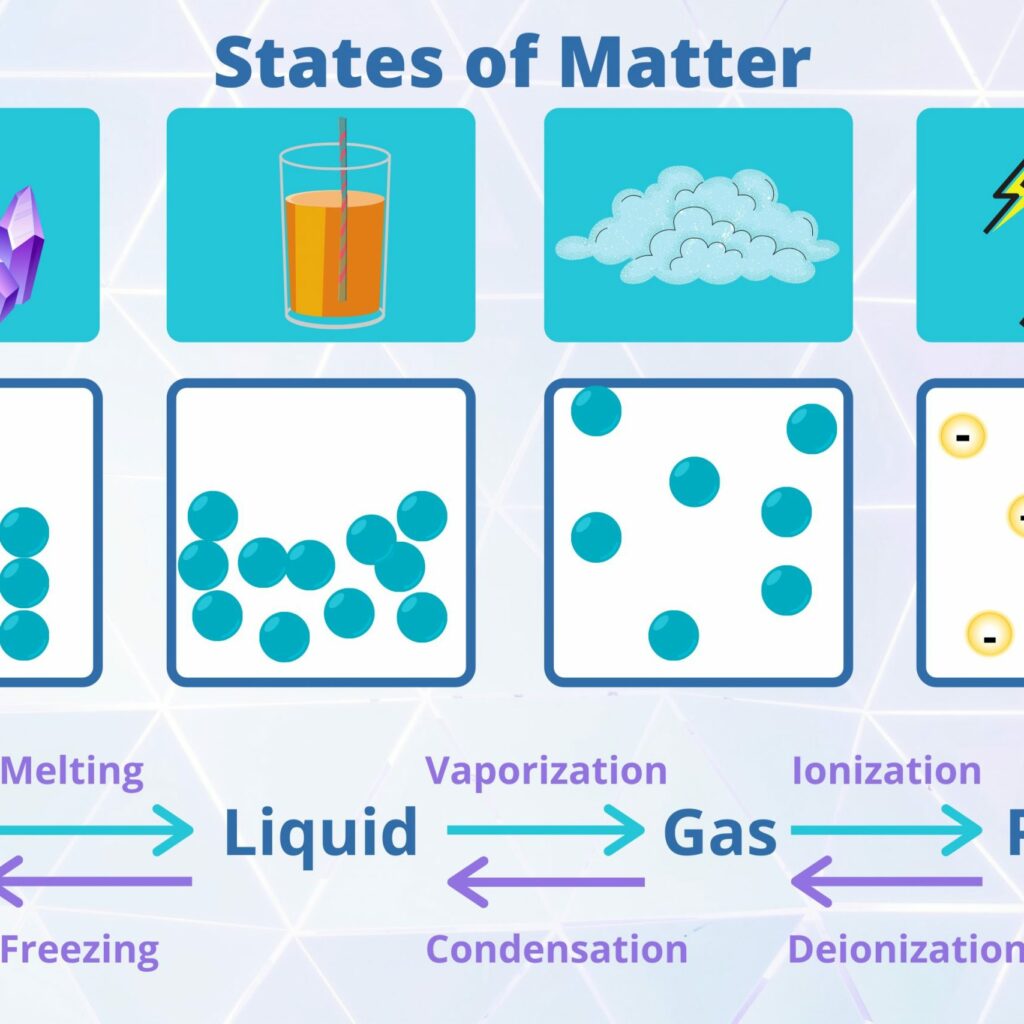
Matter traditionally exists in four principal states: solid, liquid, gas, and plasma. Each state is distinguished by unique physical properties, intermolecular forces, and energy levels, which dictate their behavior and appearance.
Solid State
In solids, particles are tightly packed, often arranged in a highly ordered pattern known as a crystal lattice. The strong intermolecular forces maintain this structure, giving solids a fixed shape and volume. The particles vibrate but remain in fixed positions, resulting in the lowest energy state among the classical phases. Solids resist changes in shape unless subjected to significant force or heat. Their properties vary widely; for example, metals are typically malleable and ductile, whereas many non-metals tend to be brittle.
Liquid State
Liquids feature particles that are close together but not rigidly fixed, allowing them to move past one another freely. This fluidity enables liquids to conform to the shape of their container while maintaining a constant volume. The intermolecular forces in liquids are weaker than in solids, facilitating flow. Phenomena such as surface tension and capillary action arise from cohesive forces (attraction between like molecules) and adhesive forces (attraction between unlike molecules).
Gaseous State
Gases consist of particles spaced far apart with minimal intermolecular attraction. They expand to fill the volume and shape of their container. Gas particles possess high kinetic energy, moving rapidly and colliding frequently. This dynamic behavior explains their ability to diffuse and occupy available space, as described by the ideal gas laws. Temperature and pressure changes influence gas behavior, with relationships such as Gay-Lussac’s Law illustrating how pressure increases with temperature at constant volume.
Plasma State
Plasma is an ionized state of matter composed of free electrons and positively charged ions. It is the most abundant state in the universe, found in stars including the sun. The intense thermal energy in plasma strips electrons from atoms, creating a soup of charged particles. Plasmas exhibit collective electromagnetic behaviors, responding to magnetic fields and forming phenomena like solar flares and auroras. Technological applications include fluorescent lighting and plasma display screens.
Phase Transitions and Energy Changes
The transformation between different states of matter is driven by variations in energy, primarily through changes in temperature and pressure. When energy is added or removed, matter undergoes phase transitions such as melting (solid to liquid), freezing (liquid to solid), vaporization (liquid to gas), condensation (gas to liquid), and ionization (gas to plasma). These processes are governed by thermodynamic principles that reveal the underlying order in material behavior.
Exotic and Non-Classical States of Matter
Beyond the four classical states, scientists have discovered additional states of matter under extreme conditions, expanding our understanding of physical phenomena:
- Bose-Einstein Condensate (BEC):
Occurs near absolute zero temperature, where particles occupy the same quantum state, acting as a single quantum entity with unique properties. - Fermionic Condensate:
Similar to BEC but formed from fermions, exhibiting superfluidity and other quantum effects at ultra-low temperatures. - Quantum Spin Liquid:
A state characterized by entangled quantum spins without long-range magnetic order, even at absolute zero, leading to highly correlated but disordered arrangements. - Supersolid:
A phase combining properties of solids and superfluids, allowing particles to flow without friction while maintaining a rigid structure.
Significance of Matter in Science and Daily Life
Matter forms the foundation of all physical reality, making its study essential across scientific disciplines. Understanding matter’s properties and transformations enables advancements in chemistry, physics, materials science, and engineering. It informs technologies ranging from electronics to energy production and influences everyday phenomena such as weather, cooking, and biological processes. Exploring new states of matter continues to push the boundaries of knowledge, offering insights into the universe’s fundamental nature and potential future innovations.
Summary
Matter is a complex and multifaceted concept encompassing all substances with mass and volume. Its classical states-solid, liquid, gas, and plasma-provide a framework for understanding material behavior, while discoveries of exotic states reveal deeper quantum mechanical principles. The continuous investigation of matter and its phase transitions enriches our comprehension of the physical world and drives technological progress, highlighting matter’s central role in both the cosmos and human experience.
FAQ
What are the four classical states of matter?
The four classical states of matter are solid, liquid, gas, and plasma, each defined by distinct physical properties.
What is a Bose-Einstein Condensate?
A Bose-Einstein Condensate is a state of matter formed at temperatures close to absolute zero, where particles act as a single quantum entity.





Leave a Reply