
Short Answer
Definition of Dark Energy
Dark energy is a mysterious form of energy that permeates all of space and is responsible for the accelerated expansion of the universe. Unlike ordinary matter and radiation, which exert gravitational attraction, dark energy produces a repulsive effect, pushing galaxies apart and influencing the large-scale dynamics of the cosmos. It constitutes approximately 70% of the total energy content of the universe, making it the dominant component shaping cosmic evolution.
Discovery and Historical Context
In the late 1990s, astronomers studying distant Type Ia supernovae made a groundbreaking observation: the universe’s expansion is not slowing down due to gravity, as previously assumed, but is instead accelerating. This unexpected finding challenged long-held beliefs about cosmic dynamics and introduced the concept of a repulsive force now known as dark energy. The term reflects both its elusive nature and its profound impact on the universe’s fate.
Dark Energy in the Framework of General Relativity
Albert Einstein’s theory of general relativity describes gravity as the curvature of spacetime caused by mass and energy. To maintain a static universe model, Einstein introduced the cosmological constant (Λ), a uniform energy density filling space that counteracts gravitational collapse. After the discovery of cosmic expansion, he regarded this constant as a mistake. However, the cosmological constant has reemerged as the leading explanation for dark energy, representing a constant energy density that drives accelerated expansion. Whether dark energy is truly the cosmological constant or a more complex phenomenon remains a central question in modern physics.
Mechanism Behind Cosmic Acceleration
Dark energy exerts a negative pressure throughout space, which counterbalances the attractive force of gravity on cosmic scales. This negative pressure causes the expansion rate of the universe to increase over time. Unlike matter, which clumps together under gravity, dark energy is uniformly distributed and does not cluster, making its effects dominant at large distances and late cosmic times.
Mathematical Description and Cosmological Models
The behavior of dark energy is often modeled using the cosmological constant Λ in Einstein’s field equations:
Gμν + Λgμν = (8πG/c⁴) Tμν
- Gμν: Einstein tensor describing spacetime curvature
- Λ: Cosmological constant representing dark energy density
- gμν: Metric tensor of spacetime
- Tμν: Energy-momentum tensor of matter and radiation
- G: Gravitational constant
- c: Speed of light
Alternative models propose dynamic scalar fields (quintessence) or modifications to gravity to explain dark energy’s properties, each with distinct implications for cosmic evolution.
Implications for the Universe’s Fate
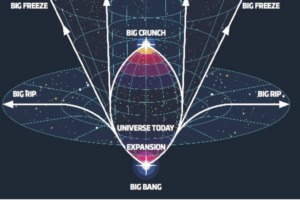
The dominance of dark energy shapes the ultimate destiny of the cosmos. If its density remains constant or increases, the universe may continue expanding indefinitely, potentially culminating in a “Big Rip” scenario where all structures are torn apart. Conversely, if dark energy diminishes or changes character, gravitational attraction could slow or reverse expansion, leading to a cosmic contraction or “Big Crunch.” These possibilities highlight the critical role dark energy plays in determining the long-term evolution of the universe.
Observational Evidence and Techniques
Multiple lines of observational data support the existence of dark energy:
- Supernovae Surveys:
Measurements of distant Type Ia supernovae reveal accelerated expansion. - Cosmic Microwave Background (CMB):
Fluctuations in the CMB provide constraints on the universe’s composition, indicating a dominant dark energy component. - Galaxy Distribution:
Large-scale structure surveys map the clustering of galaxies, consistent with dark energy’s influence on cosmic expansion.
Future missions with enhanced sensitivity aim to refine these observations, seeking to determine whether dark energy’s properties evolve over time.
Challenges and Theoretical Perspectives
Despite its profound effects, dark energy remains undetectable by direct means, revealing itself only through gravitational influences. This invisibility has spurred numerous theoretical proposals, including:
- Scalar Field Theories:
Hypothetical fields permeating space that vary over time and space. - Modified Gravity:
Extensions or alternatives to Einstein’s general relativity that alter gravitational behavior on cosmic scales.
Each approach carries significant consequences for fundamental physics, potentially linking cosmology with particle physics and quantum theory.
Philosophical and Existential Significance
Beyond its scientific importance, dark energy invites reflection on humanity’s place in the cosmos. The accelerating expansion suggests a future where galaxies drift beyond each other’s reach, leading to a colder, emptier universe. This scenario challenges our understanding of permanence and existence, intertwining cosmological inquiry with profound philosophical questions about origin, destiny, and meaning.
Summary: The Enigma of Dark Energy
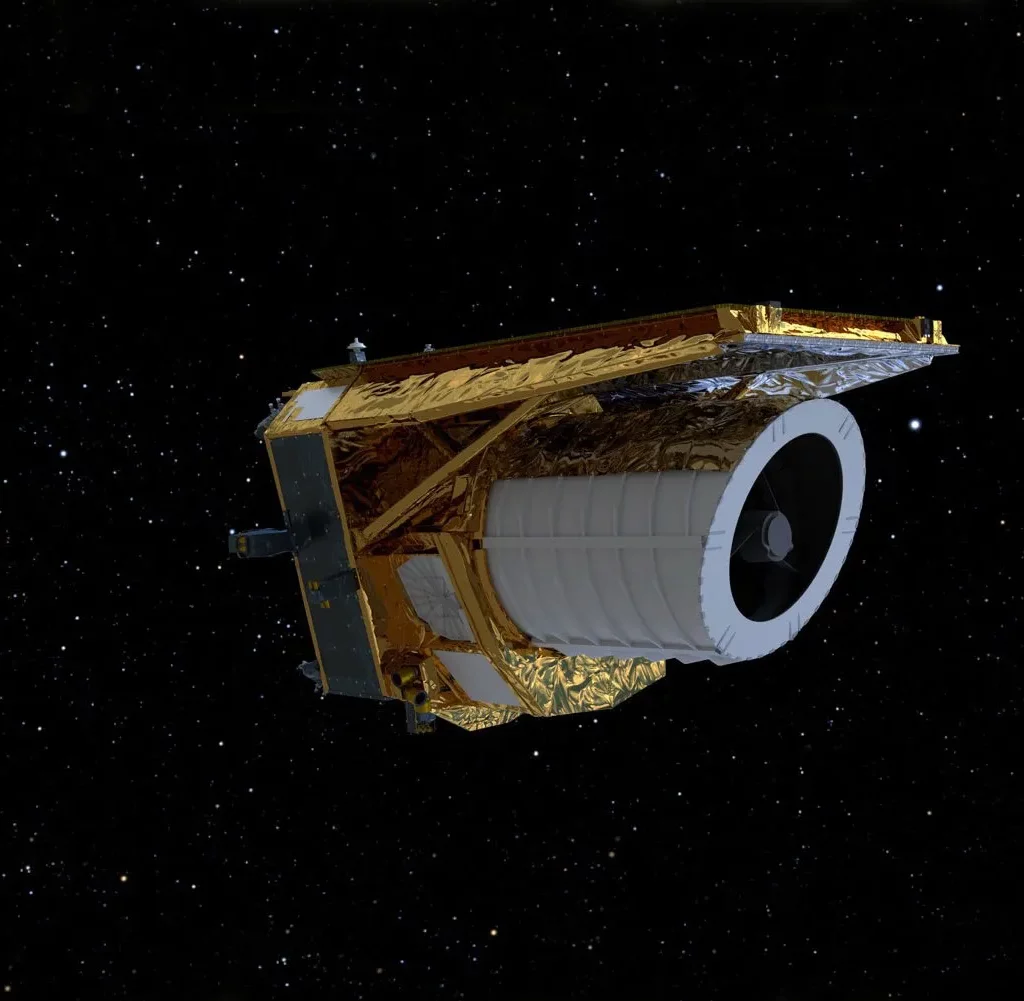
Dark energy stands as one of the most compelling mysteries in modern astrophysics. It is the invisible force propelling the universe’s accelerated expansion, defying conventional physics and dominating the cosmic energy budget. Understanding dark energy is essential not only for unraveling the universe’s past and future but also for advancing fundamental physics. As observational techniques and theoretical models evolve, humanity continues its quest to illuminate this shadowy component of reality, promising new insights into the nature of the cosmos.
FAQ
What is dark energy?
Dark energy is a form of energy that drives the accelerated expansion of the universe.
Why is dark energy important?
It constitutes 70% of the universe's energy and influences its future dynamics.
How was dark energy discovered?
Through observations of distant Type Ia supernovae in the late 1990s.
What theories explain dark energy?
The cosmological constant and dynamic scalar fields are among the leading theories.

Leave a Reply