
Short Answer
Definition of Atomic Spectra
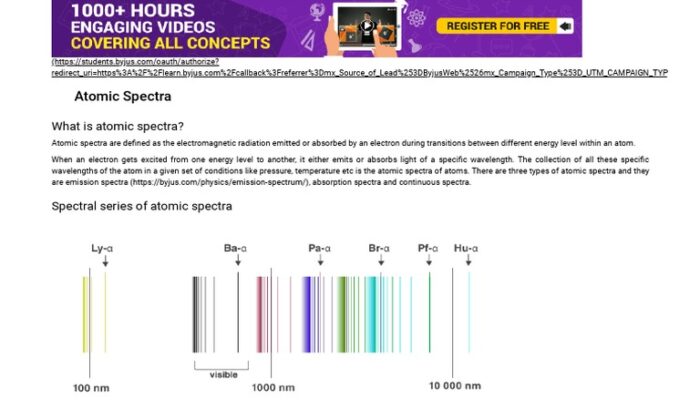
Atomic spectra refer to the unique patterns of electromagnetic radiation that atoms emit or absorb. These patterns arise when atoms interact with energy sources such as heat, electrical currents, or electromagnetic waves, causing electrons to move between discrete energy levels. As electrons transition back to their original states, they release photons at specific wavelengths, producing characteristic spectral lines. These spectra serve as a fundamental tool for understanding the electronic structure and properties of atoms and ions.
Types and Classifications of Atomic Spectra
Atomic spectra are primarily divided into two categories: emission spectra and absorption spectra, each revealing different aspects of atomic behavior.
- Emission Spectra:
These occur when electrons fall from higher to lower energy levels, emitting light at distinct wavelengths. Emission spectra can be further classified into: - Continuous Spectra: Produced by incandescent solids or liquids, these spectra display an unbroken range of wavelengths without gaps.
- Line Spectra: Characterized by sharp, discrete lines, these spectra are typical of heated gases. For example, hydrogen’s Balmer series exhibits specific visible lines corresponding to electron transitions.
- Band Spectra: Generated by molecules, these spectra consist of clusters of closely spaced lines resulting from vibrational and rotational transitions within molecules.
- Absorption Spectra:
These spectra appear when light passes through a cooler gas or liquid, and certain wavelengths are absorbed to excite electrons to higher energy states. The result is a continuous spectrum interrupted by dark lines or bands, which act as elemental fingerprints.
Mechanism Behind Atomic Spectra
The formation of atomic spectra is governed by the quantized nature of electron energy levels within atoms. When energy is supplied, electrons absorb photons and jump to excited states. As they return to lower energy levels, they emit photons with energies equal to the difference between these levels. The specific wavelengths of emitted or absorbed light correspond to these energy differences, producing the observed spectral lines.
Mathematical Framework and Formulas
The wavelengths of spectral lines can be calculated using formulas derived from quantum mechanics. For hydrogen-like atoms, the Rydberg formula is commonly used:
1/λ = R (1/n₁² – 1/n₂²)
- λ: Wavelength of the emitted or absorbed light
- R: Rydberg constant (~1.097 × 10⁷ m⁻¹)
- n₁, n₂: Principal quantum numbers of the lower and higher energy levels, respectively (n₂ > n₁)
This equation quantifies the relationship between electron transitions and the resulting spectral lines, enabling precise predictions of spectral wavelengths.
Applications and Real-World Examples
Atomic spectra have widespread applications across various scientific and technological fields:
- Astronomy:
Spectroscopic analysis allows astronomers to determine the chemical composition of stars and galaxies. The Doppler effect causes shifts in spectral lines (redshift and blueshift), providing insights into celestial objects’ motion and the expanding universe. - Technology:
Devices such as lasers, fluorescent lamps, and gas discharge tubes rely on controlled electron transitions within atoms to produce coherent or specific light emissions. - Medicine:
Spectroscopic techniques are employed in diagnostic imaging and biochemical analysis, offering detailed information about molecular structures and physiological processes. - Environmental Science:
Atomic absorption spectroscopy is instrumental in detecting trace elements and pollutants, aiding in environmental monitoring and protection.
Historical Development of Atomic Spectroscopy
The exploration of atomic spectra dates back to the late 19th and early 20th centuries, with significant contributions from scientists like J.J. Balmer and Niels Bohr. Balmer’s empirical formula described the visible spectral lines of hydrogen, while Bohr’s atomic model introduced the concept of quantized energy levels, explaining electron transitions and spectral emissions. These foundational discoveries paved the way for modern quantum mechanics and advanced spectroscopic techniques.
Common Misunderstandings About Atomic Spectra
- Misconception: Atomic spectra are continuous and uniform.
Correction: Atomic spectra are typically discrete, consisting of distinct lines or bands corresponding to specific electron transitions. - Misconception: Emission and absorption spectra are identical.
Correction: Emission spectra display bright lines on a dark background, while absorption spectra show dark lines superimposed on a continuous spectrum.
Significance of Atomic Spectra in Science and Daily Life
Understanding atomic spectra is crucial for advancing knowledge in physics, chemistry, and astronomy. It enables precise identification of elements, elucidates atomic and molecular structures, and supports the development of technologies that impact everyday life. From enabling the creation of lasers to enhancing medical diagnostics and environmental monitoring, atomic spectra remain a vital area of scientific inquiry with far-reaching implications.
FAQ
What is the difference between emission and absorption spectra?
Emission spectra consist of bright lines on a dark background formed when electrons emit light moving to lower energy levels, whereas absorption spectra show dark lines on a continuous background created when electrons absorb light to move to higher energy levels.
How are atomic spectra used in astronomy?
Astronomers analyze atomic spectra to determine the chemical composition, temperature, and movement of stars and galaxies by studying the characteristic spectral lines and their shifts.
What is the Rydberg formula and what does it calculate?
The Rydberg formula calculates the wavelengths of spectral lines emitted or absorbed by hydrogen-like atoms, based on the differences in energy levels between electron transitions.
Why are atomic spectra important in technology?
Atomic spectra underpin technologies such as lasers, fluorescent lamps, and gas discharge tubes by controlling electron transitions to produce specific light emissions.
What are common misconceptions about atomic spectra?
Common misconceptions include the ideas that atomic spectra are continuous and uniform, and that emission and absorption spectra are the same, both of which are incorrect.






Leave a Reply