
Short Answer
Definition of a Qubit
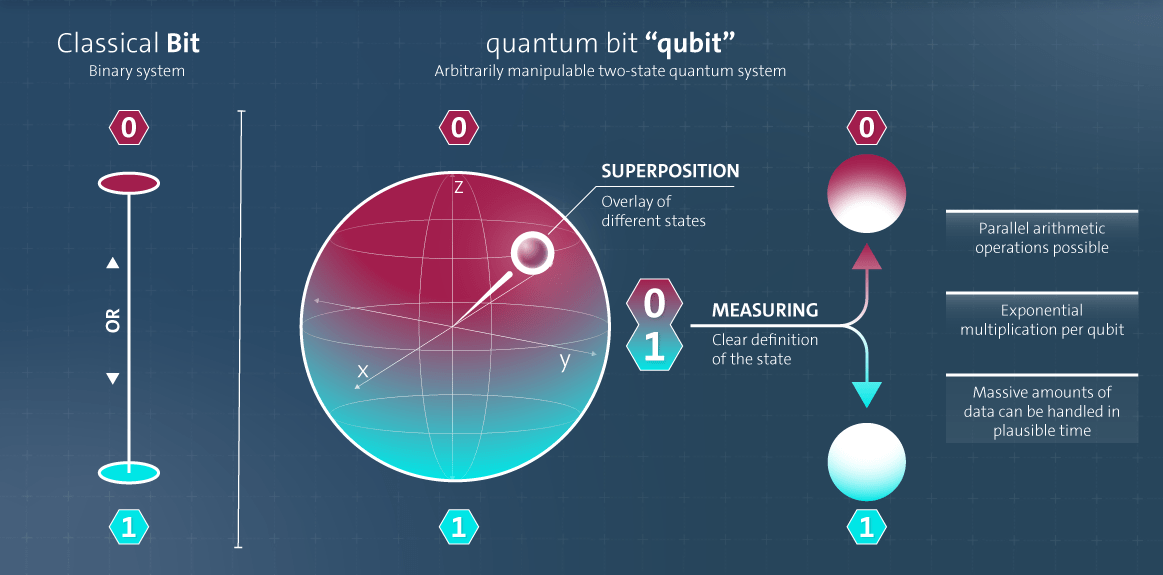
A qubit, or quantum bit, serves as the fundamental unit of information in quantum computing. Unlike classical bits that are restricted to binary states of either 0 or 1, qubits can exist in a superposition of both states simultaneously. This property allows quantum computers to process complex computations far more efficiently than classical systems within practical timeframes.
Visualizing Qubit States: The Bloch Sphere
The state of a qubit can be effectively represented using the Bloch sphere model. This conceptual tool depicts a qubit’s state as a point on the surface of a sphere. The north and south poles correspond to the classical bit values 0 and 1, respectively, while any other point on the sphere’s surface represents a superposition of these states. The angular coordinates on the sphere relate directly to the probability amplitudes of measuring the qubit in either state, illustrating the unique ways quantum mechanics manipulates information.
Physical Realizations of Qubits
Qubits can be implemented through various physical systems, each exploiting different quantum mechanical effects. These diverse approaches offer distinct advantages and challenges in terms of coherence, scalability, and operational fidelity.
Superconducting Qubits
Superconducting qubits are among the most widely researched and utilized types. They are fabricated from superconducting materials that exhibit zero electrical resistance at cryogenic temperatures. These qubits operate by forming Josephson junctions, which can switch between discrete energy states when stimulated by microwave pulses. Their compatibility with existing semiconductor fabrication techniques and scalability potential have made them a cornerstone in many leading quantum computing platforms.
Trapped Ion Qubits
Trapped ion qubits use individual ions confined by electromagnetic fields. Quantum states are manipulated and measured by precisely targeting these ions with laser beams. This method benefits from exceptionally long coherence times and high precision in quantum gate operations. Although scaling up trapped ion systems remains challenging, their superior operational fidelity makes them promising candidates for quantum communication and networking applications.
Topological Qubits
Topological qubits represent a novel approach based on the principles of topology. They arise from the braiding of anyons-exotic quasiparticles with non-Abelian statistics. The key advantage of topological qubits lies in their inherent resistance to local disturbances, which could significantly reduce errors caused by decoherence. This fault-tolerant nature positions them as a potential solution to one of quantum computing’s most critical obstacles.
Photonic Qubits
Photonic qubits encode quantum information in the properties of individual photons, such as polarization or spatial modes. Their ability to travel long distances with minimal loss makes them ideal for quantum communication protocols, including quantum key distribution. Ongoing research aims to improve their scalability and integration into complex quantum networks.
Quantum Dot Qubits
Quantum dot qubits utilize semiconductor nanocrystals where electrons are confined in discrete energy levels due to quantum confinement effects. These qubits can be electrically controlled, aligning well with existing semiconductor manufacturing processes. While promising for scalable quantum computing, challenges remain in achieving precise and coherent control over quantum dot states.
Applications and Impact of Qubits
The development of qubit technology is poised to transform numerous scientific and technological fields. Quantum computers leveraging qubits can tackle complex problems in optimization, cryptography, and the simulation of quantum systems that are currently intractable for classical computers. For instance, in pharmaceutical research, quantum simulations could model molecular interactions with unprecedented accuracy, accelerating drug discovery. Additionally, quantum-enhanced machine learning algorithms may unlock new capabilities in artificial intelligence.
Technical Challenges in Qubit Development
Despite their promise, qubits face significant hurdles. One major issue is maintaining coherence-the duration a qubit can preserve its quantum state-since short coherence times lead to computational errors. Implementing effective quantum error correction is essential for reliable operation. Furthermore, scaling up quantum systems while ensuring robust connectivity between qubits remains a complex engineering challenge. Each qubit technology presents unique difficulties that researchers continue to address.
Future Directions in Qubit Research
Looking ahead, hybrid quantum systems that combine different types of qubits may emerge, leveraging the strengths of each to overcome individual limitations. Such integrative approaches could accelerate the realization of practical, fault-tolerant quantum computers. Collaborative efforts between academic institutions and industry players are expected to drive rapid advancements, bringing the vision of widespread quantum computing closer to reality.
Summary
Qubits mark a revolutionary departure from classical bits by enabling superposition and other quantum phenomena that underpin quantum computing. The variety of qubit implementations-from superconducting circuits to photonic systems-demonstrates the innovative strategies employed to harness quantum mechanics. While challenges in coherence, scalability, and error correction persist, ongoing research continues to unlock the transformative potential of quantum technologies for science and industry.
FAQ
What is a qubit?
A qubit is the basic unit of quantum information, functioning in superposition to enable complex calculations.
How does a qubit differ from a classical bit?
Unlike classical bits, which can be either 0 or 1, qubits can exist in both states simultaneously due to superposition.
What are the main types of qubits?
The main types include superconducting qubits, trapped ion qubits, topological qubits, and photonic qubits.






Leave a Reply