
Short Answer
Understanding Quantum Computing
Quantum computing represents a revolutionary approach to processing information, captivating experts across physics, engineering, and mathematics. It challenges the boundaries of classical computing by proposing solutions to problems that traditional computers find impractical or impossible to solve. This raises a fundamental inquiry: is quantum computing simply an advanced iteration of classical computing, or does it embody a fundamentally new framework rooted in the principles of quantum physics?
Classical vs. Quantum Computing: Core Concepts
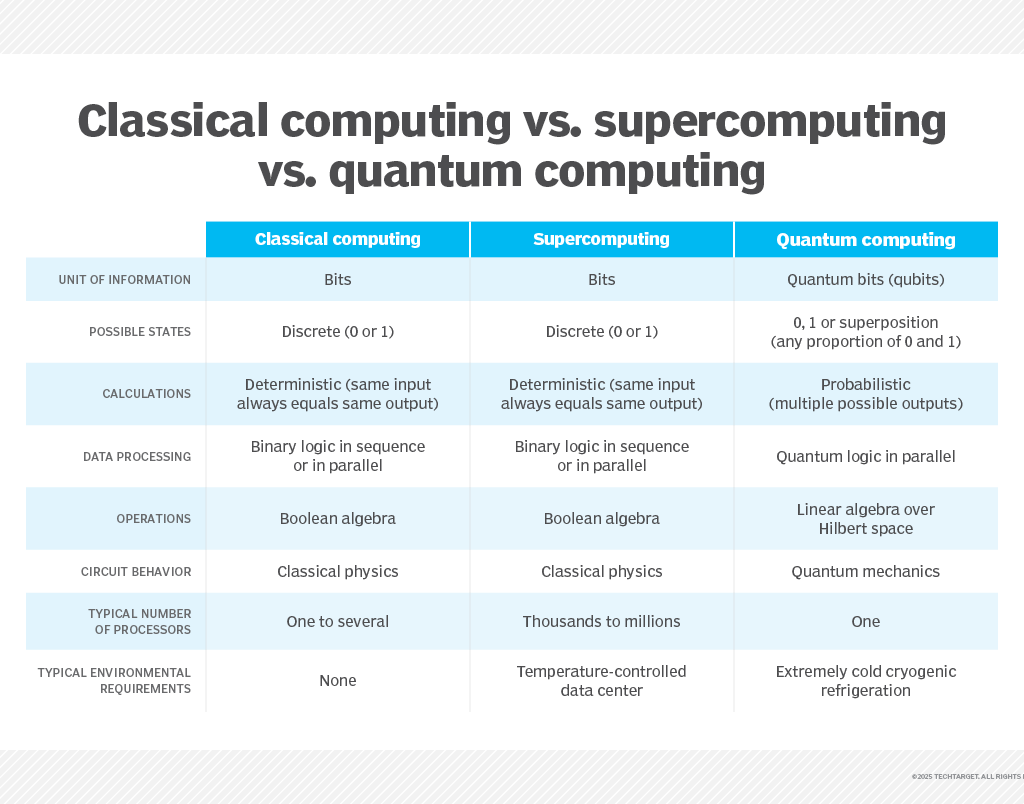
To appreciate the distinction, it is essential to first understand the basics of classical computing. Classical computers operate using bits, which are binary units representing either 0 or 1. These bits underpin all classical algorithms, relying on Boolean logic to perform calculations and execute instructions deterministically-meaning the output is precisely determined by the input and programmed rules.
In contrast, quantum computing utilizes quantum bits, or qubits, as its fundamental units of information. Unlike classical bits, qubits can exist in a superposition, simultaneously representing multiple states. This unique property enables quantum computers to handle vast amounts of data in parallel, vastly expanding computational possibilities beyond classical limits.
Key Quantum Phenomena: Superposition and Entanglement
- Superposition:
Qubits can occupy multiple states at once, allowing quantum systems to process numerous potential outcomes simultaneously. This defies classical binary logic and opens new avenues for computation. - Entanglement:
When qubits become entangled, their states become interdependent regardless of the physical distance between them. This non-local connection defies classical intuition and is crucial for enhancing quantum computational power.
Challenges in Quantum Computing
Despite its promise, quantum computing faces significant hurdles. Qubits are extremely sensitive to external disturbances, leading to a loss of coherence-a phenomenon known as quantum decoherence-where quantum information degrades into classical states. Maintaining qubit stability over time is critical for reliable quantum operations, prompting ongoing research into error correction techniques and fault-tolerant quantum architectures.
Additionally, the probabilistic nature of quantum mechanics introduces uncertainty that contrasts with the deterministic framework of classical algorithms. This necessitates the development of novel computational paradigms tailored to quantum principles.
Historical and Theoretical Foundations
Visionaries like Richard Feynman and David Deutsch pioneered the concept of using quantum systems to simulate complex physical processes, highlighting the limitations of classical computation in capturing quantum phenomena. Their work laid the groundwork for understanding that quantum computers operate under fundamentally different rules, requiring new approaches to algorithm design and problem-solving.
Quantum Algorithms: Demonstrating Computational Advantage
Several quantum algorithms exemplify the distinct capabilities of quantum computing:
- Shor’s Algorithm:
Provides an efficient polynomial-time method for integer factorization, a task that is exponentially difficult for classical algorithms. This breakthrough has profound implications for cryptography and data security. - Grover’s Algorithm:
Enables faster searching of unsorted databases, offering quadratic speedup over classical search methods and impacting fields reliant on large-scale data processing.
Applications Across Diverse Fields
Quantum computing’s potential extends well beyond theoretical interest, promising transformative impacts in various sectors:
- Quantum Simulations:
Facilitate the study of complex molecular and chemical interactions, advancing materials science and pharmaceutical development. - Quantum Machine Learning:
Could accelerate artificial intelligence by enhancing data processing and pattern recognition capabilities. - Optimization Problems:
Offer innovative solutions for logistics, supply chain management, and other areas requiring efficient resource allocation.
Philosophical and Future Perspectives
Imagining a future where quantum computers are widespread invites reflection on how enhanced computational power might redefine concepts of intelligence and problem-solving. This evolution challenges traditional views on complexity and human cognition, suggesting a new computational philosophy that integrates quantum principles.
Interdisciplinary Impact and Significance
While quantum computing is deeply rooted in physics, its influence spans computer science, mathematics, and philosophy. This interdisciplinary nature fosters a dialogue that questions established paradigms, introduces novel logical frameworks, and offers solutions to both current and unforeseen challenges.
Conclusion: Beyond Physics to a New Computational Era
The exploration of quantum computing transcends a purely physical perspective, intertwining determinism with probabilistic uncertainty. Understanding qubits, superposition, and entanglement not only advances computational theory but also reshapes our broader comprehension of knowledge and technological potential. As this field progresses, it promises to redefine the future of computation and its role in society.
FAQ
What is a quantum computer?
A quantum computer harnesses the principles of quantum mechanics, such as superposition and entanglement, to perform computations that are infeasible for classical computers.
How do quantum computers differ from classical computers?
Quantum computers use qubits that can exist in multiple states simultaneously, unlike classical bits which are binary, enabling them to process complex problems more efficiently.
What is quantum entanglement?
Entanglement is a quantum phenomenon where qubits become linked such that the state of one instantly influences another, enabling complex correlations important for quantum computation.
What are the main challenges in quantum computing?
Maintaining qubit stability, preventing decoherence, and implementing error correction to ensure accurate computations are primary challenges.
What are some real-world applications of quantum computing?
Applications span cryptography, molecular simulations for drug discovery, optimization problems, and improving machine learning algorithms.






Leave a Reply