
Short Answer
Definition of Coaxial and Fiber Optic Cables
Coaxial and fiber optic cables are two predominant technologies used for transmitting data and signals in modern communication systems. Each type features distinct construction and operational principles, offering unique advantages tailored to specific applications in telecommunications and data networking.
Coaxial Cable: Composition and Operation
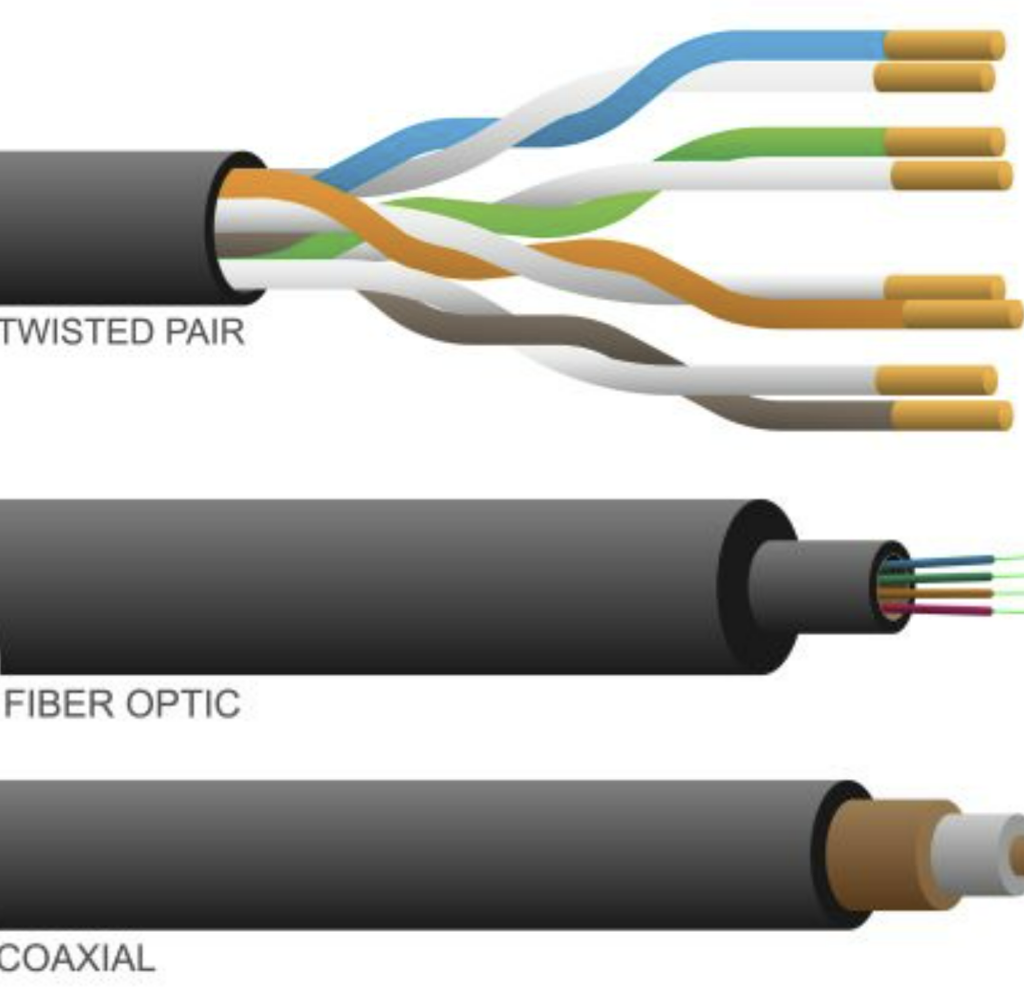
Coaxial cables, often referred to as coax cables, consist of a central conductor encased by an insulating layer, which is further surrounded by a metallic shield. Both the inner conductor and the outer shield share a common central axis, giving the cable its name. Typically, the core conductor is made of copper, while the shielding is composed of copper or aluminum, all protected by an outer plastic jacket.
These cables are designed to carry radio frequency (RF) signals efficiently, making them suitable for applications such as cable television, broadband internet, and other high-frequency transmissions. The coaxial design minimizes electromagnetic interference (EMI), preserving signal quality over extended distances and ensuring reliable data transfer.
Varieties of Coaxial Cables
- RG-6:
Widely used for digital television and cable internet, RG-6 cables feature enhanced shielding and broader bandwidth, supporting high-quality signal transmission. - RG-58:
Common in wireless communication and radio setups, RG-58 cables have a smaller diameter and are better suited for short-range applications rather than cable TV. - RG-59:
Primarily employed in closed-circuit television (CCTV) systems and video transmission, RG-59 cables offer lower bandwidth compared to RG-6 but are effective over shorter distances.
Fiber Optic Cable: Structure and Signal Transmission
Fiber optic cables transmit data by sending pulses of light through thin strands of glass or plastic fibers. The cable’s core, where light travels, is surrounded by a cladding layer with a lower refractive index, enabling total internal reflection to keep light signals contained within the core. This assembly is protected by an outer sheath that shields the fibers from physical damage.
Fiber optics provide significant advantages over traditional electrical cables, including the ability to transmit data over much longer distances without signal degradation. Their high bandwidth capacity and rapid data transmission rates make them indispensable in telecommunications, internet backbones, and data center infrastructures.
Categories of Fiber Optic Cables
- Single-mode Fiber (SMF):
Featuring a small core diameter (around 8 to 10 microns), SMF cables allow light to travel straight through the fiber with minimal dispersion. They are ideal for long-distance and high-speed communication networks. - Multi-mode Fiber (MMF):
With a larger core size (typically 50 or 62.5 microns), MMF cables support multiple light paths simultaneously, making them suitable for shorter distance applications such as local area networks (LANs) and data centers.
Comparative Overview of Coaxial and Fiber Optic Cables
- Transmission Medium:
Coaxial cables transmit electrical signals, whereas fiber optic cables use light pulses, resulting in different performance characteristics. - Bandwidth and Speed:
Fiber optic cables offer substantially higher bandwidth and faster data rates, accommodating the growing demand for high-speed internet and multimedia streaming. - Installation and Durability:
Coaxial cables are generally easier to install and more rugged, while fiber optics require specialized handling and installation expertise due to their delicate nature. - Cost Factors:
Although fiber optic systems involve higher initial costs for materials and labor, their superior performance and lower signal loss often provide better long-term value.
Practical Applications of Coaxial and Fiber Optic Cables
Coaxial cables remain prevalent in residential and commercial television distribution, broadband internet access, and certain radio frequency applications. Their robustness and ease of use make them a practical choice for many existing infrastructures.
Fiber optic cables dominate in scenarios requiring high data throughput and long-distance transmission, such as telecommunications backbones, high-speed internet service providers, and large-scale data centers. Their ability to handle vast amounts of data at high speeds is critical for modern digital communication networks.
Common Misunderstandings About Cable Technologies
- Misconception: Fiber optic cables are always more expensive in the long run.
Correction: While initial installation costs are higher, fiber optics often reduce maintenance expenses and signal loss, making them cost-effective over time. - Misconception: Coaxial cables cannot support high-speed internet.
Correction: Coaxial cables can deliver broadband internet effectively, though fiber optics provide superior speeds and bandwidth for future-proofing networks.
Significance in Modern Communication
Understanding the distinctions between coaxial and fiber optic cables is vital for designing efficient and reliable communication systems. Each cable type plays a crucial role in supporting the infrastructure of digital communication, from traditional television and internet services to cutting-edge high-speed data transmission. Selecting the appropriate cable technology ensures optimal performance, cost-efficiency, and scalability in an increasingly connected world.
FAQ
What is the difference between single-mode and multi-mode fiber optic cables?
Single-mode fiber has a smaller core and supports long-distance, high-speed communication with minimal dispersion, while multi-mode fiber has a larger core supporting multiple light paths for shorter distances.
Can coaxial cables support high-speed internet?
Yes, coaxial cables can effectively deliver broadband internet, though fiber optics provide higher speeds and greater bandwidth for future needs.
Why are fiber optic cables more expensive to install?
Fiber optic cables require specialized handling, equipment, and labor due to their delicate glass fibers and installation complexity, leading to higher initial costs.
How do coaxial cables minimize electromagnetic interference?
Coaxial cables use a metallic shield around the central conductor to block external electromagnetic signals, preserving signal integrity.






Leave a Reply