
Short Answer
Definition of Gravitational Waves
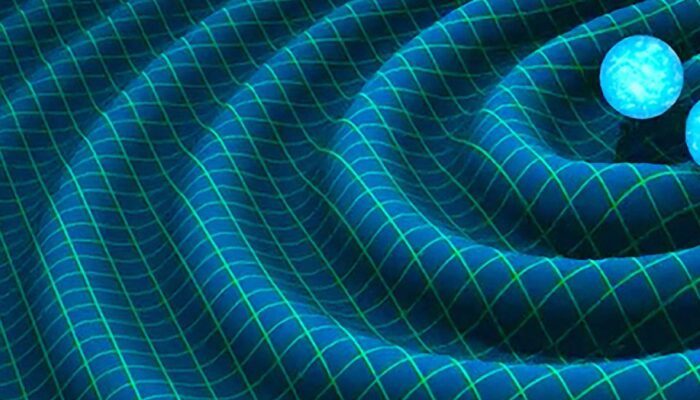
Gravitational waves are ripples in the fabric of spacetime generated by accelerating massive objects, as predicted by Albert Einstein’s general theory of relativity. These waves propagate outward at the speed of light, carrying information about dynamic cosmic events that cause distortions in spacetime. Unlike electromagnetic waves, gravitational waves interact very weakly with matter, allowing them to travel vast cosmic distances without significant attenuation or scattering.
- Origin:
Produced by violent astrophysical phenomena such as merging black holes, neutron star collisions, and supernovae. - Nature:
Disturbances in spacetime geometry rather than electromagnetic radiation. - Detection:
Measured by highly sensitive interferometers that detect minute changes in distance caused by passing waves.
Astrophysical Applications
Gravitational waves have revolutionized observational astronomy by providing a novel means to study cosmic events that are otherwise hidden or obscured. Unlike light or radio waves, which can be absorbed or scattered by interstellar dust and gas, gravitational waves pass through matter almost unaffected, delivering pristine data from the most energetic and distant phenomena in the universe.
- Event Reconstruction:
Analysis of gravitational waveforms allows scientists to recreate the dynamics of black hole mergers, neutron star collisions, and supernova explosions occurring billions of light-years away. - Complement to Electromagnetic Observations:
They reveal phenomena that emit little or no electromagnetic radiation, thus expanding the scope of cosmic observation beyond traditional telescopes.
Role in Fundamental Physics
Gravitational wave detection provides a unique laboratory for testing the limits of Einstein’s general relativity under extreme gravitational conditions. By examining properties such as wave speed, polarization states, and amplitude decay, physicists can verify the theory’s predictions or uncover deviations that might suggest new physics.
- Testing Gravity Theories:
Precise measurements have already ruled out several alternative gravity models, refining our understanding of spacetime and matter behavior in intense gravitational fields. - Exploring Extreme Environments:
Observations probe conditions unattainable in terrestrial laboratories, such as those near merging black holes.
Insights into Cosmology
Gravitational waves open a window into the universe’s earliest moments, offering clues about epochs inaccessible to electromagnetic observations. Since electromagnetic signals only emerged after the cosmic “dark ages,” gravitational waves can carry information from the universe’s infancy, including the inflationary period and primordial phase transitions.
- Probing the Early Universe:
Detection of the stochastic gravitational wave background may reveal signatures of cosmic strings and other relics from the Big Bang. - Understanding Large-Scale Structure:
These waves help reconstruct the universe’s formation and evolution on the grandest scales.
Multi-Messenger Astronomy
The integration of gravitational wave data with other cosmic messengers-such as neutrinos, gamma rays, and electromagnetic radiation-has inaugurated a new era of multi-messenger astronomy. This approach enables simultaneous observation of astrophysical events through different channels, enriching the scientific narrative.
- Case Study:
The combined detection of gravitational waves and electromagnetic signals from neutron star mergers has elucidated the synthesis of heavy elements in kilonova explosions. - Enhanced Understanding:
Multi-messenger observations provide comprehensive insights into the mechanisms driving cosmic phenomena.
Technological Innovations Driven by Gravitational Wave Research
The pursuit of gravitational wave detection has spurred significant technological progress, particularly in precision instrumentation and data analysis. The development of ultra-sensitive interferometers capable of detecting minuscule spacetime distortions has inspired advancements across various scientific and industrial fields.
- Instrumentation:
Technologies designed for gravitational wave observatories have influenced inertial navigation systems and quantum measurement devices. - Computational Advances:
Sophisticated noise reduction and signal processing algorithms have propelled growth in machine learning and computational science.
Philosophical and Epistemological Implications
The discovery and study of gravitational waves challenge traditional concepts of observation and knowledge in astronomy. By shifting the focus from electromagnetic signals to spacetime distortions, gravitational wave astronomy redefines how humanity perceives and investigates the cosmos.
- New Paradigm:
Knowledge acquisition now includes direct measurement of spacetime dynamics, expanding the epistemological framework of cosmic inquiry. - Human Perspective:
This shift prompts deeper reflection on our place in the universe and the nature of reality itself.
Future Prospects and Space-Based Observatories
Looking ahead, gravitational wave astronomy is poised to expand with the deployment of spaceborne detectors such as the Laser Interferometer Space Antenna (LISA). These observatories will access frequency ranges unattainable from Earth, enabling the detection of gravitational waves from supermassive black hole mergers and other exotic sources.
- Expanded Frequency Range:
Space-based detectors will observe lower-frequency waves, broadening the spectrum of detectable events. - Enhanced Discovery Potential:
This will deepen our understanding of the universe and fuel scientific breakthroughs for decades.
Conclusion: The Transformative Impact of Gravitational Waves
Gravitational waves have emerged as a transformative scientific tool, bridging empirical discovery, theoretical physics, cosmology, technological innovation, and philosophical thought. Their ability to unveil hidden cosmic phenomena, rigorously test gravitational theories, and illuminate the universe’s earliest moments is unparalleled. As detection methods advance, gravitational wave astronomy will continue to enrich humanity’s cosmic narrative, fostering interdisciplinary knowledge and inspiring awe at the intricate nature of spacetime.
FAQ
What are gravitational waves?
Gravitational waves are ripples in spacetime caused by massive accelerating objects, like merging black holes.
How are gravitational waves detected?
They are detected using highly sensitive interferometers that measure tiny changes in distance caused by passing waves.
What is multi-messenger astronomy?
It is an approach that combines data from gravitational waves with other signals like neutrinos and electromagnetic radiation.
What are the implications of gravitational waves for physics?
They allow testing of general relativity and provide insights into extreme gravitational conditions.

Leave a Reply