
Short Answer
Definition of Dark Matter Galaxies
Dark matter galaxies refer to hypothetical cosmic structures composed almost entirely of dark matter, lacking the ordinary, luminous matter that forms stars and planets. Unlike conventional galaxies, which are visible due to the light emitted by their baryonic components, these galaxies would be invisible to traditional telescopes, detectable only through their gravitational effects.
- Dark Matter:
A form of matter that does not emit, absorb, or reflect electromagnetic radiation, making it undetectable by direct observation. - Dark Matter Galaxy:
A theoretical galaxy consisting predominantly or exclusively of dark matter, without the presence of stars or gas clouds.
The Role of Dark Matter in Cosmic Structure
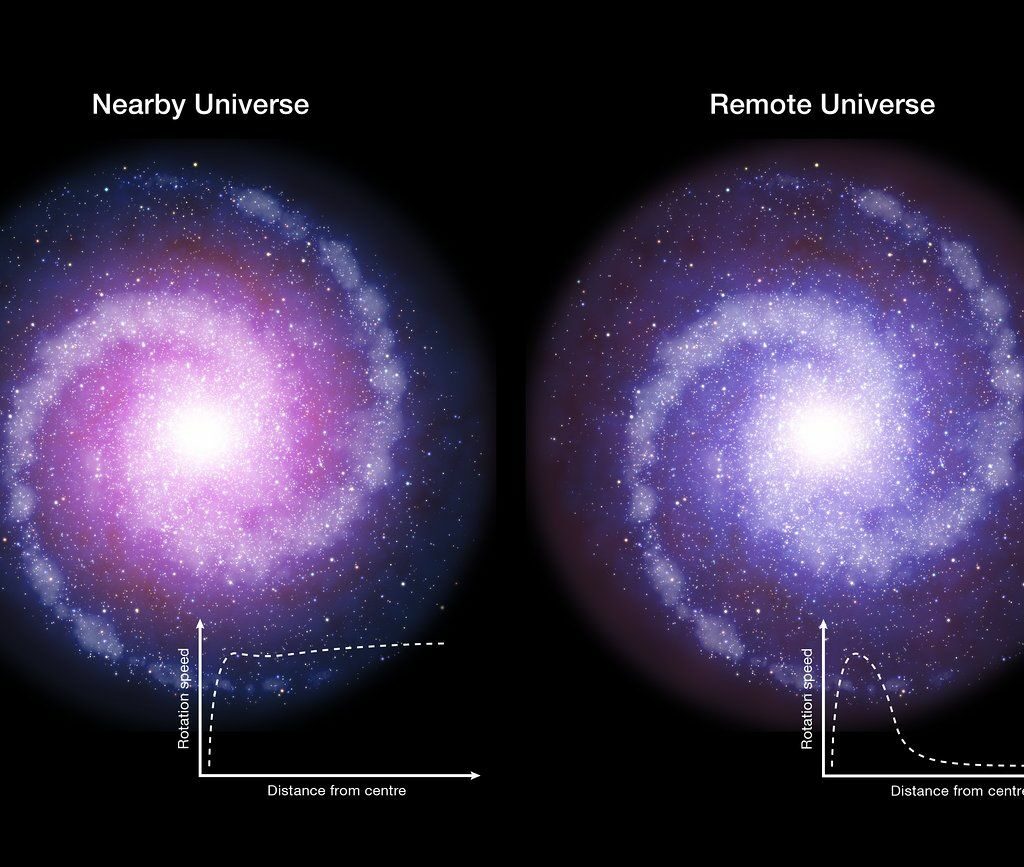
Dark matter is a fundamental component of the universe, constituting about 85% of all matter. It acts as an invisible framework that shapes the large-scale structure of the cosmos. Galaxies, including the Milky Way, are embedded within extensive halos of dark matter that extend well beyond their visible edges. This dark matter scaffolding influences galaxy formation and rotation, providing the gravitational pull necessary for ordinary matter to accumulate and form stars.
Formation Mechanisms and Limitations
While dark matter is crucial in the formation of galaxies, it cannot independently create the luminous structures we associate with galaxies. The primary candidates for dark matter particles, such as weakly interacting massive particles (WIMPs), interact mainly through gravity and weak nuclear forces. Their inability to emit or absorb energy prevents them from cooling and condensing into dense regions, unlike baryonic matter which can radiate energy and collapse to form stars and planets.
- Cooling and Clumping:
Ordinary matter loses energy through electromagnetic radiation, allowing it to condense into stars. Dark matter lacks this mechanism, remaining diffuse and unable to form compact objects. - Density Profiles:
Dark matter typically forms smooth, extended halos rather than dense cores necessary for star formation.
Thermal Dynamics and Structural Differences
The thermal behavior of dark matter contrasts sharply with that of baryonic matter. While ordinary matter cools and contracts, igniting nuclear fusion in stars, dark matter remains in a hot, diffuse state due to its non-interaction with electromagnetic forces. This fundamental difference means that a galaxy composed solely of dark matter would lack the distinct shapes and luminous features-such as spiral arms or elliptical forms-that characterize visible galaxies.
Simulations and Theoretical Insights
Computational models focusing exclusively on dark matter reveal the formation of large, diffuse halos that mimic the gravitational influence of galaxies but lack the concentrated mass needed to trigger star formation. These halos could be considered “ghost galaxies,” invisible except for their gravitational effects on surrounding matter and light. This raises the question of whether such structures qualify as galaxies or represent a separate class of cosmic phenomena.
Detection Challenges and Methods
Since dark matter does not emit light, detecting dark matter-only galaxies relies on indirect observational techniques. Gravitational lensing, where the mass of a dark matter halo bends light from background objects, offers one method to infer their presence. Additionally, perturbations in the motion of visible celestial bodies can hint at the influence of unseen mass concentrations. Despite these methods, confirming the existence of pure dark matter galaxies remains difficult due to the subtlety of their signatures.
Emerging Evidence and Theoretical Possibilities
Recent theoretical frameworks and cosmological simulations suggest the existence of “dark galaxies” with minimal baryonic content. Observations of isolated gas clouds with little star formation hint at a continuum of galactic types, from baryon-rich to nearly starless. However, definitive evidence for galaxies composed entirely of dark matter is still lacking, constrained by current observational capabilities and model limitations.
Cosmic Evolution and Environmental Factors
In the early universe, dark matter structures played a pivotal role by gathering primordial gas that eventually formed the first stars and galaxies. However, sustaining a galaxy without baryonic matter over cosmic timescales challenges established principles of galactic evolution. Without stars, processes such as chemical enrichment, feedback mechanisms, and dynamic galactic phenomena cannot occur, resulting in static, inert halos rather than evolving galaxies.
Why Understanding Dark Matter Galaxies Is Important
Exploring the concept of galaxies made solely of dark matter deepens our understanding of the universe’s composition and the interplay between visible and invisible matter. It challenges traditional definitions of galaxies and highlights the limitations of current observational methods. Advancements in technology and theory may one day reveal these elusive structures, offering new insights into cosmic matter distribution and the fundamental nature of dark matter.
Common Misconceptions
Dark matter galaxies would look like normal galaxies but without stars.
Without baryonic matter, dark matter galaxies would lack visible features and recognizable shapes, appearing as diffuse, invisible halos.
Dark matter can cool and form compact objects like stars.
Dark matter does not interact electromagnetically and cannot radiate energy, preventing it from cooling and collapsing into dense structures.
Dark matter galaxies have been definitively observed.
While theoretical models predict their existence, no pure dark matter galaxies have been conclusively detected to date.
FAQ
What are dark matter galaxies?
They are hypothetical galaxies composed mostly of dark matter, lacking visible stars or gas.
How are dark matter galaxies detected?
They can be inferred through techniques like gravitational lensing and studying motion perturbations of visible celestial bodies.
Have dark matter galaxies been observed?
No pure dark matter galaxies have been conclusively detected to date.

Leave a Reply