
Short Answer
Definition of Dark Energy and Ether
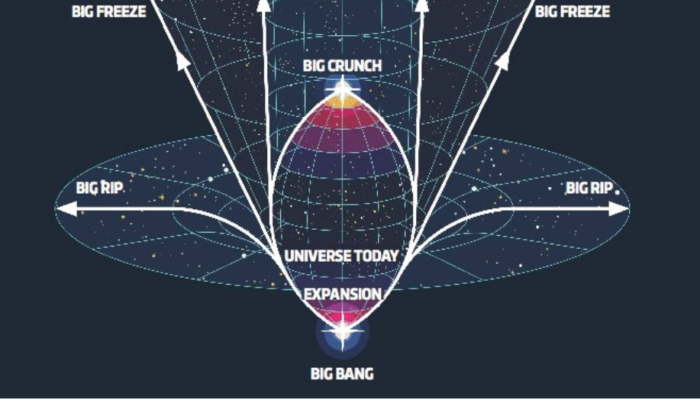
Dark energy is a mysterious and dominant force in modern cosmology, responsible for the accelerated expansion of the universe. It constitutes approximately 70% of the universe’s total energy content and remains one of the most profound enigmas in astrophysics. Historically, the concept of ether was proposed as an invisible medium filling space, thought to carry electromagnetic waves. Although both dark energy and ether involve invisible cosmic components, their nature and roles differ significantly.
- Dark Energy:
A form of energy intrinsic to space that exerts a repulsive gravitational effect, causing the universe’s expansion to speed up. - Ether:
A hypothetical mechanical medium once believed to permeate space and enable the propagation of light waves, later disproven by experiments.
Historical Background: From Ether to Dark Energy
In the late 19th and early 20th centuries, scientists postulated the existence of ether as a medium necessary for light wave transmission, analogous to how air carries sound. This concept was widely accepted until the Michelson-Morley experiment failed to detect Earth’s motion relative to ether, delivering a critical blow to the hypothesis. The null result paved the way for Einstein’s theory of relativity, which eliminated the need for any such medium.
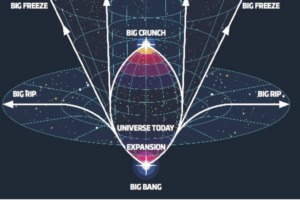
Decades later, observations of distant supernovae revealed that the universe’s expansion is accelerating, a discovery that introduced dark energy as a new cosmic component. Unlike ether, dark energy is not a medium but an intrinsic property of space or a dynamic field influencing cosmic evolution.
Theoretical Models Explaining Dark Energy
Several frameworks have been proposed to understand dark energy’s nature and effects:
- Cosmological Constant (Λ):
Introduced by Einstein and later revived, this model treats dark energy as a constant, uniform energy density filling space, producing a repulsive gravitational effect. Despite its simplicity, it faces the “fine-tuning problem,” where theoretical predictions vastly exceed observed values. - Quintessence:
A dynamic scalar field that evolves over time, potentially varying the influence of dark energy and offering a more flexible explanation than the static cosmological constant. - Modified Gravity Theories:
These propose alterations to general relativity on cosmic scales, explaining accelerated expansion without invoking a new energy form.
Comparing Dark Energy and Ether: Similarities and Differences
While both concepts involve invisible entities permeating the cosmos, their fundamental characteristics diverge:
- Purpose:
Ether was conceived as a mechanical medium for electromagnetic wave propagation; dark energy is an intrinsic energy component causing cosmic acceleration. - Physical Nature:
Ether implied a particulate or mechanical substrate; dark energy is associated with spacetime properties or fields without requiring a medium. - Reference Frames:
Ether suggested a preferred frame of reference, which modern physics rejects; dark energy respects Lorentz invariance, consistent with relativity.
Observational Evidence and Experimental Approaches
Dark energy’s presence is inferred from astrophysical observations rather than direct detection:
- Type Ia Supernovae:
These stellar explosions serve as “standard candles” to measure cosmic distances and reveal accelerated expansion. - Cosmic Microwave Background (CMB):
Fluctuations in the CMB provide clues about the universe’s composition and the influence of dark energy. - Large-Scale Structure:
The distribution of galaxies and baryon acoustic oscillations help constrain dark energy’s properties.
In contrast, ether was a theoretical construct tested through laboratory experiments, none of which confirmed its existence.
Philosophical and Scientific Significance
Both ether and dark energy reflect humanity’s efforts to explain unseen cosmic phenomena. Ether addressed 19th-century challenges in understanding wave propagation within a Newtonian framework, while dark energy confronts 21st-century puzzles about the universe’s fate and the nature of spacetime. Each concept emerged from gaps in empirical knowledge, illustrating the evolving relationship between theory and observation in science.
Why Understanding Dark Energy Is Crucial
Dark energy reshapes our comprehension of the cosmos, influencing theories in physics, astronomy, and cosmology. Its study challenges foundational principles, drives technological advancements in observational astronomy, and deepens our grasp of the universe’s past, present, and future. Unraveling dark energy’s mysteries could unlock new physics beyond the current paradigms, impacting both scientific knowledge and philosophical perspectives on existence.
Summary and Outlook
Although dark energy and ether share superficial similarities as invisible cosmic agents, dark energy represents a revolutionary concept grounded in rigorous observation and advanced theoretical models. It is not a revival of the archaic ether but a distinct phenomenon that continues to challenge and expand our understanding of the universe. Ongoing research aims to clarify its nature, promising profound insights into the fabric of reality and the ultimate destiny of the cosmos.
FAQ
What is dark energy?
Dark energy is a mysterious force responsible for the accelerated expansion of the universe, constituting about 70% of its total energy content.
How does dark energy differ from ether?
Unlike ether, which was a proposed medium for light wave transmission, dark energy is an intrinsic property of space affecting cosmic expansion.
What evidence supports the existence of dark energy?
Evidence for dark energy comes from observations of Type Ia supernovae, the Cosmic Microwave Background, and the large-scale structure of the universe.

Leave a Reply