
Short Answer
Definition of Mental Calculation
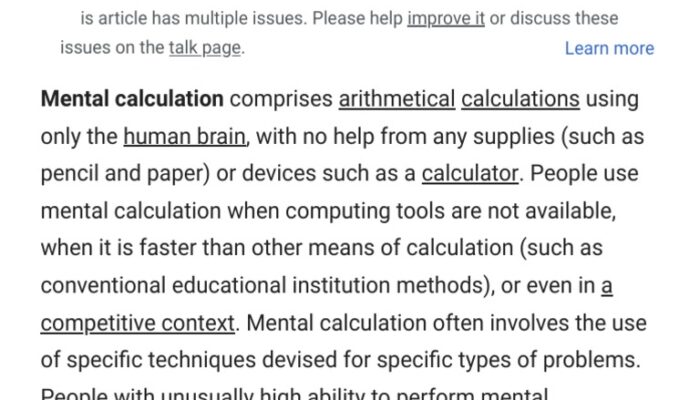
Mental calculation refers to the process of performing arithmetic operations entirely in one’s mind without the aid of calculators, paper, or other tools. It is a cognitive exercise that enhances numerical agility and sharpens analytical thinking by encouraging individuals to manipulate numbers mentally through various strategies.
Common Techniques in Mental Multiplication
Several approaches are widely used to simplify mental multiplication, each leveraging different cognitive strengths. These include decomposition, the distributive property, pattern recognition, and visualization. Employing these methods not only facilitates quick calculations but also strengthens numerical intuition and problem-solving skills.
Decomposition Method
Decomposition involves breaking down complex numbers into smaller, more manageable parts to simplify calculations. For example, when multiplying 11 by 33, the number 33 can be split into 30 and 3. This transforms the original problem into two simpler multiplications:
- 11 × 30:
Multiplying 11 by 30 results in 330. - 11 × 3:
Multiplying 11 by 3 gives 33.
Adding these partial products together (330 + 33) yields the final answer, 363. This method reduces cognitive load by leveraging familiar multiplication facts.
Distributive Property
The distributive property of multiplication over addition states that multiplying a sum by a number is equivalent to multiplying each addend separately and then adding the results. Applying this to 11 × 33:
11 × (30 + 3) = (11 × 30) + (11 × 3)
This approach mirrors decomposition but explicitly highlights the underlying algebraic principle, reinforcing understanding of mathematical operations and their properties.
Pattern Recognition with the Number 11
The number 11 exhibits unique characteristics that simplify multiplication. When multiplying two-digit numbers by 11, a recognizable pattern emerges:
- Write the digits of the multiplicand with a space between them.
- Add the two digits together.
- Place the sum in the middle of the original digits to form the product.
For instance, with 33:
3 _ 3 → 3 + 3 = 6 → 363
This pattern confirms the product of 11 × 33 as 363 and illustrates the elegant relationships within numbers that mental math can reveal.
Visualization and Geometric Interpretation
Visualizing multiplication as an area model can deepen comprehension. Imagine a rectangle divided into sections representing the factors:
- Horizontal side: 11 units
- Vertical side: 33 units
The total area corresponds to the product 11 × 33. By partitioning the rectangle into smaller sections (e.g., 11 × 30 and 11 × 3), one can visually grasp the decomposition process, integrating spatial reasoning with numerical calculation.
Mathematical Explanation and Formula
The multiplication of two numbers, a and b, can be expressed as:
Product = a × b
Using the distributive property, if b is decomposed into b₁ and b₂ such that b = b₁ + b₂, then:
a × b = a × (b₁ + b₂) = (a × b₁) + (a × b₂)
Applying this to 11 × 33:
11 × 33 = 11 × (30 + 3) = (11 × 30) + (11 × 3) = 330 + 33 = 363
Practical Applications and Examples
Mental multiplication techniques are valuable in everyday scenarios such as quick financial calculations, estimating quantities, or solving problems without electronic devices. For example:
- Shopping: Calculating the total cost of 11 items priced at $33 each.
- Time management: Estimating total minutes when performing 11 tasks each taking 33 minutes.
- Education: Enhancing students’ arithmetic skills through mental math exercises.
Common Misconceptions About Mental Calculation
Mental math is only about memorizing tricks.
While patterns and shortcuts help, mental calculation fundamentally develops understanding of number relationships and arithmetic principles.
Mental calculation is less accurate than written methods.
With practice, mental math can be both fast and precise, especially for manageable numbers and well-understood techniques.
Significance of Mental Calculation Skills
Mastering mental calculation fosters cognitive flexibility, enhances problem-solving abilities, and builds confidence in handling numbers. These skills are crucial not only in academic contexts but also in daily life and professional environments where quick, accurate numerical reasoning is essential. Moreover, engaging with mental math nurtures a deeper appreciation for the structure and beauty of mathematics, encouraging lifelong learning and intellectual curiosity.
FAQ
What is mental calculation?
Mental calculation is performing arithmetic operations in your mind without using tools like calculators or paper.
How does the decomposition method work for multiplying numbers?
It breaks a complex multiplication into smaller parts, multiplies each, and adds the results to get the final answer.
Why is the number 11 special in mental multiplication?
Multiplying two-digit numbers by 11 often follows a simple pattern where you add the digits and place the sum between them.
Are mental calculation methods accurate?
Yes, with practice, mental calculation can be both fast and accurate, especially for manageable numbers.




Leave a Reply