
Short Answer
Definition of Electronics Engineering
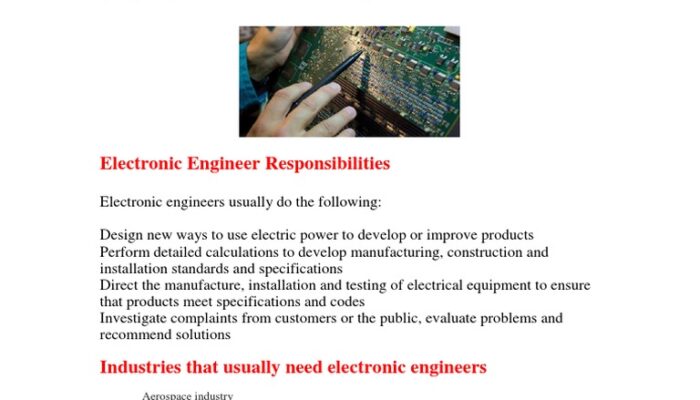
Electronics engineering is a vibrant and multifaceted branch of engineering focused on the design, development, and application of electronic circuits, devices, and systems. It integrates principles from various scientific disciplines to create technologies that power modern communication, computing, and control systems. This field demands a broad skill set and a deep understanding of both theoretical concepts and practical applications, making it a challenging yet rewarding profession.
Fundamental Knowledge Areas
Mathematics and Physics Foundations
A solid grasp of mathematics and physics forms the cornerstone of electronics engineering expertise. Key mathematical tools include calculus, linear algebra, and differential equations, which are essential for analyzing circuits, signals, and control mechanisms. Physics concepts such as classical mechanics and electromagnetism underpin the behavior of electronic components and systems. These foundational sciences enable engineers to predict and manipulate the flow of electrons and energy within devices.
Circuit Design and Component Understanding
Mastery of circuit design is critical, encompassing both analog and digital domains. Engineers must be proficient in using simulation tools like SPICE to model circuit behavior before physical implementation. A thorough knowledge of fundamental components-resistors, capacitors, inductors, diodes, and transistors-is indispensable for creating efficient, reliable electronic systems. This expertise allows for the innovation and optimization of devices ranging from simple gadgets to complex machinery.
Microcontrollers and Embedded Systems
With the rise of the Internet of Things (IoT), familiarity with microcontrollers and embedded systems has become increasingly important. Electronics engineers should be skilled in programming languages such as C, C++, and Python to develop systems capable of real-time data processing with minimal latency and energy consumption. This knowledge enables the creation of smart, interconnected devices that respond dynamically to their environments.
Signal Processing Techniques
Signal processing, both analog and digital, is a vital area of expertise. It involves methods like filtering, Fourier analysis, and modulation to interpret and manipulate signals. In today’s data-driven world, the ability to efficiently process signals is crucial for applications in telecommunications, multimedia, and sensor networks. Engineers must also address challenges such as noise reduction and latency to ensure signal integrity and system performance.
Communications Systems
Understanding communication systems is essential for designing and optimizing technologies that transmit information reliably. This includes knowledge of modulation schemes, network theory, and wireless protocols. Electronics engineers working in telecommunications, satellite communications, and related fields must balance bandwidth efficiency, scalability, and robustness to push the boundaries of connectivity.
Power Electronics and Energy Management
Power electronics focuses on the control and conversion of electrical energy through devices like converters, inverters, and controllers. Engineers must comprehend concepts such as power factor, efficiency, and thermal management to develop sustainable and effective power systems. This area is increasingly significant as the world prioritizes energy conservation and renewable energy integration.
Electromagnetic Compatibility (EMC) and Interference (EMI)
Designing electronic systems that operate reliably in environments with multiple devices requires expertise in minimizing electromagnetic interference. Knowledge of EMC and EMI principles ensures that circuits function without disrupting or being disrupted by other equipment. Engineers employ various strategies and adhere to industry standards to achieve robust, interference-resistant designs.
Professional Skills Beyond Technical Knowledge
Project Management and Collaborative Work
Electronics engineers frequently collaborate within multidisciplinary teams, working alongside software developers, system integrators, and quality assurance specialists. Proficiency in project management-including scope definition, scheduling, and budget control-is vital for delivering complex projects successfully. Effective communication skills are equally important for explaining technical concepts to diverse audiences and fostering teamwork.
Keeping Pace with Emerging Technologies
The rapid evolution of technology necessitates continuous learning and adaptability. Staying informed about breakthroughs in areas such as artificial intelligence, machine learning, and quantum computing can inspire innovation and keep engineers at the forefront of their field. Awareness of emerging trends enables professionals to anticipate future challenges and opportunities in electronics engineering.
Why Electronics Engineering is Crucial
Electronics engineering plays a pivotal role in advancing modern technology, impacting industries from healthcare to telecommunications and renewable energy. Its principles enable the creation of devices and systems that improve quality of life, enhance communication, and drive economic growth. As technology continues to evolve, electronics engineers are essential in shaping a connected, efficient, and sustainable future.
Summary
Excelling in electronics engineering requires a comprehensive understanding of mathematics, physics, circuit design, embedded systems, signal processing, communications, power management, and electromagnetic compatibility. Coupled with strong project management and a commitment to lifelong learning, these competencies empower engineers to innovate and solve complex problems in a rapidly changing technological landscape. The discipline offers both challenges and rewards for those dedicated to mastering its diverse and intricate domains.
FAQ
What are the essential skills for an electronics engineer?
An electronics engineer should have a solid understanding of mathematics and physics, circuit design, embedded systems, signal processing, communications, power management, and project management skills.
Why is continuous learning important in electronics engineering?
Continuous learning is essential due to the rapid evolution of technology, which requires engineers to stay updated with emerging trends and innovations.




Leave a Reply