
Short Answer
Definition of Nuclear Fission
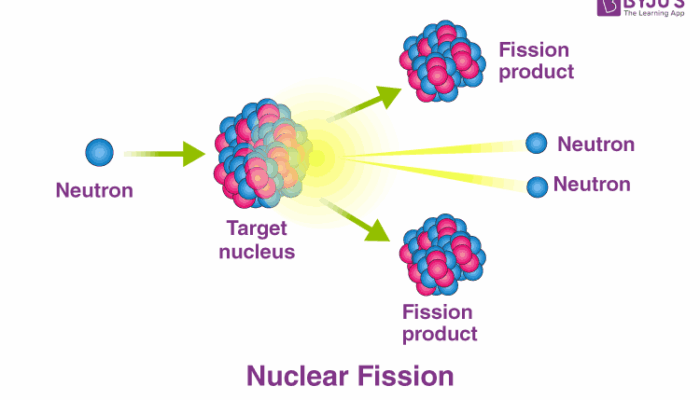
Nuclear fission is a fundamental physical process in which the nucleus of an atom splits into two or more smaller nuclei, accompanied by the release of a considerable amount of energy. This phenomenon is central to both nuclear power generation and atomic weaponry, representing a complex interplay between nuclear physics and quantum mechanics.
- Atomic nucleus:
The dense core of an atom, composed of protons and neutrons, collectively called nucleons. - Fission process:
The division of a heavy atomic nucleus into lighter fragments, releasing energy and free neutrons. - Energy release:
The energy liberated during fission arises from the conversion of mass into energy, as described by Einstein’s mass-energy equivalence.
Structure and Stability of Atomic Nuclei
The atomic nucleus is held together by the strong nuclear force, one of the four fundamental forces in nature. This force acts over very short distances, roughly the size of the nucleus, and counterbalances the electromagnetic repulsion between positively charged protons. The stability of a nucleus depends on a delicate equilibrium between these forces, which quantum mechanics helps to explain through the behavior of nucleons as both particles and waves.
Quantum Nature of Nucleons
Within the nucleus, protons and neutrons do not behave as classical particles but exhibit wave-particle duality. Each nucleon occupies a quantum state characterized by a wave function, which describes the probability distribution of its position and energy. The Heisenberg uncertainty principle further dictates that precise knowledge of a nucleon’s position limits the precision of its momentum measurement, introducing inherent uncertainty that influences nuclear stability.
Mechanism of Nuclear Fission
Nuclear fission is initiated when a nucleus absorbs energy, often through the capture of a neutron. This energy absorption excites the nucleus, elevating nucleons to higher energy states and destabilizing the nuclear structure. As the nucleus approaches a critical energy threshold, the repulsive electromagnetic forces among protons begin to overpower the strong nuclear force.
Quantum Tunneling and Fission Initiation
Quantum tunneling plays a pivotal role in enabling nucleons to overcome the potential barrier created by the strong nuclear force. Despite the barrier, nucleons can probabilistically escape the nucleus, leading to its fragmentation. For example, uranium-235, upon neutron absorption, forms an unstable compound nucleus that is highly susceptible to splitting into smaller nuclei, releasing additional neutrons and energy.
Chain Reactions and Their Control
The neutrons emitted during fission can induce further fission events in nearby nuclei, creating a self-sustaining chain reaction. Managing this reaction is crucial in nuclear reactors, where it is maintained at a controlled rate to produce steady energy output. In contrast, nuclear weapons exploit an uncontrolled, rapid chain reaction, resulting in an immense and instantaneous release of energy.
Mathematical Framework of Nuclear Fission
The behavior of nucleons and the evolution of the nuclear system during fission are described by quantum mechanics, particularly through the Schrödinger equation:
iħ ∂ψ/∂t = Ĥψ
- ψ (psi): The wave function representing the quantum state of the nucleus.
- Ĥ (Hamiltonian operator): Represents the total energy of the system, including kinetic and potential energies.
- ħ (reduced Planck constant): A fundamental constant in quantum mechanics.
This equation governs the time evolution of the nuclear wave function, allowing predictions of nucleon distributions and fission probabilities. Additionally, statistical mechanics aids in understanding the multitude of possible fission fragment configurations, reflecting the inherent randomness of the process.
Practical Applications and Examples
Nuclear fission underpins the operation of nuclear power plants, where controlled fission reactions generate heat to produce electricity. It is also the principle behind atomic bombs, where rapid, uncontrolled fission leads to massive explosive energy release. Common fissile materials include uranium-235 and plutonium-239, both capable of sustaining chain reactions upon neutron absorption.
Common Misconceptions About Nuclear Fission
Nuclear fission is a purely classical process.
Fission is fundamentally governed by quantum mechanics, involving wave functions, quantum tunneling, and probabilistic outcomes.
All nuclei undergo fission easily.
Only certain heavy nuclei, such as uranium-235 and plutonium-239, have the right properties to undergo fission readily under neutron bombardment.
Nuclear fission always results in the same fragments.
The fission process produces a variety of fragment isotopes, reflecting the statistical nature of the event.
Philosophical and Ethical Considerations
The quantum perspective on nuclear fission challenges our classical intuition about matter and energy, highlighting the probabilistic and uncertain nature of fundamental processes. This understanding raises profound ethical questions regarding the use of nuclear technology, balancing the benefits of energy generation against the risks of proliferation and environmental impact. Responsible stewardship of nuclear knowledge is essential to harness its power safely and ethically.
Significance of Quantum Mechanics in Nuclear Fission
Quantum mechanics provides the essential framework for comprehending nuclear fission, revealing the intricate balance of forces and probabilities that govern atomic nuclei. This insight is crucial for advancing nuclear technology, improving reactor safety, and developing new applications. The quantum roots of fission remind us of the profound connection between microscopic phenomena and their macroscopic consequences in science and society.
FAQ
What causes an atomic nucleus to undergo fission?
An atomic nucleus undergoes fission when it absorbs energy, typically from a neutron, causing it to become unstable and split into smaller nuclei.
How does the strong nuclear force relate to nuclear fission?
The strong nuclear force holds nucleons together, but if the repulsive electromagnetic force between protons overcomes it due to added energy, the nucleus can split.
Can nuclear fission be controlled?
Yes, in nuclear reactors, fission chain reactions are controlled to produce steady energy output, whereas in nuclear weapons, the reaction is uncontrolled and rapid.






Leave a Reply