
Short Answer
Definition of Boron Nitride
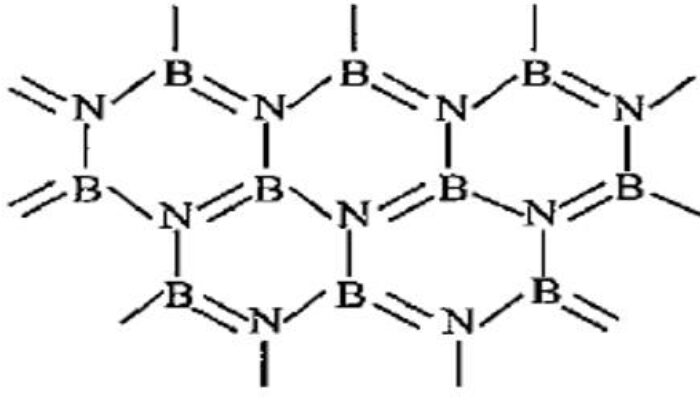
Boron nitride (BN) is a remarkable compound in the field of material science, known for its unique combination of simplicity in structure and complexity in properties. Often referred to as the “white graphite,” boron nitride shares a layered crystalline structure similar to carbon-based graphite but exhibits distinct physical and chemical characteristics that set it apart. This duality makes BN a fascinating material with diverse applications across multiple industries.
Structural Variants of Boron Nitride
Boron nitride exists in several allotropes, each with unique structural and functional traits:
- Hexagonal Boron Nitride (h-BN):
Resembling graphite, h-BN features a planar, layered structure where boron and nitrogen atoms form hexagonal sheets. This arrangement imparts excellent lubricating properties and thermal conductivity. - Cubic Boron Nitride (c-BN):
With a three-dimensional lattice akin to diamond, c-BN is renowned for its exceptional hardness, making it a prime material for cutting tools and abrasives. - Amorphous Boron Nitride:
Lacking a defined crystalline structure, this form offers flexibility and moldability, suitable for applications requiring adaptable material shapes.
Thermal Conductivity and Stability
Hexagonal boron nitride exhibits impressive thermal conductivity, comparable to that of graphite, enabling efficient heat dissipation in electronic and industrial devices. This property is crucial for maintaining device performance under high thermal loads. Additionally, BN maintains its structural integrity and thermal properties at elevated temperatures, making it ideal for use in environments such as aerospace and automotive sectors where materials face extreme heat.
Electrical Insulation Properties
Boron nitride is an excellent electrical insulator due to its wide bandgap, which prevents the flow of electrical current. This characteristic allows BN to serve as a protective barrier in electronic components, safeguarding them from electrical interference and short circuits. Its high dielectric strength makes it valuable in composite insulators and other electrical applications where reliable insulation is critical.
Chemical Resistance and Stability
One of BN’s standout features is its exceptional chemical inertness. The strong covalent bonds between boron and nitrogen atoms create a material highly resistant to oxidation and corrosion, even in harsh chemical environments. This durability is advantageous in aerospace, metallurgy, and chemical processing industries, where exposure to reactive substances is common. Furthermore, BN’s biocompatibility and chemical stability make it suitable for biomedical uses, including drug delivery systems and implantable devices.
Mechanical Strength and Durability
Boron nitride demonstrates a broad spectrum of mechanical properties depending on its allotrope. Cubic BN rivals diamond in hardness, making it indispensable for industrial cutting and abrasive tools. Its toughness and resistance to deformation ensure longevity and performance under demanding conditions. Conversely, hexagonal BN, while softer, offers a low coefficient of friction due to its layered structure, providing excellent lubrication. This makes h-BN ideal for coatings and surface treatments aimed at reducing wear and extending machinery lifespan.
Applications and Significance
The multifaceted nature of boron nitride, combining structural diversity with thermal, electrical, chemical, and mechanical advantages, positions it as a critical material in modern technology. Its ability to perform under extreme conditions while maintaining stability and functionality makes it invaluable in electronics, aerospace, automotive, chemical processing, and biomedical fields. As industries continue to demand materials that enhance performance and durability, boron nitride’s unique properties ensure its ongoing relevance and potential for innovation.
Summary
Boron nitride is a versatile material characterized by its various allotropes, each contributing distinct properties such as high thermal conductivity, electrical insulation, chemical resistance, and mechanical strength. This combination of features enables BN to meet the challenges of advanced technological applications, making it a material of choice for scientists and engineers seeking robust and reliable solutions.
FAQ
What are the primary structural forms of boron nitride?
Boron nitride exists mainly as hexagonal (h-BN), cubic (c-BN), and amorphous forms, each with unique physical properties.
Why is boron nitride called 'white graphite'?
Because hexagonal boron nitride has a layered structure similar to graphite, but with distinct properties such as electrical insulation.
What applications benefit from boron nitride’s thermal conductivity?
Applications in electronics, automotive, and aerospace industries utilize boron nitride’s ability to efficiently dissipate heat.
Is boron nitride chemically reactive?
No, boron nitride is chemically inert and highly stable against oxidation and corrosion.
How does the hardness of cubic boron nitride affect its uses?
Its hardness rivals diamond, making cubic boron nitride ideal for cutting tools and abrasive materials.





Leave a Reply