
Short Answer
Definition of Nuclear Forces
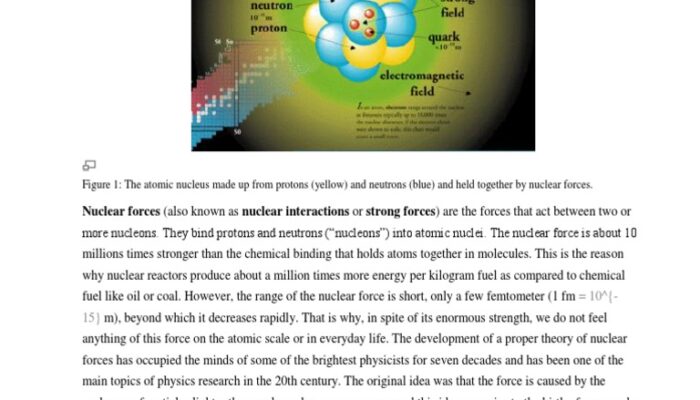
Nuclear forces are fundamental interactions that hold the components of an atomic nucleus together. These forces act as the binding agents that maintain the cohesion of protons and neutrons within the nucleus, overcoming the repulsive electromagnetic forces between positively charged protons. They are essential to the stability of matter and play a critical role in the structure and behavior of atoms.
- Strong Nuclear Force:
The primary force responsible for binding nucleons (protons and neutrons) tightly within the nucleus. - Weak Nuclear Force:
A subtler force involved in certain types of radioactive decay and particle interactions.
Historical Background and Discovery
The understanding of nuclear forces emerged from pivotal scientific breakthroughs in the early 20th century. The discovery of the electron by J.J. Thomson in 1897 revealed the atom’s internal complexity, but it was Ernest Rutherford’s 1909 gold foil experiment that fundamentally reshaped atomic theory. Rutherford demonstrated that atoms consist of a dense, positively charged nucleus surrounded by orbiting electrons, setting the stage for nuclear physics.
Subsequent advances in quantum mechanics, pioneered by Max Planck and Albert Einstein, introduced the wave-particle duality concept, which was crucial for explaining atomic interactions. These quantum insights laid the foundation for exploring the forces operating within the nucleus.
Fundamental Types of Nuclear Forces
Strong Nuclear Force
The strong nuclear force is the dominant interaction that binds protons and neutrons together inside the nucleus. It originates from the interactions of quarks and gluons, the elementary particles that compose nucleons. This force is characterized by its extremely short range, effective only at distances on the order of a femtometer (10-15 meters), roughly the size of an atomic nucleus.
The theory of quantum chromodynamics (QCD) describes how quarks are held together by gluons, providing a detailed framework for understanding the strong force’s behavior.
Weak Nuclear Force
The weak nuclear force governs processes such as beta decay, where a neutron transforms into a proton or vice versa. Although weaker and acting over even shorter distances than the strong force, it is vital for nuclear reactions that change one type of particle into another, influencing stellar processes and element formation.
Scientific Models Explaining Nuclear Forces
Early nuclear physics combined experimental findings with theoretical models to explain nuclear behavior. The liquid drop model, introduced by George Gamow, likened the nucleus to a droplet of liquid, where surface tension represents the nuclear force holding nucleons together. This analogy helps explain nuclear stability and the conditions under which nuclei become unstable and undergo fission.
Such models illustrate the delicate equilibrium within the nucleus, where attractive nuclear forces counterbalance repulsive electromagnetic forces, much like a precariously balanced structure sensitive to small perturbations.
Key Experiments and Advances
The 1930s marked a period of intense experimental progress. James Chadwick’s discovery of the neutron in 1932 added a new dimension to nuclear structure, revealing that nuclei contain neutral particles alongside protons. Enrico Fermi’s experiments with neutron bombardment further expanded knowledge of nuclear reactions and isotopes.
The discovery of nuclear fission in 1938 by Otto Hahn and Fritz Strassmann, with theoretical interpretation by Lise Meitner and Otto Frisch, demonstrated that splitting heavy nuclei releases vast amounts of energy. This breakthrough had profound scientific and societal consequences, leading to both nuclear power generation and the development of nuclear weapons.
Modern Research and Technological Implications
Post-World War II, nuclear physics research accelerated with the construction of particle accelerators and cyclotrons, enabling the synthesis of new elements and deeper exploration of nuclear reactions. The pursuit of nuclear fusion, where light nuclei combine to form heavier ones, exemplifies ongoing efforts to harness nuclear forces for clean energy, mirroring processes that power stars.
Societal and Ethical Considerations
While nuclear forces underpin the very fabric of matter, their application raises complex ethical questions. The dual-use nature of nuclear technology-capable of both generating energy and creating weapons-necessitates careful regulation and responsible stewardship to balance scientific progress with global security and environmental concerns.
Why Understanding Nuclear Forces Is Crucial
Comprehending nuclear forces is fundamental to multiple scientific disciplines, including physics, chemistry, and astrophysics. These forces explain the stability of matter, the mechanisms of radioactive decay, and the processes driving stellar evolution and element synthesis. Moreover, nuclear science has practical applications in medicine, energy production, and national defense, making it a cornerstone of modern technology and research.
Common Misconceptions About Nuclear Forces
Nuclear forces are the same as electromagnetic forces.
Nuclear forces are distinct fundamental interactions that operate at subatomic scales, whereas electromagnetic forces act between charged particles over longer distances.
The weak nuclear force is insignificant due to its short range.
Despite its limited range, the weak force is essential for processes like beta decay and plays a critical role in the life cycles of stars.
Summary
The study of nuclear forces reveals a complex interplay of fundamental interactions that govern the structure and stability of atomic nuclei. From early atomic models to contemporary quantum theories, the exploration of these forces has transformed our understanding of matter and energy. As research continues, nuclear forces remain central to both scientific discovery and technological innovation, highlighting their enduring significance in unraveling the mysteries of the universe.
FAQ
What are nuclear forces?
Nuclear forces are fundamental interactions that hold protons and neutrons together within an atomic nucleus.
What roles do the strong and weak nuclear forces play?
The strong nuclear force binds nucleons tightly, while the weak nuclear force is involved in processes like radioactive decay.






Leave a Reply