
Short Answer
Definition of Bose-Einstein Statistics
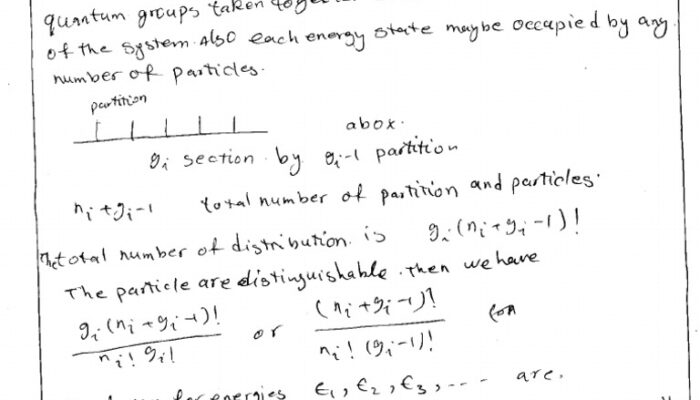
Bose-Einstein statistics, formulated by physicists Satyendra Nath Bose and Albert Einstein in the early 1900s, provide a fundamental framework for describing the statistical behavior of particles known as bosons. These particles, which include photons and certain atoms, follow unique quantum rules that differ from those governing fermions. This statistical model is essential for understanding how bosons distribute themselves among available energy states when in thermal equilibrium, leading to phenomena that defy classical physics.
- Bosons:
Particles with integer spin that can occupy the same quantum state simultaneously. - Statistical Equilibrium:
The condition where particle distributions remain stable over time under given temperature and energy constraints. - Quantum Effects:
Macroscopic manifestations of quantum mechanics, such as coherence and condensation, arising from Bose-Einstein statistics.
Fundamental Principles and Mechanisms
Bose-Einstein statistics describe how indistinguishable bosons tend to cluster in the lowest available energy states at low temperatures, a behavior that contrasts sharply with fermions, which obey the Pauli exclusion principle. This clustering leads to collective quantum states where particles lose their individual identities and act as a unified whole. The mechanism underlying this phenomenon is the indistinguishability and integer spin of bosons, which allows multiple particles to occupy identical quantum states without restriction.
Bose-Einstein Condensation: A Macroscopic Quantum State
One of the most striking outcomes of Bose-Einstein statistics is the formation of Bose-Einstein condensates (BECs). When a dilute gas of bosonic atoms is cooled to temperatures approaching absolute zero, a large fraction of the atoms collapse into the lowest quantum state, creating a new phase of matter. This condensate exhibits quantum properties on a macroscopic scale, where the atoms behave coherently as a single quantum entity rather than as individual particles.
- Experimental Realization:
First achieved in 1995 using rubidium-87 atoms, marking a milestone in quantum physics. - Applications:
BECs have paved the way for advances in quantum computing, ultra-precise measurements, and fundamental studies of quantum mechanics.
Superfluidity in Helium-4: Quantum Fluid Dynamics
Superfluidity in liquid helium-4 exemplifies Bose-Einstein statistics in action within a condensed matter system. When cooled below approximately 2.17 Kelvin, helium-4 transitions into a superfluid phase characterized by zero viscosity and the ability to flow without energy loss. This phenomenon arises because helium-4 atoms, which are bosons, condense into a coherent ground state, enabling frictionless flow and other non-classical behaviors.
- Critical Temperature:
The lambda point (~2.17 K) marks the onset of superfluidity. - Quantum Phase Transition:
The shift from normal fluid to superfluid is a quantum phase transition driven by Bose-Einstein condensation. - Research Significance:
Studies of superfluid helium provide insights into quantum hydrodynamics and topological quantum phenomena.
Laser Operation and Photon Coherence
The principles of Bose-Einstein statistics are integral to understanding laser technology. Lasers produce coherent light through stimulated emission, a process where photons-bosonic particles-are induced to occupy the same quantum state. This collective occupation results in a highly coherent and amplified beam of light, demonstrating macroscopic quantum coherence in an optical system.
- Stimulated Emission:
The mechanism by which photons trigger the emission of identical photons, leading to light amplification. - Macroscopic Quantum System:
The laser acts as a large-scale quantum system where photon coherence is maintained. - Technological Impact:
Lasers revolutionized communication, medicine, and manufacturing by harnessing quantum coherence.
Quantum Gases: Interplay of Bose and Fermi Statistics
Research into quantum gases has expanded our understanding of how different quantum statistics govern particle behavior. While bosons follow Bose-Einstein statistics, fermions adhere to Fermi-Dirac statistics, which prohibit multiple occupancy of the same quantum state. Investigations into mixtures of Bose and Fermi gases reveal complex interactions, such as phase separation and induced superfluidity, highlighting the rich physics emerging from the coexistence of these two particle types.
- Fermi Gases:
Composed of fermions like electrons, exhibiting exclusion principles. - Bose-Fermi Mixtures:
Systems where bosons and fermions interact, leading to novel quantum phases. - Scientific Importance:
These studies deepen our grasp of quantum many-body systems and emergent phenomena.
Quantum Vortices: Topological Features in Superfluids
Quantum vortices are fascinating manifestations of Bose-Einstein phenomena observed during the superfluid transition. These vortices consist of a core region devoid of superfluid density, encircled by quantized circulation of the superfluid flow. Their formation and stability provide direct evidence of the collective quantum nature of superfluids and serve as a bridge between quantum mechanics and fluid dynamics.
- Vortex Core:
A central area where superfluid density drops to zero. - Quantized Circulation:
The superfluid flow around the vortex is quantized, reflecting underlying quantum constraints. - Topological Significance:
Vortices illustrate fundamental aspects of topological quantum physics.
Applications in Precision Measurement and Technology
The coherence properties arising from Bose-Einstein statistics have enabled breakthroughs in metrology and precision instrumentation. Technologies such as atomic clocks and atomic interferometers exploit the quantum coherence of Bose-Einstein condensates and laser light to achieve unprecedented accuracy. These advancements underpin critical systems like global navigation and timing infrastructure, demonstrating the practical impact of quantum statistical principles.
- Atomic Clocks:
Devices that use quantum coherence for ultra-precise timekeeping. - Atomic Interferometry:
Techniques that measure minute changes in physical quantities using coherent atomic states. - Societal Impact:
Enhanced navigation, telecommunications, and scientific research rely on these quantum-enabled technologies.
Common Misconceptions About Bose-Einstein Phenomena
Bose-Einstein condensates are just theoretical constructs.
BECs have been experimentally realized and studied extensively since 1995.
Superfluidity violates the laws of classical physics.
Superfluidity is fully consistent with quantum mechanics, revealing limits of classical descriptions.
Lasers do not involve quantum effects.
Laser operation fundamentally depends on quantum coherence and stimulated emission of photons.
Significance and Impact of Bose-Einstein Statistics
The study of Bose-Einstein statistics has profoundly influenced multiple scientific disciplines, from fundamental physics to applied technology. By elucidating how bosons behave collectively, this framework has challenged classical paradigms and enabled the discovery of new states of matter and quantum phenomena. The ongoing exploration of Bose-Einstein effects continues to inspire innovations in quantum computing, materials science, and precision measurement, underscoring its pivotal role in advancing both theoretical understanding and practical applications.
FAQ
What is Bose-Einstein statistics?
Bose-Einstein statistics describe the distribution of identical indistinguishable bosons over energy states in thermal equilibrium, allowing multiple particles to occupy the same quantum state.
What practical applications arise from Bose-Einstein phenomena?
Applications include quantum computing, precision measurement technologies like atomic clocks, lasers for communication, and studies of superfluidity in materials science.
How do Bose-Einstein condensates differ from classical gases?
Unlike classical gases where particles behave independently, in Bose-Einstein condensates large numbers of bosons occupy the same ground quantum state, acting as a single quantum entity.






Leave a Reply