
Short Answer
Definition of Fredkin Gates
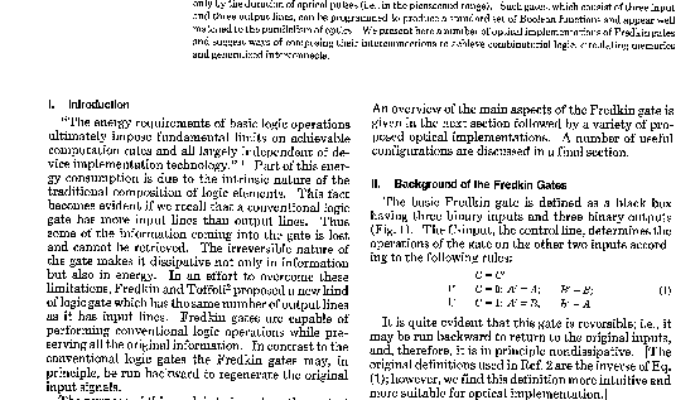
Fredkin gates are a class of reversible logic gates fundamental to the advancement of quantum and theoretical computing. Unlike traditional logic gates, which often lose information during processing, Fredkin gates preserve input data by enabling the exact reconstruction of inputs from outputs. This reversibility is crucial for minimizing energy loss and enhancing computational efficiency.
- Reversible Logic:
Fredkin gates operate under the principle that every output state corresponds uniquely to an input state, ensuring no information is discarded. - Energy Efficiency:
By preventing information loss, these gates reduce heat generation, a common issue in classical computing systems.
Principles of Reversible Computing
At the heart of Fredkin gates lies reversible computing, a paradigm designed to conserve information and reduce energy dissipation during computation. Classical computing processes typically involve irreversible operations that discard bits of information, resulting in heat production and increased power consumption. Fredkin gates counteract this by allowing computations to be reversed, thereby recovering original inputs from outputs without loss.
This characteristic is especially significant in quantum computing, where maintaining coherence and minimizing decoherence are essential. Fredkin gates support quantum operations by preserving quantum states, facilitating more stable and efficient quantum algorithms.
Role in Quantum Algorithms
Fredkin gates enhance the design and execution of quantum algorithms by leveraging their reversible nature. This capability allows complex quantum operations to be performed without the energy inefficiencies inherent in classical logic gates. For example, optimization and search algorithms, such as Grover’s algorithm, benefit from Fredkin gates by improving the precision and reliability of quantum state manipulations.
Additionally, Fredkin gates are instrumental in quantum error correction schemes. Their reversibility enables the system to revert to previous states, mitigating errors caused by environmental noise and preserving the integrity of qubit operations, which is vital for practical quantum computing.
Applications in Cryptography
As quantum computing evolves, so does the need for robust cryptographic methods. Fredkin gates contribute to this by enabling the construction of encryption algorithms that are inherently resistant to traditional decryption techniques. Their reversible logic supports advanced cryptographic protocols, including quantum key distribution (QKD), which ensures secure communication by detecting any interception attempts through the reversibility of operations.
Moreover, Fredkin gates facilitate secure multiparty computation, allowing multiple participants to jointly compute functions without exposing their private inputs. This capability is a significant advancement in maintaining data privacy and security in distributed computing environments.
Modeling Complex Systems with Fredkin Gates
Beyond computation, Fredkin gates are valuable tools in simulating complex systems found in physics and biology. Their ability to implement reversible transformations makes them ideal for modeling dynamic interactions and processes with high fidelity.
For instance, in cellular automata, Fredkin gates enable the creation of sophisticated algorithms that mimic biological phenomena such as genetic variation, natural selection, and ecological dynamics. These models provide deeper insights into the mechanisms governing living systems and their evolution.
Emerging Computing Paradigms Enabled by Fredkin Gates
Fredkin gates are instrumental in the development of novel computing frameworks, including optical and neuromorphic computing. Optical computing leverages light for data transmission and processing, offering speed advantages over electronic systems. Integrating Fredkin gates into optical circuits allows for rapid, energy-efficient data manipulation at the speed of light.
Neuromorphic computing, which emulates the neural structures of the human brain, also benefits from Fredkin gates. By constructing networks of reversible gates that simulate synaptic connections, researchers aim to develop adaptive learning algorithms that improve artificial intelligence systems’ efficiency and responsiveness.
Mathematical Representation of Fredkin Gates
The Fredkin gate is a three-input, three-output reversible gate often represented as a controlled swap gate. Its operation can be described as follows:
- Inputs: C (control), A, B
- Outputs: C, A’, B’
- Function: If C = 0, then A’ = A and B’ = B (no swap). If C = 1, then A’ = B and B’ = A (swap occurs).
This behavior ensures that the control bit remains unchanged while the other two bits are conditionally swapped, preserving reversibility.
Common Misconceptions About Fredkin Gates
Fredkin gates are only theoretical and have no practical applications.
Fredkin gates are actively used in quantum computing, cryptography, and complex system modeling, demonstrating significant practical relevance.
Reversible computing is slower than classical computing.
While reversible computing may introduce complexity, it reduces energy loss and can enhance performance in quantum and optical computing contexts.
Significance of Fredkin Gates in Modern Technology
Fredkin gates are pivotal in bridging classical and quantum computing, offering pathways to more energy-efficient, secure, and powerful computational systems. Their reversible nature addresses fundamental limitations of traditional logic gates, enabling advancements in quantum algorithms, cryptographic security, and the simulation of complex natural phenomena. As research progresses, Fredkin gates are expected to underpin emerging technologies that redefine computational capabilities and scientific exploration.
FAQ
What are Fredkin gates?
Fredkin gates are reversible logic gates that preserve input data during processing, crucial for quantum computing.
How do Fredkin gates improve energy efficiency?
They minimize energy loss by allowing computations to be reversed without discarding information.
What applications do Fredkin gates have?
They are used in quantum algorithms, cryptography, and modeling complex systems in physics and biology.




Leave a Reply