
Short Answer
Definition of an Atom
An atom is the smallest unit of matter that retains the properties of an element. It serves as the fundamental constituent of all substances in the universe, forming the basis for the diverse materials we encounter. Despite their incredibly small size, atoms possess a complex internal structure that governs the behavior and characteristics of matter at both microscopic and macroscopic scales.
Fundamental Components of an Atom
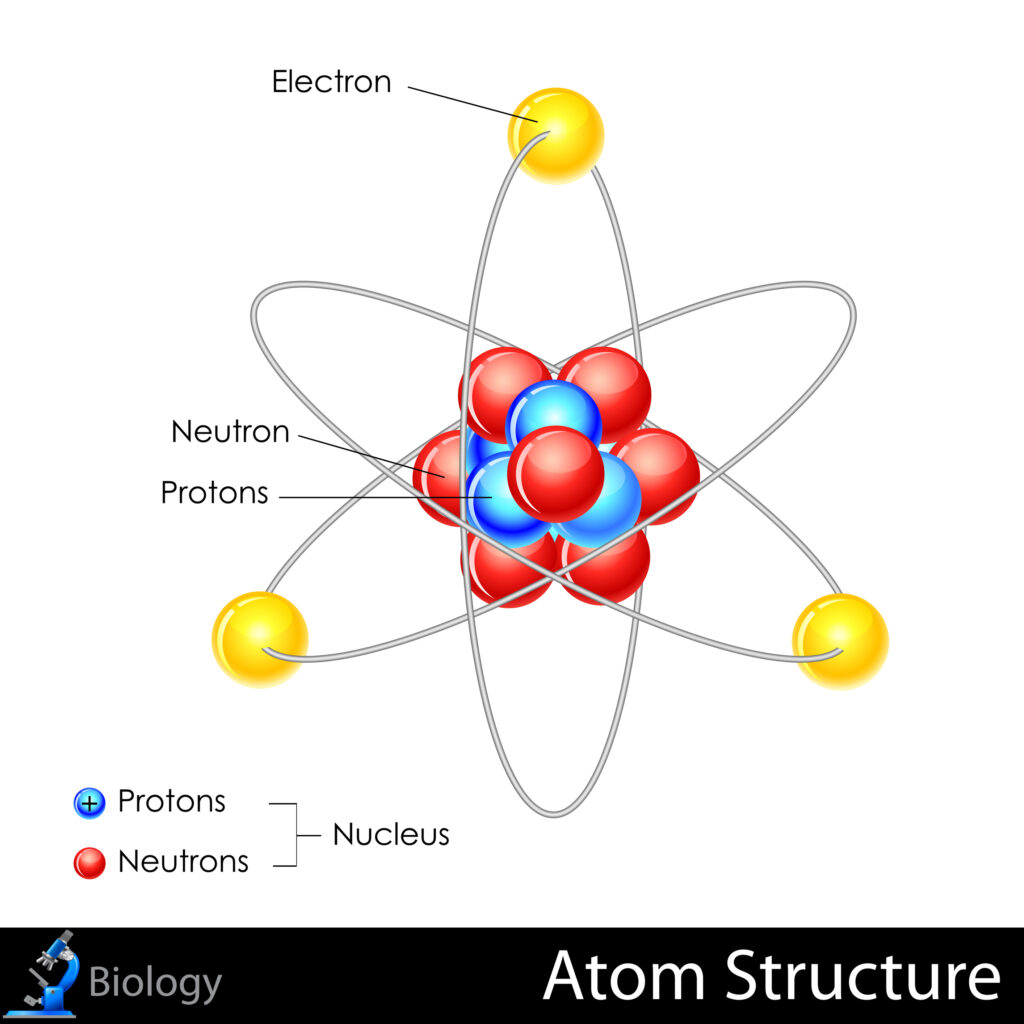
Atoms are composed of three essential subatomic particles: protons, neutrons, and electrons. These particles are arranged in a distinctive configuration that defines the atom’s identity and properties.
- Protons:
Positively charged particles located in the nucleus, contributing significantly to the atom’s mass and determining the element’s atomic number. - Neutrons:
Electrically neutral particles also found in the nucleus, adding to the atom’s mass and influencing isotopic variations. - Electrons:
Negatively charged, lightweight particles that orbit the nucleus within defined energy levels or shells, responsible for chemical bonding and interactions.
Atomic Structure and Its Significance
The nucleus, a dense core at the center of the atom, contains protons and neutrons tightly bound together. Surrounding this nucleus is the electron cloud, where electrons move in probabilistic patterns dictated by quantum mechanics. The number of protons (atomic number) uniquely identifies each element, such as hydrogen with one proton or oxygen with eight. This atomic number not only classifies elements but also influences their chemical behavior and reactivity.
Electron Configuration and Chemical Bonding
Electrons occupy specific energy levels or shells around the nucleus, with their arrangement governed by quantum mechanical principles. The outermost electrons, known as valence electrons, play a crucial role in chemical bonding. Atoms seek to achieve stable electron configurations, often resembling the nearest noble gas, through various types of bonds:
- Ionic Bonds:
Formed by the transfer of electrons from one atom to another, typically between metals and nonmetals, resulting in oppositely charged ions that attract each other. - Covalent Bonds:
Created when atoms share electrons to fill their valence shells, leading to the formation of molecules. - Metallic Bonds:
Characterized by a ‘sea’ of delocalized electrons shared among metal atoms, imparting properties like electrical conductivity and malleability.
Isotopes and Atomic Variability
Atoms of the same element can differ in the number of neutrons they contain, producing isotopes. These isotopes may exhibit distinct physical properties or radioactive decay behaviors. The study of isotopes is vital in applications such as radiometric dating, which helps determine the age of archaeological finds, and nuclear medicine, where radioactive isotopes are used for diagnosis and treatment.
Quantum Mechanics and Atomic Behavior
At the subatomic level, classical deterministic models give way to quantum mechanics, which describes electron positions and energies in terms of probabilities. This framework explains phenomena like quantum entanglement and superposition, which have profound implications for emerging technologies such as quantum computing. Understanding these quantum effects is essential for advancing modern physics and material science.
Atomic Interactions in Chemical Reactions
Chemical reactions involve the breaking and forming of bonds between atoms, transforming reactants into new products. These processes are driven by kinetic energy and governed by thermodynamic principles, enabling the dynamic changes in matter that underpin biological functions, industrial processes, and environmental phenomena.
Macroscopic Implications of Atomic Structure
The collective arrangement and bonding of atoms determine the physical properties of materials, including their phase (solid, liquid, gas), density, melting and boiling points, and electrical conductivity. For example, the exceptional hardness of diamond arises from a rigid lattice of carbon atoms connected by strong covalent bonds, whereas water’s liquid state at room temperature is due to weaker hydrogen bonds between molecules.
Atoms in the Cosmos
Beyond terrestrial matter, atoms aggregate under gravitational forces to form larger structures such as stars and planets. This cosmic assembly illustrates the transition from microscopic atomic interactions to vast celestial bodies, highlighting the interconnectedness of physical laws across scales.
Why Understanding Atoms Is Crucial
Grasping the nature of atoms is fundamental to numerous scientific disciplines, including physics, chemistry, biology, and materials science. It enables the development of new technologies, from medical imaging to nanotechnology, and deepens our comprehension of the universe’s fabric. The study of atoms not only enriches scientific knowledge but also inspires philosophical reflection on the essence of existence and the intricate design of nature.
Summary
In essence, atoms are intricate assemblies of protons, neutrons, and electrons that form the foundation of all matter. Their internal structure and interactions dictate the properties and behaviors of substances, influencing everything from chemical reactions to the formation of celestial bodies. Exploring atomic composition and dynamics provides critical insights into the material world and fuels ongoing advancements in science and technology.
FAQ
What are the main components of an atom?
An atom is primarily made up of protons, neutrons, and electrons.
Why is atomic structure important?
Atomic structure determines the chemical properties and behavior of elements.
What are isotopes?
Isotopes are variants of the same element with different numbers of neutrons.






Leave a Reply