
Short Answer
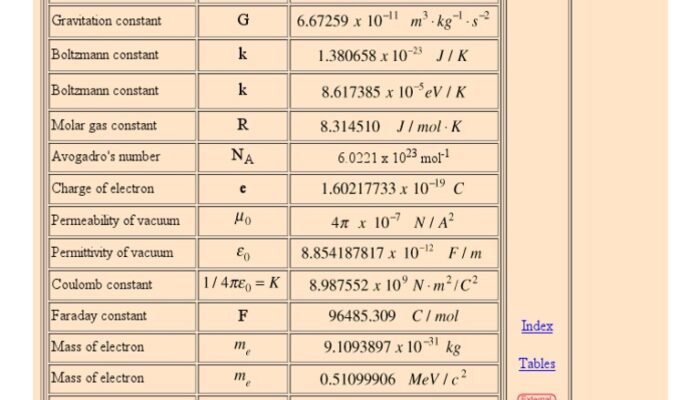
Definition of Fundamental Constants
Fundamental constants are intrinsic quantities in nature that remain unchanged across different physical contexts and theoretical frameworks. These constants serve as the foundational parameters in physics, underpinning the laws that govern the universe. Examples include:
- Speed of Light (c):
Approximately 299,792,458 meters per second, this constant represents the maximum speed at which information or matter can travel in a vacuum. It is central to Einstein’s theory of relativity and acts as a universal speed limit. - Planck’s Constant (h):
A key element in quantum mechanics, Planck’s constant quantifies the discrete nature of energy levels, linking the energy of photons to their frequency and bridging the gap between classical and quantum physics. - Gravitational Constant (G):
Governing the strength of gravitational attraction, this constant is fundamental to Newtonian gravity and Einstein’s general relativity, determining how masses influence one another across space.
Theoretical Perspectives on Variability
While traditionally regarded as immutable, some theoretical frameworks propose that these constants might not be fixed eternally. Certain cosmological models, such as those involving a varying speed of light (VSL), suggest that constants could change depending on the universe’s age or its evolutionary phase. This challenges the classical definition of a constant and opens new avenues for understanding the fabric of space and time.
For instance, if the speed of light were different during early cosmic epochs, it would have profound consequences for the interpretation of cosmological data and the laws governing the universe. Such hypotheses also raise questions about the universality of physical laws, especially when considering multiverse theories where constants might differ between universes.
Implications of Changing Constants
Should fundamental constants vary, even slightly, the ramifications for physics and cosmology would be significant. Variations in the gravitational constant, for example, could provide alternative explanations for phenomena like the accelerated expansion of the universe, currently attributed to dark energy. This possibility invites a reexamination of existing models and encourages the search for new physics beyond the Standard Model.
Moreover, the detection of such changes would necessitate a critical reassessment of empirical data, emphasizing the dynamic relationship between theoretical predictions and observational evidence.
Experimental Approaches to Detect Variability
Advances in precision measurement technologies have enabled scientists to test the constancy of fundamental constants with extraordinary accuracy. Instruments such as atomic clocks and laser interferometers are at the forefront of this research, capable of detecting minute fluctuations that could indicate variability.
Although current experimental results largely support the constancy of these parameters, ongoing investigations continue to push the boundaries, leaving open the possibility of discovering subtle deviations that could revolutionize our understanding of physics.
Philosophical and Scientific Reflections
The notion that fundamental constants might change over time or space carries profound philosophical implications. It challenges the classical view of a deterministic universe governed by unchanging laws, suggesting instead a cosmos that may be more fluid and dynamic.
This perspective invites a dialogue between physics, metaphysics, and the philosophy of science, questioning whether the laws of nature are absolute truths or evolving constructs shaped by the progression of scientific knowledge.
Connection to the Anthropic Principle
The potential variability of constants also intersects with the anthropic principle, which considers why the constants of nature appear finely tuned to allow the emergence of life. If constants can fluctuate, it raises the question of whether their observed stability is a prerequisite for the existence of observers like us.
This viewpoint adds a layer of complexity to the study of fundamental constants, blending scientific inquiry with existential considerations about the conditions necessary for life in the universe.
Future Directions in Research
Discovering that fundamental constants are not truly constant would prompt a major shift in theoretical physics. Scientists would need to develop new frameworks that integrate variable constants, potentially uniting classical and quantum theories in novel ways.
This endeavor would require innovative approaches to reconcile emerging empirical evidence with established principles, potentially leading to breakthroughs in our comprehension of the universe’s underlying structure.
Conclusion
The hypothesis that fundamental constants may vary challenges long-held assumptions and stimulates a broad spectrum of scientific and philosophical exploration. It underscores the intricate relationship between empirical investigation and theoretical innovation, highlighting humanity’s ongoing quest to unravel the mysteries of the cosmos. As research progresses, we may uncover a more intricate and dynamic narrative of the universe than previously envisioned, reshaping our understanding of reality itself.
FAQ
What are fundamental constants?
Fundamental constants are intrinsic quantities in nature that remain unchanged across different physical contexts and theoretical frameworks, serving as foundational parameters in physics.
Can fundamental constants change?
Some theoretical frameworks propose that fundamental constants might not be fixed eternally, suggesting variations based on the universe’s age or evolutionary phase.
What are the implications if constants vary?
Variations in fundamental constants could lead to significant changes in our understanding of physics and cosmology, challenging existing models and inviting new theories.





Leave a Reply