
Short Answer
Definition of Dark Matter and Its Cosmic Role
Dark matter is a mysterious and invisible form of matter that constitutes about 27% of the universe’s total energy content. It does not emit, absorb, or reflect light, making it undetectable through conventional telescopes. Despite its elusive nature, dark matter plays a fundamental role in shaping the large-scale structure of the cosmos by exerting gravitational forces that influence the formation and evolution of galaxies.
- Dark Matter:
A non-luminous component of the universe that interacts primarily through gravity. - Dark Matter Haloes:
Massive, roughly spherical regions of dark matter that envelop galaxies and act as gravitational scaffolds.
Formation and Structure of Dark Matter Haloes
Following the Big Bang, as the universe expanded and cooled, matter began to clump together under gravity. Regions with slightly higher density attracted more matter, deepening gravitational wells and leading to the formation of dark matter haloes. These haloes serve as the gravitational backbone around which ordinary (baryonic) matter accumulates, eventually giving rise to galaxies.
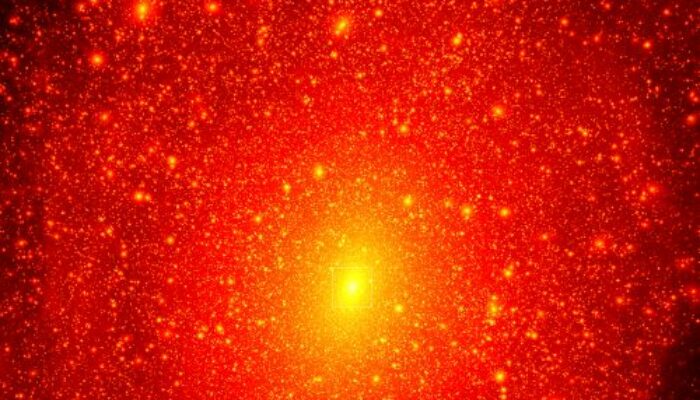
Contrary to earlier beliefs that dark matter haloes are smooth and uniform, recent high-resolution cosmological simulations reveal that these haloes possess a complex, irregular structure. Instead of a homogeneous shell, dark matter haloes exhibit a “clumpy” morphology, characterized by dense substructures and uneven mass distribution.
Hierarchical Substructure: The Matryoshka Doll Analogy
Dark matter haloes contain smaller clumps known as subhaloes, nested within larger haloes in a hierarchical fashion. This arrangement resembles Russian Matryoshka dolls, where each smaller doll fits inside a larger one. These subhaloes influence the dynamics of their host galaxies and are critical for understanding phenomena such as galaxy rotation curves and gravitational lensing.
Mechanisms Behind Clumpiness in Dark Matter Haloes
The clumpy nature of dark matter haloes arises from complex gravitational interactions and cosmic evolution processes, including tidal forces and virialization. As dark matter particles interact gravitationally over billions of years, they form a cosmic web of filaments, voids, and knots. This intricate network results in localized concentrations of mass within haloes, which vary significantly in size and density.
Significance of Clumpiness in Galaxy Formation and Evolution
The uneven distribution of dark matter within haloes is crucial for the birth and development of galaxies. These dense clumps create gravitational wells that attract baryonic matter, facilitating star formation and the assembly of galactic structures. Furthermore, the pattern of clumpiness can influence galactic interactions, mergers, and the long-term fate of galaxies.
Addressing the Satellite Galaxy Problem
One notable cosmological puzzle is the discrepancy between the predicted number of satellite galaxies from dark matter simulations and the fewer satellites observed around galaxies like the Milky Way. The clumpy substructure model offers a plausible explanation: many subhaloes may lack sufficient baryonic matter to form visible galaxies, thus remaining dark and undetectable.
Advanced Simulations and Their Contributions
Modern N-body simulations, which model the gravitational interactions of millions of particles, have revolutionized our understanding of dark matter haloes. These computational tools provide detailed visualizations of the cosmic web and reveal the scale and distribution of clumps within haloes. By capturing the dynamic evolution of dark matter, simulations help scientists interpret observational data and refine theoretical models.
Implications for Cosmology and Dark Energy
The clumpy distribution of dark matter also has profound implications for broader cosmological questions. The interplay between the gravitational pull of dark matter clumps and the accelerating expansion of the universe driven by dark energy may shed light on phenomena such as cosmic inflation and the universe’s ultimate destiny. Understanding these interactions is essential for unraveling the fundamental forces shaping the cosmos.
Why Understanding Dark Matter Clumpiness Matters
Recognizing the heterogeneous nature of dark matter haloes transforms our perception of the universe from a smooth, uniform expanse to a richly textured cosmic tapestry. This insight is vital for astrophysics, as it influences galaxy formation theories, gravitational lensing studies, and the search for direct dark matter detection. By appreciating the complexity of dark matter structures, researchers can better interpret astronomical observations and develop more accurate cosmological models.
Summary
Contemporary research and simulations depict dark matter haloes not as smooth, featureless spheres but as intricate, clumpy structures with hierarchical subhaloes. This nuanced understanding enhances our grasp of galaxy formation, cosmic evolution, and the fundamental nature of the universe. As simulation techniques advance and observational data improve, the enigmatic role of dark matter continues to unfold, offering deeper insights into the cosmic dance between visible and invisible matter.
FAQ
What is dark matter?
Dark matter is a non-luminous, invisible form of matter that makes up about 27% of the universe and influences the formation of galaxies through gravitational forces.
What are dark matter haloes?
Dark matter haloes are massive, roughly spherical regions of dark matter that envelop galaxies and serve as gravitational scaffolds.
Why is clumpiness in dark matter important?
The clumpy distribution of dark matter within haloes plays a crucial role in galaxy formation and can influence cosmic evolution and interactions.



Leave a Reply