Why was CERN built?

The European Organization for Nuclear Research, commonly known as CERN, stands as a monumental edifice of scientific ambition and inquiry. Established in 1954, its inception was fueled by a confluence of factors that transcended national pride and post-war recovery. At the heart of CERN’s creation lies a profound aspiration: to unfurl the enigmatic tapestry of […]

Read More →

How were the 12 fundamental particles originally identified?

The identification of the twelve fundamental particles, which form the cornerstone of the Standard Model of particle physics, is a captivating journey through scientific inquiry that spans decades and unfolds the intricate tapestry of the universe. These particles, divided into two broad categories—fermions and bosons—each play a critical role in the fundamental structure of matter […]

Read More →

What are elementary particles made of?

Have you ever pondered the intricate tapestry of the universe and the fundamental constituents that compose it? The notion of elementary particles often tantalizes the imagination. These enigmatic entities serve as the foundational elements of matter, yet they elude straightforward comprehension. So, what are elementary particles made of? To navigate this compelling inquiry, we delve […]

Read More →

What are quarks in an atom?

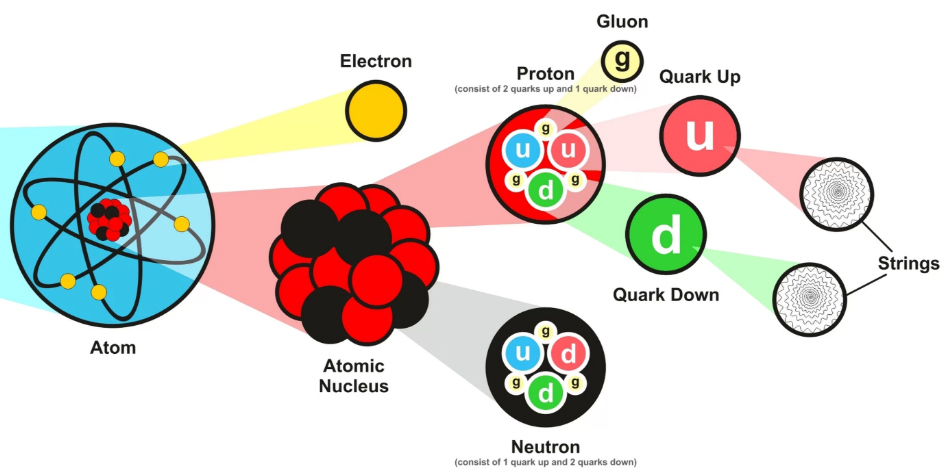
What if you could peel back the layers of matter, delving into an intricate world that defies the simplicity of everyday observations? The atom, long acknowledged as the fundamental building block of all matter, is not as elementary as one might surmise. At its heart, more specifically within its nucleus, lies a bewilderingly complex ensemble […]

Read More →

Are there elementary particles undiscovered in the universe?

In the realm of particle physics, the quest to elucidate the fundamental constituents of matter has been an enduring pursuit. The Standard Model, which has underpinned a plethora of experimental findings, delineates a framework comprising twelve elementary particles. However, profound questions remain regarding whether there exist additional, undiscovered elementary particles lurking in the cosmos, potentially […]

Read More →

What are the fundamentals of particle physics?

Particle physics, a fundamental branch of theoretical physics, delves into the intricacies of the smallest constituents of matter and the forces that govern them. As an overarching field, it aims to elucidate the fundamental structure of the universe. This discipline encompasses a plethora of concepts, experiments, and philosophical inquiries. This article aims to explore the […]

Read More →

What are current research directions in particle physics?

Particle physics remains a captivating domain of inquiry, relentlessly seeking to unravel the fundamental constituents of matter and the interactions that govern their behavior. As researchers delve deeper into the fabric of the universe, several prominent research directions emerge, each underscored by a commitment to elucidating not only the known but also the unknown. This […]

Read More →

Why is Higgs boson a boson

The Higgs boson, often termed the “god particle,” continues to captivate physicists and laypersons alike due to its profound implications for our understanding of mass and the fundamental structure of the universe. This elementary particle is classified as a boson, a categorization embedded within the framework of quantum field theory. Understanding why the Higgs boson […]

Read More →

Why is it assumed that neutrinos have rest mass?

Neutrinos, an enigmatic class of subatomic particles, have captivated physicists’ imaginations for decades. Initially presumed to be massless, recent advancements in experimental physics have led to a fundamental reassessment of their properties, particularly regarding their rest mass. This article endeavors to elucidate the rationale behind the prevailing assumption that neutrinos possess rest mass, while simultaneously […]

Read More →