
Short Answer
Definition of Spintronics
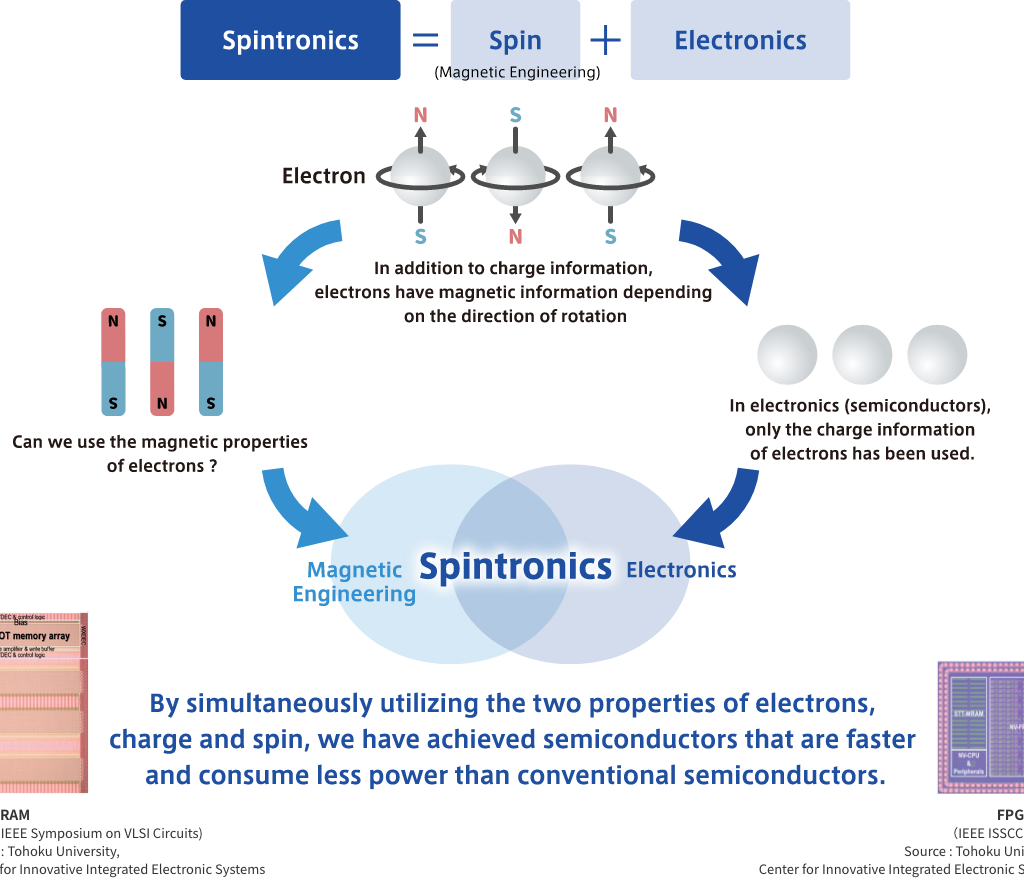
Spintronics, derived from the term “spin transport electronics,” is an innovative branch of semiconductor technology that exploits the intrinsic spin of electrons alongside their electric charge. This quantum mechanical property of electrons offers a new dimension for data processing and storage, promising significant improvements in the speed, efficiency, and functionality of electronic devices. Spintronics is poised to transform various fields, including computing, data storage, sensor technology, and the emerging realm of quantum computing.
Fundamental Concepts of Electron Spin
Electron spin is a fundamental quantum property representing the intrinsic angular momentum of electrons. It can be visualized as a tiny magnetic moment, similar to a spinning top, with electrons existing in one of two spin states: “up” or “down.” These discrete spin orientations serve as the basis for encoding information in spintronic systems. Mastery over the manipulation and control of electron spin states is essential for the development of advanced spin-based technologies.
Mechanism of Spin-Polarized Currents
Central to spintronics is the generation and utilization of spin-polarized currents-streams of electrons predominantly aligned in a single spin orientation. These currents are typically produced using ferromagnetic materials or by applying specialized magnetic fields that favor one spin direction. When electrons move through a medium with controlled spin polarization, it enables more efficient data transmission and storage, facilitating devices that operate faster and consume less energy compared to traditional charge-based electronics.
Key Spintronic Devices and Their Operation
Spintronics has given rise to a variety of devices that leverage electron spin for enhanced performance:
- Magnetic Tunnel Junctions (MTJs):
These consist of two ferromagnetic layers separated by a thin insulating barrier. The electrical resistance of the junction changes depending on whether the magnetizations of the layers are aligned parallel or antiparallel, enabling binary data representation. - Spin Field-Effect Transistors (Spin-FETs):
These devices utilize both the charge and spin of electrons to modulate current flow, offering improved efficiency and speed over conventional transistors that rely solely on charge.
Spintronics in Quantum Computing
The integration of spintronics with quantum computing is particularly promising. Quantum bits, or qubits, can be realized using electron spin states, which provide a robust platform for encoding quantum information. Spin-based qubits exhibit long coherence times, a critical factor for reliable quantum computation. Advances in spintronics are enabling the development of stable and controllable spin qubits, which could accelerate the realization of practical quantum computers.
Material Innovations Driving Spintronics
Research into materials suitable for spintronic applications is rapidly evolving. Several classes of materials have shown exceptional promise due to their unique spin-related properties:
- Magnetic Semiconductors:
These materials combine magnetic ordering with semiconductor behavior, facilitating spin manipulation within electronic circuits. - Topological Insulators:
Characterized by conducting surface states with spin-momentum locking, these materials enable efficient spin transport with minimal energy loss. - Graphene:
Known for its exceptional electrical conductivity and long spin diffusion lengths, graphene is a leading candidate for spintronic devices. - Perovskite Oxides and Transition Metal Dichalcogenides:
These materials exhibit remarkable spin properties and compatibility with existing semiconductor fabrication methods, making them attractive for future device integration.
Challenges Facing Spintronics Development
Despite its potential, spintronics faces several significant obstacles:
- Spin Stability at Room Temperature:
Maintaining coherent spin states under ambient conditions is difficult due to thermal fluctuations that disrupt spin alignment. - Scalability of Fabrication:
Engineering methods to produce spintronic devices on a large scale with consistent quality remains a complex challenge. - Interdisciplinary Collaboration:
Progress requires coordinated efforts among physicists, materials scientists, and electrical engineers to overcome technical and theoretical barriers.
Future Directions and Practical Applications
The outlook for spintronics is highly optimistic as ongoing research continues to deepen understanding of spin dynamics and material properties. Experimental prototypes of spintronic devices are already demonstrating promising results, suggesting that commercial applications may soon follow. Potential future technologies include ultra-low power electronics, memory systems surpassing current flash memory capabilities, and advanced sensors with enhanced sensitivity and functionality.
Importance of Spintronics in Modern Technology
Spintronics represents a paradigm shift in electronics by introducing quantum mechanical spin as a resource for information processing. This approach not only promises to overcome the limitations of traditional charge-based devices but also opens new avenues for innovation in computing, data storage, and sensing technologies. The continued advancement of spintronics is expected to have profound impacts on both scientific research and everyday technology, driving the next generation of electronic devices.
FAQ
What is spintronics?
Spintronics is a technology that uses the spin of electrons, in addition to their charge, to improve electronic devices’ speed, efficiency, and functionality.
How do spin-polarized currents work in spintronics?
Spin-polarized currents consist of electrons aligned in a single spin orientation, enabling more efficient data transmission and reduced energy consumption.
What materials are important for spintronic devices?
Key materials include magnetic semiconductors, topological insulators, graphene, perovskite oxides, and transition metal dichalcogenides.
What challenges does spintronics face?
Challenges include maintaining spin stability at room temperature, scalable fabrication, and interdisciplinary collaboration.
How is spintronics related to quantum computing?
Spintronics can be used to create spin-based qubits with long coherence times, helping realize stable and controllable quantum bits for quantum computers.






Leave a Reply