
Short Answer
Definition of the Quantum Hall Effect
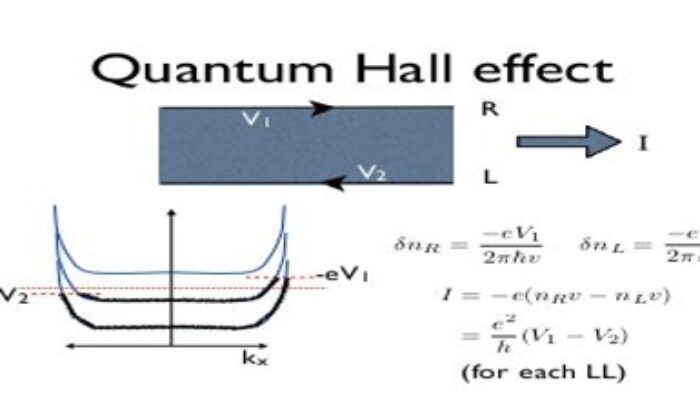
The Quantum Hall Effect (QHE) is a remarkable phenomenon observed in condensed matter physics, where the interplay between electric charge, magnetic fields, and quantum mechanics produces quantized conductance in two-dimensional electron systems. This effect becomes especially prominent at extremely low temperatures, revealing unique quantum states that challenge classical understanding of electron behavior.
Fundamental Principles Behind the Quantum Hall Effect
To comprehend the QHE, it is essential to understand the basics of quantum mechanics and electromagnetism. When electrons move within a two-dimensional plane subjected to a perpendicular magnetic field, their motion is profoundly altered. At sufficiently low temperatures, these electrons or quasiparticles settle into discrete quantum states, resulting in quantized energy levels and distinctive transport properties.
- Two-Dimensional Electron Gas (2DEG):
Electrons confined to a thin layer behave differently than in three dimensions, enabling the observation of quantum phenomena like the QHE. - Magnetic Field Influence:
A strong magnetic field perpendicular to the electron plane forces electrons into circular orbits, quantizing their energy into Landau levels. - Low Temperature Requirement:
Cooling the system near absolute zero reduces thermal disturbances, allowing fragile quantum states to emerge clearly.
Temperature’s Role in Enabling Quantum Hall States
Temperature is a critical parameter in the manifestation of the QHE. As the system approaches near-zero temperatures, thermal vibrations diminish, permitting electrons to occupy well-defined quantum states without disruption. This environment fosters spontaneous magnetization effects and leads to the quantization of Hall conductance, which appears as distinct plateaus when measured experimentally.
Types of Quantum Hall Effect
Integer Quantum Hall Effect (IQHE)
Discovered in 1980 by Klaus von Klitzing, the Integer Quantum Hall Effect is characterized by the Hall conductance taking on integer multiples of fundamental constants. This quantization is extraordinarily precise and corresponds to the ratio of the electron charge to Planck’s constant. The IQHE highlights the deep connection between quantum mechanics and electrical conductance, providing a new standard for resistance measurement.
Fractional Quantum Hall Effect (FQHE)
Shortly after the IQHE discovery, researchers observed the Fractional Quantum Hall Effect, where conductance values appear as fractions rather than integers. This phenomenon arises from strong electron-electron interactions, leading to the formation of composite quasiparticles known as composite fermions. The FQHE reveals the collective behavior of electrons in two-dimensional systems under intense magnetic fields and low temperatures.
Topological Order and Edge States in the Quantum Hall Effect
Unlike traditional phases of matter defined by symmetry breaking, the QHE is governed by topological order-a property that remains unchanged under continuous deformations. This topological nature gives rise to robust edge states at the boundaries of the material, where electrons can move without scattering, even in the presence of impurities or defects. These edge states are crucial for potential applications in quantum computing, as they offer stability for quantum bits (qubits).
Mathematical Framework of the Quantum Hall Effect
The quantization of Hall conductance can be expressed mathematically as:
σxy = ν (e²/h)
- σxy: Hall conductance
- ν: Filling factor (integer for IQHE, fractional for FQHE)
- e: Elementary charge of the electron
- h: Planck’s constant
This formula encapsulates how conductance is quantized in discrete steps determined by fundamental physical constants and the filling factor, which reflects the number of filled Landau levels or fractional states.
Practical Applications and Technological Impact
The Quantum Hall Effect has transcended theoretical interest to become a cornerstone in precision metrology. Its highly stable and quantized conductance values serve as the basis for resistance standards worldwide, enabling unparalleled accuracy in electrical measurements. Furthermore, the principles derived from QHE research have inspired the development of novel materials such as topological insulators and have broadened the scope of quantum material science.
Emerging Materials and Future Directions
Recent advances in material science, particularly the study of graphene-a single layer of carbon atoms with exceptional electronic properties-have opened new avenues for exploring the QHE. Graphene’s unique band structure allows for multiple valence bands and enhanced magnetic interactions, potentially leading to new quantum Hall states and deeper insights into electron correlations.
Common Misconceptions About the Quantum Hall Effect
The QHE occurs at any temperature.
The QHE requires extremely low temperatures to suppress thermal noise and allow quantum states to form.
The QHE is only relevant for theoretical physics.
The QHE has practical applications in precision measurement and emerging quantum technologies.
The quantization in QHE is arbitrary.
The quantization is governed by fundamental constants and topological properties of the system.
Significance of the Quantum Hall Effect in Modern Science
The Quantum Hall Effect is pivotal in advancing our understanding of quantum phenomena in low-dimensional systems. It bridges fundamental physics with practical technology, influencing fields such as quantum computing, materials science, and metrology. By revealing how electrons behave under extreme conditions, the QHE continues to inspire innovative research and technological breakthroughs, shaping the future landscape of condensed matter physics and beyond.
FAQ
What causes the Quantum Hall Effect?
It arises from the interaction of electrons confined in two dimensions under strong magnetic fields at low temperatures, leading to quantized Hall conductance.
What are composite fermions in the context of the Quantum Hall Effect?
Composite fermions are quasiparticles formed by electrons binding with magnetic flux quanta, explaining the fractional quantization in the Fractional Quantum Hall Effect.
Why is topological order important in the Quantum Hall Effect?
Topological order ensures robustness of edge states against disorder, which is critical for stable quantum behaviors and potential quantum computing applications.
How has the Quantum Hall Effect influenced technology?
It has led to the establishment of resistance standards with high precision and inspired research into novel quantum materials and quantum information science.



Leave a Reply