Carbon Nanotubes Store Solar Energy: Sunlight in a Cylinder

Definition of Carbon Nanotubes Carbon nanotubes (CNTs) are cylindrical nanostructures formed by rolling sheets of graphene into seamless tubes. Composed entirely of carbon atoms arranged in a hexagonal lattice, these nanomaterials exhibit exceptional mechanical strength, electrical conductivity, and thermal stability. Their unique architecture and properties make them highly valuable in various scientific and technological fields, […]

Read More →

Is a doctorate in applied physics more flexible than nuclear?

Definition of Applied Physics and Nuclear Physics Physics is a broad scientific discipline encompassing numerous specialized fields, each with unique challenges and career paths. Two notable doctoral-level specializations are applied physics and nuclear physics. Both fields deepen understanding of fundamental physical principles but differ significantly in their scope, applications, and career flexibility. Applied Physics Applied […]

Read More →

How Strong Is Borophene? Breaking Records at Atomic Scale

Definition of Borophene Borophene is a novel two-dimensional material consisting of a single atomic layer of boron atoms arranged in a distinctive lattice structure. This ultrathin sheet exhibits extraordinary mechanical, electrical, and thermal properties that surpass many traditional materials, positioning it as a groundbreaking advancement in the field of advanced materials science. Atomic Composition: Comprised […]

Read More →

What is so special about carbon nanotubes?

Definition and Overview of Carbon Nanotubes Carbon nanotubes (CNTs) represent a remarkable form of carbon, showcasing the element’s extraordinary adaptability. These nanoscale cylindrical structures resemble intricately woven fibers, combining exceptional strength with innovative potential in fields such as nanotechnology and materials science. Understanding their significance requires an exploration of their unique architecture, intrinsic properties, synthesis […]

Read More →

How many hydrogen atoms are in a mole?

Definition of a Mole in Chemistry The mole is a fundamental unit in chemistry that quantifies the amount of substance. It is defined as the number of elementary entities-such as atoms, molecules, ions, or particles-contained in exactly 12 grams of carbon-12. This number, known as Avogadro’s constant, is approximately 6.022 × 10²³. The mole bridges […]

Read More →

How does Quantum Machine Learning work?

Definition of Quantum Machine Learning Quantum Machine Learning (QML) is an emerging discipline that merges the principles of quantum physics with machine learning techniques. It explores how quantum computing can be leveraged to improve the efficiency and capabilities of algorithms designed to analyze and interpret data. This innovative field not only promises significant computational advancements […]

Read More →

Do particle physicists accept quantum field theory?

Definition of Quantum Field Theory Quantum Field Theory (QFT) is a fundamental framework in modern physics that describes particles not as isolated objects but as excitations or disturbances in underlying fields that permeate all of space. This approach unifies quantum mechanics with special relativity, providing a comprehensive language to explain the behavior and interactions of […]

Read More →

Sagar Kumar’s Atomic Ambitions: Navigating Nanoscience and Beyond

Overview of Nanoscience and Atomic Ambitions Nanoscience, an interdisciplinary field merging physics, chemistry, and biology, has rapidly evolved into a dynamic area of scientific research. Sagar Kumar’s Atomic Ambitions emerges as a groundbreaking work that thoroughly examines the principles and phenomena at the nanoscale. This book offers readers a blend of theoretical insights and practical […]

Read More →

Will we ever have a quantum computer on the chip?

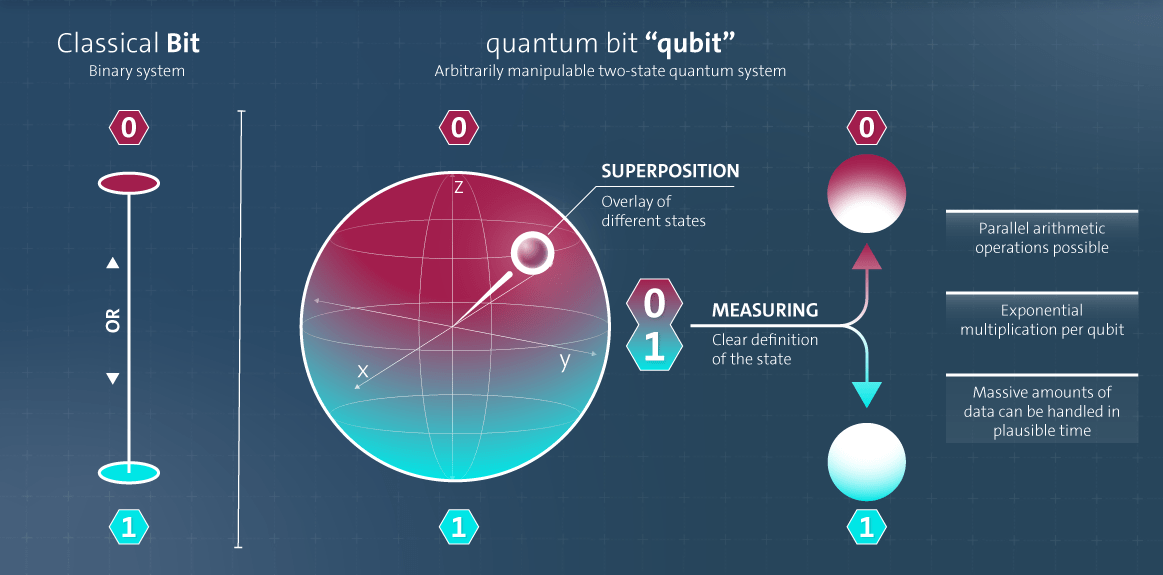
Understanding Quantum Computing Quantum computing marks a revolutionary transformation in how computations are performed. Unlike traditional computers that use bits as the fundamental unit of data-each bit representing either a 0 or a 1-quantum computers utilize quantum bits, or qubits. These qubits can exist in a superposition, meaning they can represent multiple states simultaneously. This […]

Read More →