
Short Answer
Definition of Quantum Condensates
Quantum condensates represent a unique state of matter where particles, such as atoms, coalesce into a single quantum entity exhibiting collective behavior. These states, including Bose-Einstein condensates (BEC) and fermionic condensates, emerge under extremely low temperatures near absolute zero, where thermal agitation is minimized, allowing quantum effects to manifest on a macroscopic scale. Despite their intriguing properties, condensates are inherently delicate and traditionally considered short-lived due to environmental disturbances and particle interactions.
Fundamental Characteristics and Formation
At the core of condensate formation lies the convergence of atoms into a coherent quantum state. This phenomenon occurs when particles occupy the same quantum ground state, resulting in a macroscopic wavefunction that describes the entire system. The suppression of thermal energy at ultracold temperatures is essential for this process, enabling quantum coherence to dominate. However, the fragile nature of these states has historically limited their coherence time, posing challenges for practical applications.
Advancements in Extending Condensate Lifetimes
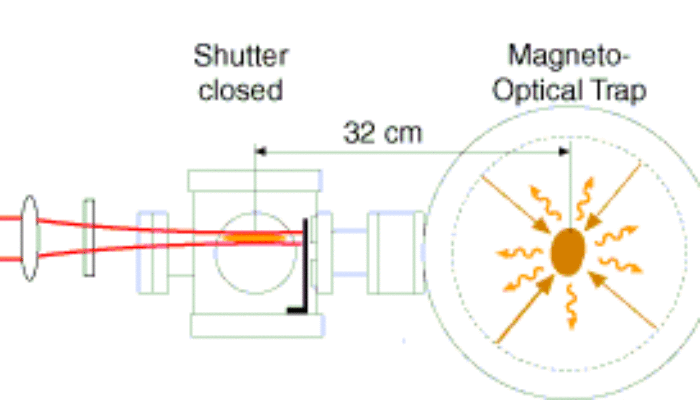
Recent experimental breakthroughs have revolutionized the ability to sustain condensates for longer durations. Enhanced cooling techniques combined with precision optical trapping allow for meticulous confinement of atoms, significantly reducing external perturbations. These innovations have led to a reassessment of the temporal boundaries of condensate stability, opening new avenues for research and technology.
Role of Controlled Disorder
Intriguingly, introducing a measured degree of microscopic disorder within condensates has been shown to prolong coherence times. This controlled randomness disrupts certain decay pathways, paradoxically stabilizing the quantum state. Such findings challenge conventional views on order and disorder in quantum systems and suggest that a delicate balance between the two can enhance robustness.
Particle Interactions and Emergent Stability
Interactions among particles within condensates, whether bosons or fermions, contribute to emergent properties that bolster stability. These coherent interactions act as a collective force, enabling the condensate to resist decoherence longer than previously anticipated. This insight underscores the active role of the condensate’s environment in shaping its lifespan.
Quasiparticles and Their Influence on Coherence
Quasiparticles-collective excitations such as phonons, magnons, and polaritons-arise from interactions within condensed states and play a pivotal role in energy dynamics. By facilitating energy dissipation and coherence preservation, quasiparticles help maintain the delicate equilibrium between stability and decay. This dynamic interaction is central to understanding the mechanisms that govern quantum coherence and thermalization in condensates.
Mathematical Framework and Coherence Time
The coherence time (( tau )) of a condensate can be described by models incorporating particle interactions, environmental coupling, and disorder effects. A simplified expression relates coherence time to the inverse of the decoherence rate (( Gamma )):
( tau = frac{1}{Gamma} )
- ( tau ): Coherence time, the duration over which the condensate maintains quantum coherence.
- ( Gamma ): Decoherence rate, influenced by environmental noise, particle collisions, and disorder.
Advanced models integrate terms accounting for quasiparticle interactions and controlled disorder, reflecting their stabilizing effects on ( tau ).
Practical Applications of Prolonged Condensate Stability
The ability to extend the lifetime of condensates has profound implications across various scientific and technological fields:
- Quantum Computing:
Enhanced coherence times improve qubit reliability, reduce error rates, and increase computational accuracy, addressing a critical challenge in quantum processor development. - High-Precision Metrology:
Stable quantum states enable ultra-precise measurements of physical constants and phenomena, leveraging superposition and entanglement for unprecedented accuracy. - Materials Science:
Understanding condensate stability informs the design of novel materials with tailored quantum properties, potentially leading to breakthroughs in superconductivity and magnetism.
Interdisciplinary Impact and Theoretical Implications
The exploration of long-lived condensates fosters collaboration among physicists, chemists, and engineers, promoting a holistic understanding of matter’s quantum nature. This research challenges existing theoretical frameworks by highlighting the active role of environmental factors and the porous boundaries between different states of matter. Insights gained extend beyond condensed matter physics, influencing emerging fields such as quantum biology and cosmology.
Common Misconceptions About Quantum Condensates
Condensates are inherently unstable and short-lived.
Advances in cooling, trapping, and controlled disorder have demonstrated that condensates can achieve significantly extended coherence times.
Disorder always disrupts quantum coherence.
Controlled microscopic disorder can paradoxically stabilize condensates by inhibiting decoherence pathways.
The environment is a passive backdrop for condensate behavior.
The environment actively influences condensate stability through interactions and quasiparticle dynamics.
Significance of Extended Coherence in Quantum States
Prolonging the lifespan of fragile quantum condensates is pivotal for advancing both fundamental science and practical technologies. It deepens our grasp of quantum mechanics, particularly the interplay between coherence and decoherence, and challenges traditional notions of time at the quantum scale. These developments pave the way for innovative quantum devices, refined measurement techniques, and a richer understanding of the universe’s quantum fabric.
Conclusion: A New Era in Quantum Condensate Research
The stabilization and lengthening of condensate lifetimes mark a transformative shift in quantum physics. By unraveling the mechanisms that govern coherence and decay, researchers are unlocking the latent potential within quantum matter. This progress not only fuels scientific curiosity but also lays the groundwork for future innovations that harness the extended temporal realms of quantum states, reshaping our interaction with the quantum world.
FAQ
What are quantum condensates?
Quantum condensates are states of matter formed when particles, like atoms, coalesce into a singular quantum entity at extremely low temperatures.
How can the lifespan of quantum condensates be extended?
Advancements in cooling techniques and controlled disorder have been shown to prolong the coherence times of quantum condensates.



Leave a Reply