
Short Answer
Definition of Friction
Friction is a fundamental force encountered whenever two surfaces come into contact and resist relative motion. It plays a crucial role in countless natural and engineered processes, from simple daily activities like walking to complex mechanical operations in industrial machinery. This force acts as a countermeasure to motion, enabling control and stability but also introducing challenges such as wear and energy loss.
- Nature of Friction:
It is a resistive force that opposes the sliding or attempted sliding of one surface over another. - Types of Friction:
Primarily divided into static friction (resisting the start of motion) and kinetic friction (resisting motion once it has started).
Measurement Units and Parameters
Since friction is a force, it is measured in Newtons (N), the standard SI unit for force. However, to evaluate how effectively friction acts between two surfaces, scientists and engineers use the coefficient of friction, a dimensionless value that relates frictional force to the normal force pressing the surfaces together.
Coefficient of Friction Explained
The coefficient of friction (μ) is defined as the ratio of the frictional force (Ff) to the normal force (N):
μ = Ff / N
This ratio varies depending on the materials involved and their surface conditions, providing a standardized way to compare frictional properties without units.
Types of Friction and Their Characteristics
Friction manifests in two main forms, each with distinct properties and implications:
- Static Friction:
The force that must be overcome to initiate movement between two stationary surfaces. It generally has a higher coefficient due to molecular adhesion and surface roughness. - Kinetic Friction:
The force opposing motion once sliding has begun, typically lower than static friction, reflecting reduced interlocking between surfaces.
Understanding these differences is vital in applications such as tire design, where maximizing static friction ensures better grip during acceleration and braking.
Methods for Measuring Friction
Quantifying friction involves specialized instruments and techniques designed to simulate and measure forces under controlled conditions.
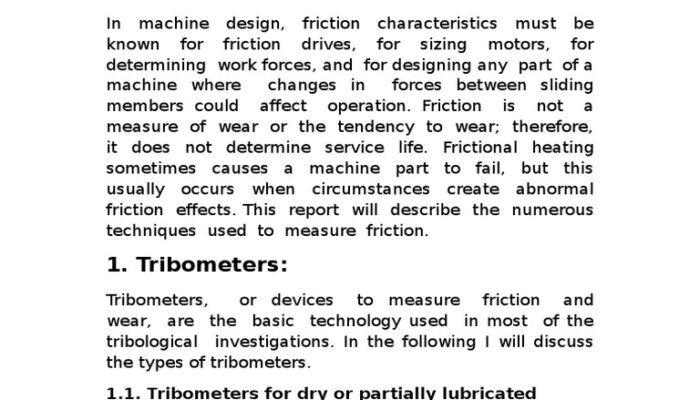
- Tribometers:
Devices that apply known forces to surfaces and measure the resulting frictional resistance. They can operate under various conditions, including dry, lubricated, or partially lubricated environments. - Test Variables:
Factors such as surface roughness, temperature, humidity, and lubrication significantly influence friction measurements and must be carefully controlled or accounted for.
Influence of Environmental and Material Factors
Friction is not solely a function of material properties but is also affected by external conditions and surface treatments.
- Lubrication:
Introducing lubricants reduces friction by creating a film that separates surfaces, lowering the coefficient of friction and minimizing wear. - Temperature and Humidity:
Variations in temperature can alter material properties and frictional behavior, while moisture often decreases friction by acting as a lubricant or contaminant. - Surface Engineering:
Advances in materials science, including nanostructured coatings and composites, enable tailored frictional properties for specific applications.
Thermodynamic Aspects of Friction
Friction generates heat due to the conversion of mechanical energy into thermal energy, which has significant implications for system performance and durability.
- Heat Generation:
Increased friction leads to temperature rises that can cause material degradation, dimensional changes, or failure. - Energy Efficiency:
Managing frictional heat is essential to reduce energy losses and improve the lifespan of mechanical components.
Tribology: The Science of Friction, Wear, and Lubrication
Tribology is the interdisciplinary field dedicated to studying friction, wear, and lubrication, providing insights that drive innovation in material design and mechanical engineering.
- Research Focus:
Developing materials and surface treatments that optimize frictional behavior for enhanced performance. - Technological Advances:
Nanotechnology and surface engineering have enabled the creation of surfaces with customized frictional properties, improving efficiency and durability.
Common Misconceptions About Friction
Friction always slows down motion.
While friction opposes motion, it is essential for activities like walking or driving, where it provides necessary traction.
The coefficient of friction is a fixed property.
It varies with surface conditions, materials, and environmental factors, making it context-dependent.
Practical Applications and Importance
Friction is a critical factor in numerous fields, influencing safety, efficiency, and functionality.
- Automotive Industry:
Tire design relies on optimizing friction to ensure grip and control under various conditions. - Manufacturing:
Controlling friction affects tool wear, energy consumption, and product quality. - Everyday Life:
From walking to using handheld devices, friction enables controlled movement and interaction.
Conclusion: The Multifaceted Nature of Friction
Although friction is measured straightforwardly in Newtons, its complexity extends far beyond simple numeric values. The coefficient of friction bridges theoretical understanding and practical application, reflecting the intricate interplay of materials, forces, and environmental conditions. Ongoing research in tribology continues to deepen our comprehension, enabling innovations that enhance performance and sustainability across diverse technological domains.
FAQ
What is friction?
Friction is a force that opposes the relative motion of two surfaces in contact.
How is friction measured?
Friction is measured in Newtons, and the effectiveness is quantified using the coefficient of friction.
What are the types of friction?
The two main types of friction are static friction and kinetic friction.
What factors influence friction?
Factors include surface roughness, temperature, humidity, and lubrication.



Leave a Reply