
Short Answer
Definition of Neutrinos and Chemical Elements
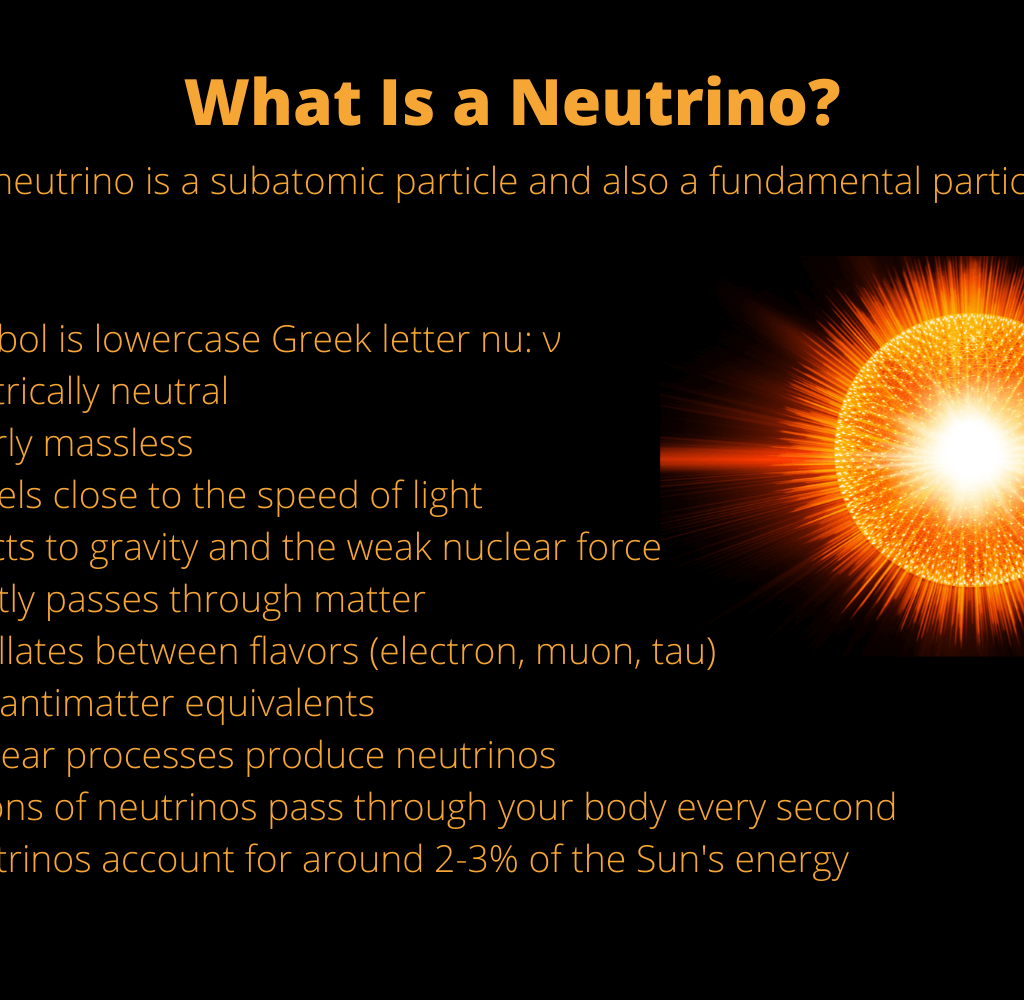
Neutrinos are fundamental subatomic particles that are integral to particle physics but should not be confused with chemical elements. Unlike chemical elements, which are defined by the number of protons in their atomic nuclei and cannot be broken down by chemical means, neutrinos are elementary particles without atomic structure. They belong to the class of fermions and are governed by quantum mechanical laws rather than chemical properties.
- Chemical Elements:
Substances characterized by a fixed number of protons in their atoms, forming the basis of the periodic table and chemical reactions. - Neutrinos:
Electrically neutral, nearly massless particles that do not form atoms and interact primarily through the weak nuclear force.
Historical Background and Discovery
The concept of the neutrino was introduced by physicist Wolfgang Pauli in 1930 to resolve inconsistencies in beta decay, where energy conservation appeared violated. The name “neutrino,” meaning “little neutral one” in Italian, reflects its neutral charge and elusive nature. Experimental confirmation of neutrinos came decades later, facilitated by the development of highly sensitive detectors capable of isolating neutrino signals from background noise.
Physical Characteristics and Types of Neutrinos
Neutrinos are extraordinarily abundant particles in the universe, surpassing electrons in number by vast margins. They are generated through various astrophysical and terrestrial processes, including nuclear fusion in stars, supernova explosions, and cosmic ray interactions with Earth’s atmosphere. Their weak interaction with matter allows them to pass through entire planets virtually undisturbed, making their detection a significant scientific challenge.
- Electron Neutrino:
Associated with electrons, involved in beta decay processes. - Muon Neutrino:
Linked to muons, heavier cousins of electrons. - Tau Neutrino:
Connected to tau particles, the heaviest charged leptons.
Neutrino Oscillation and Mass Implications
One of the most intriguing phenomena involving neutrinos is their ability to oscillate between different flavors-electron, muon, and tau-as they travel through space. This flavor transformation implies that neutrinos possess a small but nonzero mass, a discovery that challenged the original Standard Model of particle physics and necessitated its revision. Neutrino oscillation has become a cornerstone in understanding particle mass and quantum behavior.
Neutrinos and Weak Nuclear Interactions
Neutrinos interact primarily via the weak nuclear force, one of the four fundamental forces distinct from electromagnetic and strong nuclear forces. This interaction is crucial in processes such as beta decay, where a neutron transforms into a proton while emitting an electron and an electron neutrino. Although neutrinos influence nuclear reactions and elemental transformations, they do not participate in chemical bonding or reactions, underscoring their non-chemical nature.
Astrophysical Significance of Neutrinos
Neutrinos play a vital role in astrophysics and cosmology, providing insights into phenomena that are otherwise difficult to observe. For example, during the collapse of massive stars in supernovae, an enormous burst of neutrinos is emitted, affecting the star’s evolution and the synthesis of heavy elements. Studying neutrinos helps scientists understand the mechanisms behind stellar explosions and the formation of the elements that compose the universe.
Neutrinos in Cosmology and Dark Matter Research
Beyond their known types, researchers hypothesize the existence of sterile neutrinos, a potential fourth variety that interacts even more weakly with matter. These particles could be candidates for dark matter, the mysterious substance that constitutes a significant portion of the universe’s mass but remains undetected by conventional means. Investigations into sterile neutrinos and their properties may unlock new physics beyond the Standard Model and shed light on the universe’s matter-antimatter imbalance.
Modern Neutrino Detection Techniques
Advancements in neutrino detection have been achieved through large-scale experiments such as Super-Kamiokande in Japan and the IceCube Neutrino Observatory in Antarctica. These facilities utilize massive volumes of water or ice combined with sensitive photodetectors to capture the faint flashes of light produced when neutrinos interact with atomic nuclei. Such experiments not only deepen our understanding of neutrinos but also provide valuable data on high-energy cosmic events like black hole activity and neutron star collisions.
Common Misconceptions About Neutrinos
Neutrinos are chemical elements.
Neutrinos are elementary particles without atomic structure and do not exhibit chemical properties.
Neutrinos have no mass.
Neutrino oscillation experiments have demonstrated that neutrinos possess a small but finite mass.
Neutrinos interact strongly with matter.
Neutrinos interact only via the weak nuclear force, making them extremely difficult to detect.
Importance of Neutrinos in Science and Technology
Neutrinos are indispensable to multiple scientific disciplines, from particle physics to cosmology. Their unique properties enable researchers to probe the fundamental laws of nature, investigate the inner workings of stars, and explore the early universe’s conditions. Technological innovations in neutrino detection also contribute to advancements in nuclear monitoring and astrophysical observations, highlighting the broad impact of neutrino research on both theoretical understanding and practical applications.
FAQ
What are neutrinos?
Neutrinos are fundamental subatomic particles that are neutral and nearly massless, primarily interacting via the weak nuclear force.
Are neutrinos a type of chemical element?
No, neutrinos are elementary particles and do not form atoms or exhibit chemical properties.
Why are neutrinos important in physics?
Neutrinos provide insights into fundamental physics, astrophysical processes, and the nature of dark matter.





Leave a Reply