

Short Answer
Definition of Dark Matter
Dark matter is a mysterious and invisible form of matter that permeates the universe, exerting gravitational effects without emitting, absorbing, or reflecting any form of electromagnetic radiation. Unlike ordinary matter, it cannot be detected through conventional observational methods such as light or heat, making it effectively invisible to current instruments. Despite this, its presence is inferred from its gravitational influence on visible cosmic structures.
- Invisible Mass:
Dark matter does not interact with electromagnetic forces, rendering it undetectable by telescopes and sensors that rely on light or radiation. - Gravitational Influence:
Its existence is primarily deduced from the gravitational effects it imposes on stars, galaxies, and galaxy clusters. - Cosmic Abundance:
Constituting approximately 85% of the total matter in the universe, dark matter vastly outweighs ordinary matter.
Historical Context and Discovery
The concept of dark matter originated from astronomical observations in the early 20th century, particularly when scientists noticed anomalies in the rotational speeds of galaxies. Stars located at the outer edges of galaxies were moving at velocities too high to be held in orbit by the gravitational pull of visible matter alone. This discrepancy suggested the presence of an unseen mass component, later termed dark matter, which acts as a gravitational anchor stabilizing galactic structures.
Galactic Rotation Curves and Evidence
One of the most compelling pieces of evidence for dark matter comes from the study of galactic rotation curves. According to Newtonian physics, stars farther from the galactic center should orbit more slowly due to weaker gravitational attraction. However, observations reveal that stars maintain nearly constant orbital speeds regardless of their distance from the center, a phenomenon known as the “flat rotation curve.”
This unexpected behavior implies the existence of a massive, invisible halo surrounding galaxies, providing the additional gravitational force necessary to sustain these high velocities. This halo is believed to be composed predominantly of dark matter, which shapes the dynamics of galaxies beyond what visible matter can explain.
Gravitational Lensing: Mapping the Invisible
Gravitational lensing, a phenomenon predicted by Einstein’s theory of general relativity, offers another method to detect dark matter indirectly. When light from distant galaxies passes near massive objects like galaxy clusters, it bends, creating distorted or multiple images of the background sources.
By analyzing the extent of this light bending, astronomers can infer the total mass of the lensing object. Remarkably, the visible matter accounts for only a small fraction of the mass required to produce the observed lensing effects. The majority of the mass is attributed to dark matter, revealing its widespread presence in cosmic structures.
Cosmic Microwave Background and Universe Composition
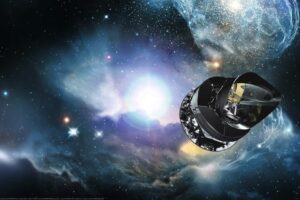
The cosmic microwave background (CMB) radiation, the residual thermal radiation from the Big Bang, provides a snapshot of the early universe. Detailed measurements of the CMB’s subtle temperature fluctuations by missions such as Planck and WMAP have allowed scientists to determine the universe’s composition with high precision.
These observations indicate that the universe consists of roughly 5% ordinary matter, 27% dark matter, and the remaining portion as dark energy. This cosmological inventory underscores the essential role of dark matter in shaping the large-scale structure and evolution of the cosmos.
Role in Large-Scale Structure Formation
Dark matter is fundamental to the formation of the universe’s vast cosmic web-a complex network of galaxies, clusters, and voids. After the Big Bang, the universe was nearly uniform, but small density fluctuations grew over time, leading to the formation of structures.
Simulations show that ordinary matter alone cannot collapse rapidly enough to form the observed large-scale structures within the universe’s age. Dark matter acts as a gravitational scaffold, providing the framework upon which ordinary matter accumulates and forms galaxies and clusters, enabling the intricate cosmic architecture we observe today.
Challenges in Direct Detection
Despite overwhelming indirect evidence, dark matter has eluded direct detection. Numerous experiments conducted deep underground and in isolated laboratories aim to observe rare interactions between dark matter particles and ordinary matter. To date, these efforts have not yielded conclusive results, leaving the true nature of dark matter an open question.
Alternative theories, such as Modified Newtonian Dynamics (MOND), propose changes to gravitational laws to explain observed phenomena without invoking dark matter. However, these models have yet to comprehensively account for all astrophysical and cosmological observations as effectively as dark matter hypotheses.
Significance of Dark Matter in Cosmology
Dark matter plays a crucial role in the universe’s stability and evolution. Without it, galaxies would not maintain their structure, and stars would drift away, unraveling the cosmic fabric. Its pervasive yet invisible presence challenges our understanding of physics and pushes the boundaries of scientific inquiry.
The pursuit to uncover dark matter’s true identity drives advancements in particle physics, cosmology, and observational astronomy, promising to deepen our comprehension of the universe’s fundamental workings.
Summary and Future Prospects
In conclusion, dark matter is a vital component of the cosmos, supported by a convergence of astronomical observations and theoretical models. From the unexpected speeds of stars in galaxies to the bending of light around massive clusters and the detailed patterns in the cosmic microwave background, dark matter emerges as an indispensable element shaping the universe.
Exploring this enigmatic substance represents humanity’s quest to illuminate the unknown, with each discovery bringing us closer to revealing the hidden forces that govern reality. The ongoing search for dark matter holds the promise of unveiling a universe even more extraordinary than previously imagined.
Common Misconceptions About Dark Matter
Dark matter is simply ordinary matter that is dark or hidden.
Dark matter is fundamentally different from ordinary matter; it does not interact with electromagnetic forces and cannot be detected by light or radiation.
Dark matter has been directly observed.
Dark matter has only been detected indirectly through its gravitational effects; direct detection remains elusive.
Dark matter and dark energy are the same.
Dark matter and dark energy are distinct; dark matter exerts gravitational attraction, while dark energy is responsible for the accelerated expansion of the universe.
FAQ
What is dark matter?
Dark matter is a form of matter that does not emit, absorb, or reflect light, making it invisible and detectable only through its gravitational effects.
How do we know dark matter exists?
We infer the existence of dark matter from gravitational effects observed in galaxies and cosmic structures, such as flat rotation curves and gravitational lensing.
What percentage of the universe is dark matter?
Dark matter makes up approximately 27% of the universe’s total matter content.




Leave a Reply